
Table of Contents
Walk into any gym in January and you will see them: a handful of people in their sixties and seventies who signed up with real determination, then quietly stopped by February. The problem is almost never commitment. It is the small, unglamorous errors nobody warns you about, the ones that turn a good habit into a sore knee, a stalled routine, or six weeks of work with nothing to show for it.
Here are the mistakes that come up again and again, and what to do instead.
Myth one: lifting weights after 60 is asking for trouble
This is the most expensive myth in older-adult fitness, and it costs people their independence. Muscle mass drops by roughly 3 to 8 percent per decade after 30, and the slide accelerates past 60. Resistance training is the only reliable brake. It also has to be real resistance. Two-kilo dumbbells waved through 20 comfortable reps will not slow anything down.
The research is reassuring: supervised strength work in people in their seventies and eighties is well studied and consistently safe, with measurable gains in leg strength, walking speed and the ability to get up off the floor unaided. The risk was never in the weights. It sits in doing too much, too soon, with sloppy form. If you want a structured route through loads, sets and progressions, this practical guide to strength, balance and long-term health walks through it sensibly.

A useful check: the last two or three reps of a set should feel genuinely difficult. If you could rattle off ten more, the weight is too light.
The all-or-nothing trap
“I only have twenty minutes, so it’s not worth bothering.” That sentence has killed more fitness plans than any injury. The official target of 150 minutes of moderate activity a week works out at about 21 minutes a day, and it does not demand a gym, a shower and a forty-minute round trip. Ten minutes of walking before breakfast plus ten minutes of chair work during the evening news clears the bar.
What actually fails is the plan that requires everything to line up perfectly. A four-week starter plan you can do in your living room beats a twice-weekly pool trip that depends on a lift, a friend and dry weather.
Doing the same routine for years
The body adapts within six to eight weeks. Once it does, the same walk at the same pace stops changing anything, and people conclude that exercise stopped working for them. What usually happened is that one ingredient went missing: balance work, or load, or a bit of intensity.
Rotating between modes is one fix, and there are real trade-offs between them. Walking is free and easy to sustain but does little for the upper body. Water workouts spare the joints and suit arthritic knees. Chair routines work when getting down to the floor is out of reach. A straight comparison of walking, weights, water workouts and chair routines helps you pick the right tool rather than defaulting to whatever you did in 2004.
Pushing through the wrong kind of pain
“No pain, no gain” was bad advice for a 25-year-old and it is worse advice at 72. The trouble is that most people cannot tell the difference between a muscle that has been worked and a joint that is being damaged, so they either stop at the first twinge or ignore something that needed attention a fortnight ago.
Telling soreness from damage
- Dull, even muscle ache arriving the next day and easing within 48 hours: normal, and a sign you did something.
- Sharp, pinpoint joint pain during the movement itself: stop the exercise, not necessarily the whole session.
- Pain that lasts beyond three days or wakes you at night: worth a professional opinion rather than another week of guessing.
- Pain that changes how you walk or makes you hesitate on stairs: a genuine red flag. Fix it before you add load.
A simple guardrail: soreness should settle within two days. If a session leaves you struggling to get off the sofa for a week, you overshot and the net effect is lost fitness, not gained.
Leaving balance to luck
Roughly one in three adults over 65 falls each year, and a fall is often the event that converts an active retirement into a cautious one. Yet balance is the first thing dropped from a routine because it feels less productive than walking or lifting. It takes six minutes, twice a week, and it does not require equipment.
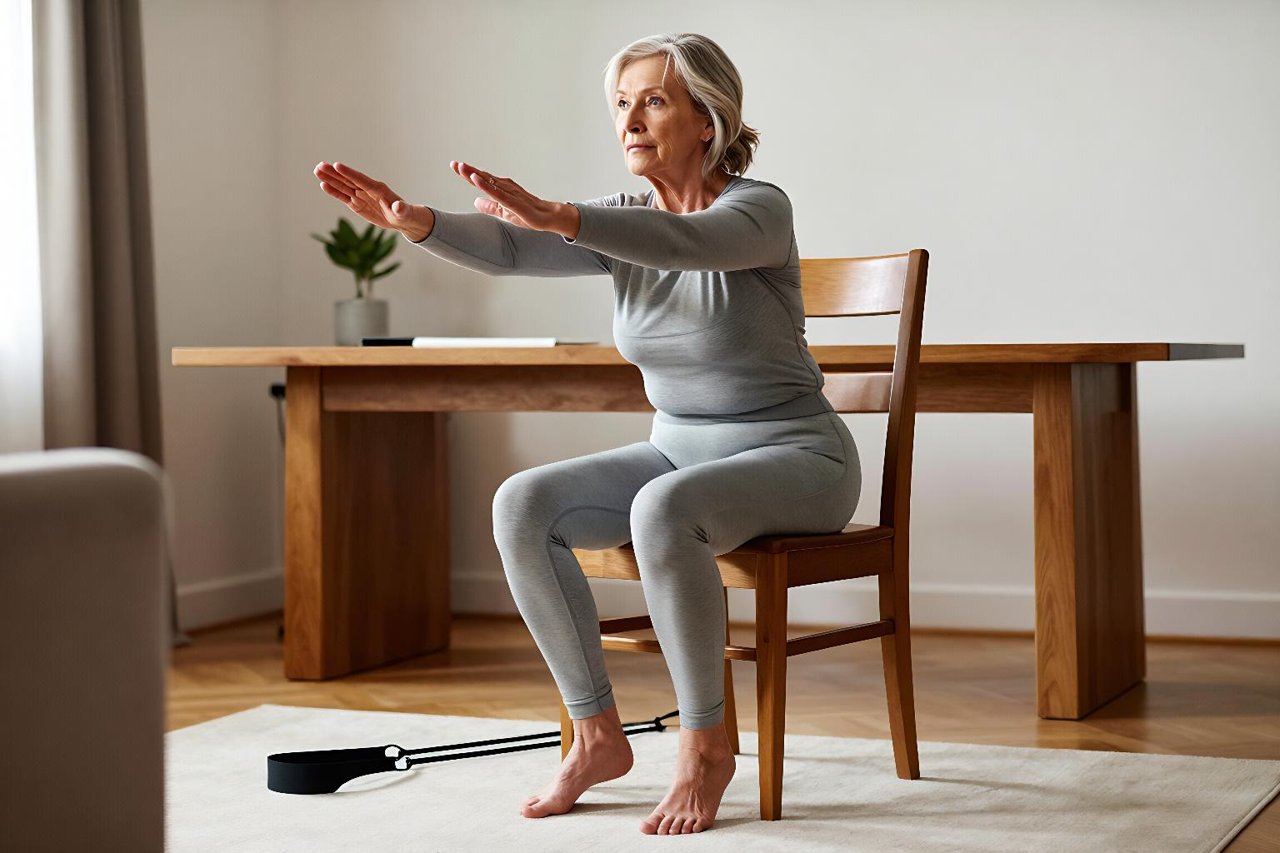
Three drills worth knowing: standing on one leg at the kitchen counter for 20 to 30 seconds each side, walking heel-to-toe along a corridor in a straight line, and standing up from a chair without using your hands for five slow reps. If floor work is uncomfortable or unsteady, chair exercises for seniors cover much of the same ground from a seated position.
Starting like you are thirty
Week one heroes do forty squats, a two-mile walk and a stretch class, then spend ten days unable to descend stairs. The pattern repeats because enthusiasm has no built-in governor.
Borrow the runner’s rule and increase by about 10 percent a week, or add one set every fortnight. Starting smaller than you think you should is not laziness. It is what makes week twelve possible.
Eating and drinking as an afterthought
Strength work without enough protein is like building a wall without bricks. Older adults need more protein per kilo than younger ones, roughly 1.0 to 1.2 grams per kilo of body weight, spread across meals rather than dumped into one dinner. For a 70-kilogram person that is around 70 to 85 grams a day, with 25 to 30 grams at each main meal.
Hydration is the quieter problem, because the thirst signal dulls with age. Two glasses of water before a morning walk prevents the light-headedness people often blame on age. Some of the well-meant healthy habits for seniors that backfire sit exactly here, including strict low-calorie eating while trying to build muscle.
Ignoring the boring setup details
Plenty of good routines collapse over footwear and furniture. Worn trainers with compressed soles make balance work unstable. A deep, soft armchair is almost impossible to stand up from safely, while a firm chair with armrests makes a dozen repetitions easy. Slippers on a polished floor are an accident waiting for a Tuesday.
Before you start, check three things: shoes with a firm sole and a closed back, a chair that does not slide or swivel, and a clear metre of floor with nothing to trip over. Keep a water bottle within reach and your phone in a pocket rather than across the room.
Never measuring anything
Progress you cannot see is progress you will abandon. Two numbers a month are enough. Count how many times you can stand from a chair in 30 seconds, and time how long you can balance on each leg. Write them on the calendar.
Improvement of three or four chair stands over eight weeks is ordinary, and it is the kind of concrete feedback that keeps a routine alive on the mornings you cannot be bothered.
Build a floor, not a ceiling
The routine that survives a bad week matters more than the ambitious one that survives a good one. Decide now what your minimum session looks like, the version you will do when you are tired, it is raining, and the knees are grumbling.
Something like this takes eight minutes and covers strength, balance and a little movement:
- Eight slow sit-to-stands from a firm chair
- Ten wall push-ups
- Twenty seconds of single-leg standing at the counter, each side
- Ten minutes of walking, indoors or out
Do that three times a week and you are maintaining. Do the fuller version when energy allows and you are building. The point is that the floor exists, so a disrupted week never becomes a lost year.


