
Table of Contents
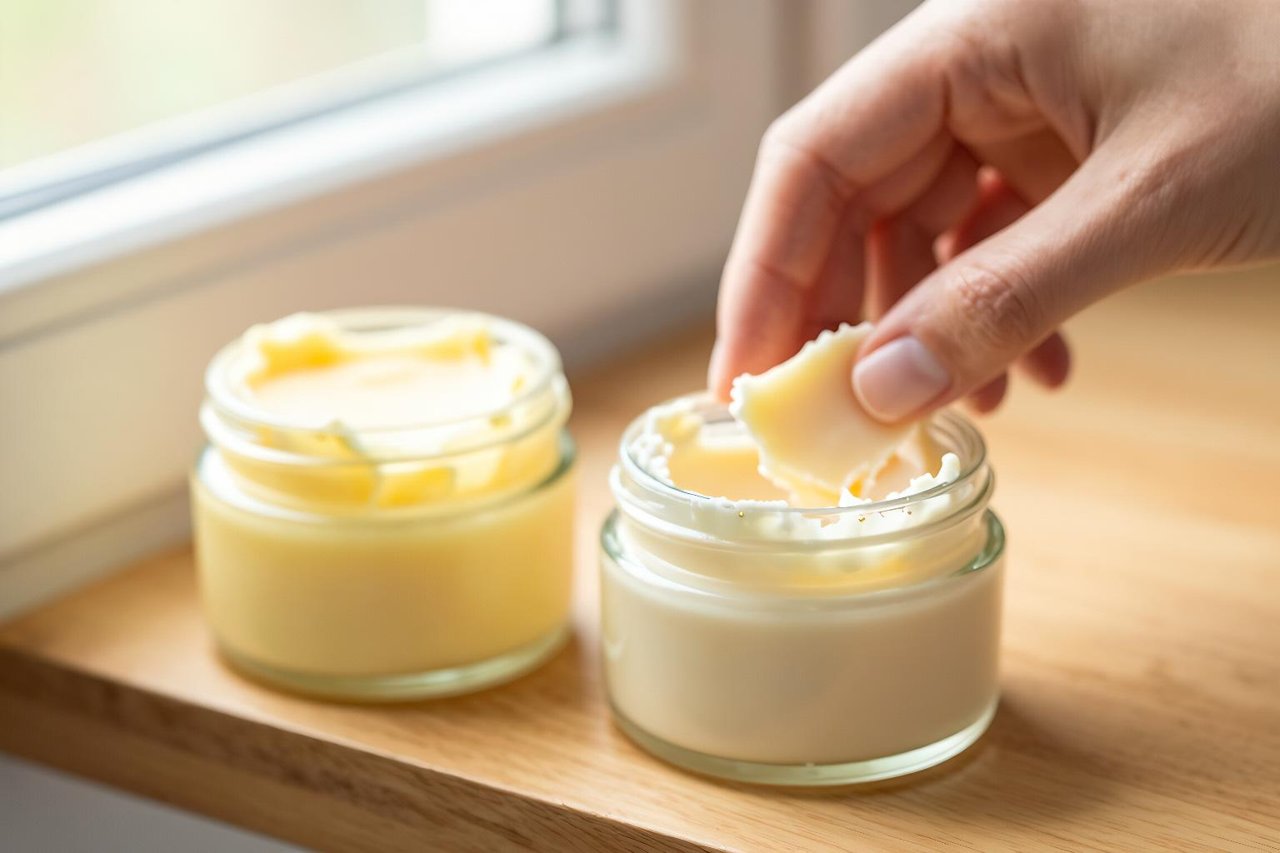
Two jars sit on the shelf looking nearly identical: pale, solid, faintly sweet. Push a finger into each and the difference shows up instantly. One gives way like soft butter. The other resists, then cracks into a waxy shard. That single physical difference explains most of what follows.
Both are plant fats used as moisturisers, both have been traded for centuries, and both will soften dry skin. They are not interchangeable, though. Knowing which one belongs on your face, which one belongs on your heels, and which one will clog your chin is the whole game.
Two Nuts, Two Very Different Fats
Shea butter is pressed from the nuts of the shea tree, Vitellaria paradoxa, which grows wild across West Africa from Senegal to Sudan. Unrefined shea arrives in shades from ivory to greyish-green, with a nutty, slightly smoky smell that fades within twenty minutes of application.
Cocoa butter comes from cacao beans, the same ones that make chocolate. It is essentially a byproduct of chocolate production, which is why it is so cheap and so plentiful. It is harder, more brittle, and smells like the inside of a chocolate factory.

The chemistry matters more than the marketing. Shea butter is roughly 40 to 50 percent oleic acid with a hefty dose of stearic acid, plus 3 to 11 percent unsaponifiables: cinnamic acid esters, phytosterols, vitamin E, and vitamin A. That unsaponifiable fraction is where its reputation for calming irritated, eczema-prone skin comes from. Cocoa butter runs about 33 percent stearic acid, 25 to 30 percent oleic, and 25 percent palmitic, with plenty of phytosterols but far fewer of the anti-inflammatory compounds that make shea interesting.
Texture, Melt Point, and How They Wear
Here is the practical bit. Shea butter melts at roughly 32 to 38°C, close to body temperature, but stays semi-soft and grainy at room temperature. It whips into a cloud with a hand mixer and spreads across skin like a gel that gradually turns to oil. Absorption is slow but thorough.
Cocoa butter melts in a similar range, around 34 to 38°C, yet it is dramatically firmer below that point. It sets hard. This is exactly why it turns up in lip balms, deodorant sticks, and solid lotion bars: it holds a shape. On skin it leaves a heavier, waxier film that takes longer to disappear.
If you have ever applied a body butter and still felt slippery three hours later, cocoa butter was almost certainly the reason.
Face or Body? The Split Is Fairly Clear
Shea butter earns the face
Shea’s comedogenic rating sits around 0 to 2 depending on how refined it is, and its texture allows it to sink into dry cheeks without sitting on top like candle wax. It works well as the final step of an evening routine for anyone with a compromised barrier: flaking around the nose, tightness after cleansing, redness from retinol. If your skin is combination or oily, though, a pea-sized amount on the dry patches is plenty. Our guide to finding the best moisturizer for your skin type covers where a butter fits into a routine that already includes humectants and emollients.
Cocoa butter earns the body
Cocoa butter’s rating is closer to 4, and the thick film it forms is the reason. Keep it off your T-zone and put it where skin is thick and rarely breaks out: shins, knees, elbows, heels, the backs of arms. It is also the better choice for anyone worried about the appearance of stretch marks, not because it erases them but because keeping that skin hydrated and flexible during pregnancy or rapid weight change is genuinely useful.
The Acne-Prone Skin Question
Comedogenic ratings are imperfect, tested on rabbit ears decades ago and never fully updated. Treat them as a rough ranking rather than a verdict. Even so, the thickness gap between these two butters is real and predictable. Cocoa butter’s high palmitic and stearic content makes it more likely to trap sebum and dead skin in a pore.
Shea is gentler, but it is not risk-free. Its oleic acid content can feed malassezia, the yeast behind fungal acne, and some people with rosacea find the cinnamic acid esters irritating rather than soothing. The honest test is two weeks of patch application along the jawline, not a label claim.
Cracked Heels, Rough Elbows, and Other Hard Cases
For skin that has genuinely thickened and split, cocoa butter is the stronger tool. A 20 percent urea cream plus a cocoa butter layer overnight is a well-worn combination for a reason. Shea works too, but it softens rather than seals. If you are dealing with split heels or callused soles, the detailed rundown of foot care products that actually work is worth reading before you buy another jar.
Smell, Shelf Life, and Reading the Label
Unrefined shea has a faintly smoky, nutty scent that some people love and others find off-putting. Refined shea is odourless and white, but the refining process strips out a good chunk of those useful unsaponifiables. Cocoa butter smells like chocolate on first contact and then mostly disappears.
On shelf life, cocoa butter wins comfortably. Its natural antioxidants keep it stable for up to two to five years, while shea is better used within 18 to 24 months of opening. Store both away from direct sun and above 25°C and neither will go rancid quickly.
- Check the INCI name. Pure shea is Butyrospermum parkii; pure cocoa is Theobroma cacao. If either appears after water, glycerin, and alcohol, you are buying a lotion, not a butter.
- Expect colour. Unrefined shea ranges from cream to pale yellow-green. Chalk-white shea has usually been bleached or heavily refined.
- Watch for filler. Cheap jars often blend shea with palm oil or shea stearin and still call it “100% shea butter.”
- Skip added fragrance if your skin is reactive. Both butters smell fine on their own.
Using Them Together
You do not have to choose. A 60/40 blend gives you shea’s absorption with cocoa’s structure. Melt 100 g of unrefined shea with 60 g of cocoa butter and 30 ml of jojoba oil in a heatproof bowl set over simmering water, chill the mixture for 20 minutes until it turns opaque, then whip it for five minutes with an electric beater. The result is a soft, scoopable cream that holds its shape in summer and feels substantial without being greasy. If you want more formulas like this, there is a good breakdown of why your skin needs body butter and how to pick the right one.
Pick Shea If… Pick Cocoa If…
Choose shea butter when your skin is dry, reactive, or eczema-prone, when you want something for the face and neck, when you dislike heavy films, or when you plan to use the jar within a year. It is the more versatile of the two and the safer default for anyone unsure.
Choose cocoa butter when you are targeting thick, tough, or cracked areas, when you want a butter that will stay put in a hot bathroom, when you are making balms or bars, or when you want the longest shelf life for the money. Accept that it will feel like a coating for the first half hour.
One last thing worth saying plainly: neither butter is a treatment for scarring, cellulite, or stretch marks in any meaningful clinical sense. What they do, and do very well, is hold water in the outer layer of skin so it stays supple and stops cracking. Buy accordingly, and buy small the first time so you can find out which one your skin actually likes.


