
Table of Contents
Passionflower is the rare herb with a backstory that outruns its marketing. The vine climbs by tendrils, throws out blooms that look engineered rather than grown, and produces a fruit that barely resembles anything you’d eat. Long before it appeared in capsule form, it was used by Indigenous communities across the Americas and later adopted by European and American physicians who wrote about it in earnest, slightly overwrought prose.
That layered history is part of why passionflower (usually Passiflora incarnata) is still so widely sold today. But tradition and evidence are different things, and it helps to know where each one ends.
A Flower That Got Named by Missionaries
Spanish missionaries in South America saw the bloom’s structure as a kind of diagram: a crown of filaments for the crown of thorns, five sepals and petals for the disciples, three styles for the nails. They called it flos passionis, the flower of the Passion, and the name stuck even as the religious reading faded.
The plant reached Europe in the 1600s as an ornamental curiosity. By the 1800s it had crossed into medicine, particularly in the United States, where Eclectic physicians prescribed it heavily for nervous conditions. Its reputation as a gentle sedative travelled faster than any chemical analysis could keep up with.

Traditional Applications Across Three Continents
Use varied considerably by region and by healer. Cherokee and other Southeastern nations worked with Passiflora incarnata as a poultice for wounds and boils, a root preparation for liver complaints, and a leaf tea for restlessness. The plant was food as well as medicine: the fruit, sometimes called a maypop, was eaten fresh or dried.
In 19th-century American practice, passionflower became a standard remedy for what practitioners called nervous exhaustion. Typical traditional applications included:
- Night-time tea for difficulty falling asleep and restless waking
- Tincture for nervous tension, irritability and low mood
- Combinations with valerian, hops or chamomile for persistent insomnia
- Cooled washes and poultices for inflamed skin and minor wounds
- Support during periods of stress, grief or convalescence
European herbalists folded it into much the same niche, usually as a milder alternative to opium-based sedatives, which were common and often ruinous. Homeopaths prepared it in high dilution. None of these traditions shared a unified theory of how it worked, which is worth remembering when a modern product claims to restore ancient wisdom.
The Chemistry Behind the Calm
The aerial parts contain a mix of flavonoids, chiefly C-glycosyl flavones such as vitexin, isovitexin and orientin, along with lesser amounts of quercetin and kaempferol derivatives. These compounds show activity at GABA-A receptors in laboratory work, which is a plausible route to sedation but not proof of it in a living person.
Passionflower also carries traces of harmala alkaloids, including harman and harmine. The amounts in typical preparations are small, and often undetectable in commercial leaf material, but their presence matters for anyone taking monoamine oxidase inhibitors. Some of the plant’s soothing reputation may come from these beta-carbolines rather than the flavonoids, and the honest answer is that researchers are still arguing about it.
What the Modern Research Actually Suggests
Sleep
A 2011 trial published in Phytotherapy Research gave 41 adults either a cup of passionflower tea or a placebo before bed for a week. The passionflower group rated their sleep quality higher, though objective sleep measures did not differ dramatically. A 2020 systematic review of the plant in insomnia concluded that results were promising but that most studies were small and short.
One frequently cited 2001 study compared passionflower extract with oxazepam, a benzodiazepine, in 36 people with generalised anxiety. Both groups improved over four weeks, and the passionflower group reported less job-related impairment. That kind of head-to-head comparison is unusual in herbal research and is a large part of why the plant keeps appearing in reviews.
Anxiety and Pre-Procedure Nerves
A 2008 randomised trial gave 60 patients either passionflower or a placebo 90 minutes before outpatient surgery. Those given the herb showed lower anxiety scores without a meaningful rise in sedation. Similar small trials have looked at dental anxiety and pre-colonoscopy jitters, with modest but consistent effects.
None of this makes passionflower a treatment for an anxiety disorder. The trials are small, the extracts vary, and follow-up rarely extends beyond a month.
Other Areas Under Investigation
Researchers have tested passionflower for menopausal symptoms, attention difficulties in children (often blended with valerian), and the restlessness of opioid and nicotine withdrawal. Results are mixed and sample sizes are frequently in the dozens. Encouraging signals exist; firm answers do not.
How People Use It Today
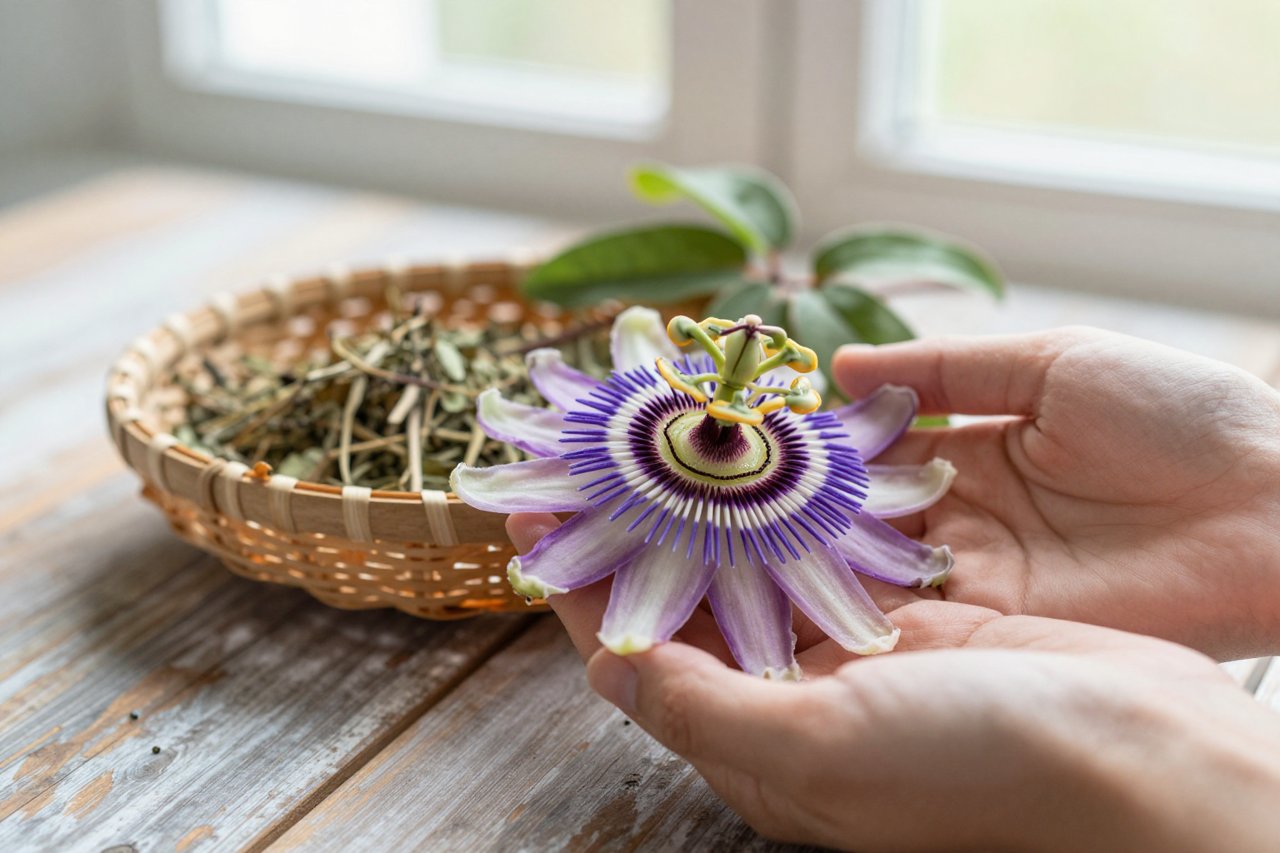
Most preparations use the dried aerial parts, meaning leaf, stem and flower rather than root. A typical infusion is one to two teaspoons of dried herb per cup of hot water, steeped covered for 10 to 15 minutes, taken up to three times daily or half an hour before bed. Tinctures are usually dosed at 1 to 4 ml of a 1:5 preparation, and standardised extracts vary enough that following the label is the only sensible approach.
Covering the cup while it steeps keeps the volatile components from escaping with the steam. Passionflower tastes grassy and slightly sweet, and blends well with lemon balm or hawthorn.
Safety, Interactions and Who Should Skip It
Passionflower is generally well tolerated. Reported effects are mild: drowsiness, occasional dizziness, and rarely nausea. The more serious considerations involve what it is combined with.
Because of the harmala alkaloids, passionflower should not be taken alongside MAOI antidepressants. It also adds to the sedative load of benzodiazepines, sleep medications, alcohol and some antihistamines, which is a real risk for anyone driving or operating machinery. Stop using it at least two weeks before planned surgery, since the anaesthetic interaction is not well characterised. Pregnant and breastfeeding women are usually advised to avoid it for lack of data rather than known harm.
Reading a Passionflower Label Properly
The most common disappointment with passionflower comes down to what is actually in the bottle. Check that the species is named as Passiflora incarnata; other species are sometimes substituted and have different alkaloid profiles. Look for a stated part of the plant, a batch number and a manufacturer willing to share a certificate of analysis. Blends that list passionflower sixth on the label, behind maltodextrin and flavourings, rarely deliver a meaningful dose.
Loose dried herb should smell faintly hay-like and keep its colour. Faded, dusty material has usually lost much of what made it worth buying. Store it away from light in a sealed jar, and replace it after about a year.
Used with reasonable care, passionflower remains one of the better-studied gentle sedatives available without a prescription. The evidence is not airtight, but it is more substantial than most of what sits beside it on the shelf, and four centuries of use have at least established where the risks lie.


