
Table of Contents
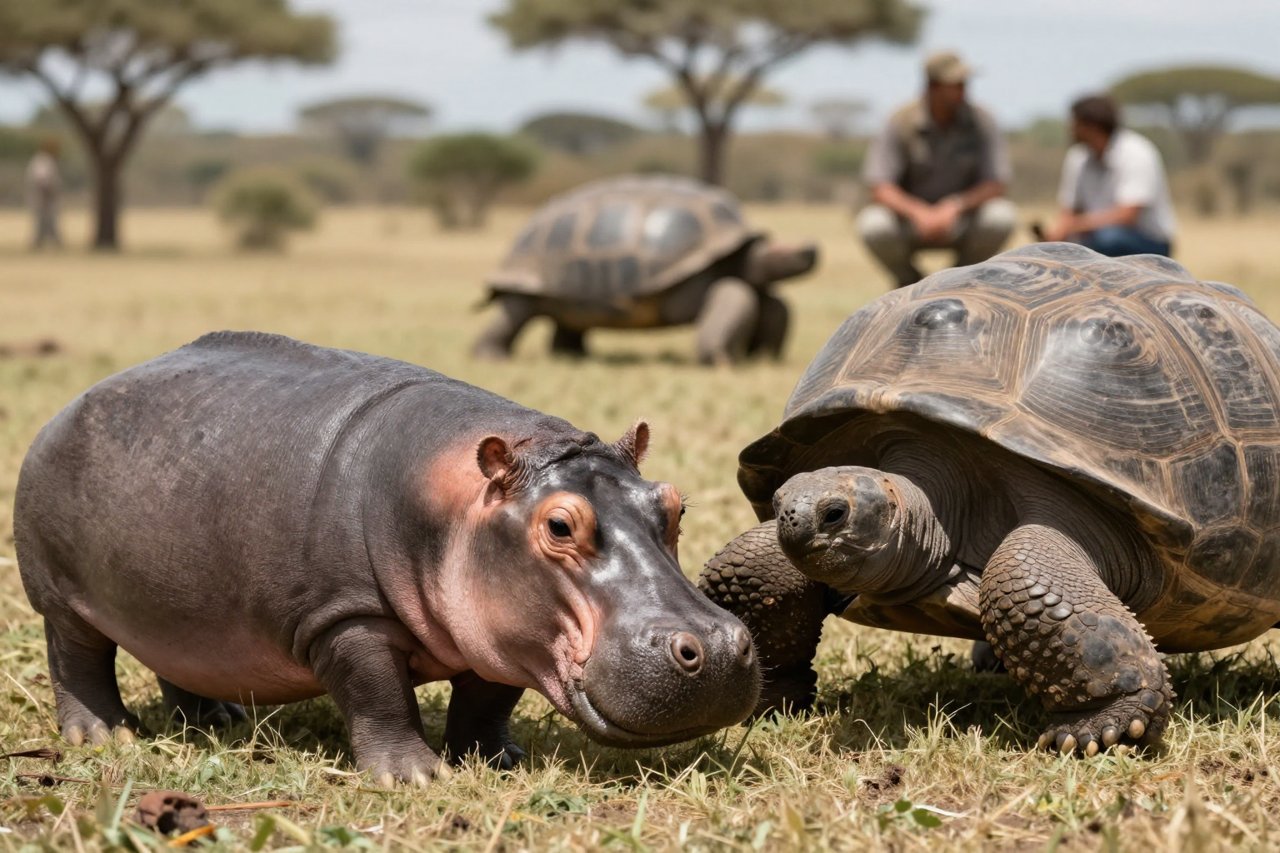
In December 2004, a young hippo was rescued from the Indian Ocean off the coast of Kenya. Keepers moved him to Haller Park near Mombasa, where he ignored the grass, the pool and the other animals. He walked toward a 130-year-old Aldabra tortoise named Mzee. The tortoise hissed. The hippo stayed. Within days, the two were sleeping side by side.
That scene explains why the top 7 most unusual animal friendships ever documented still circulate years after the first photos appear. They are not scripted. They cross the lines we expect nature to enforce: predator and prey, mammal and reptile, wild and domestic. Some were recorded by scientists; others by keepers who kept a camera within reach. All of them show that animal social behavior is more flexible than a simple rulebook suggests.
1. Owen the hippo and Mzee the tortoise
Owen was orphaned and alone when he arrived at Haller Park. Mzee was a slow-moving reptile with no reason to mother a hippo. Keepers watched the young hippo follow the tortoise, nudge him and try to settle against his shell. Mzee initially resisted, then allowed contact. The pair napped in the same patch of shade and moved through the enclosure together. Their bond was documented daily by staff and later became the subject of a children’s book. What makes it unusual is not just the size gap. It is the substitution: a social mammal used an ancient reptile as a stand-in for the herd he had lost.
2. Tarra the elephant and Bella the Labrador
At The Elephant Sanctuary in Hohenwald, Tennessee, Tarra, an Asian elephant, formed a close bond with Bella, a yellow Labrador who had the run of the property. The two spent hours near each other. Bella would trot alongside Tarra; Tarra would slow down. In 2011, Bella was injured and had to stay inside for treatment. Tarra stood outside the office door and waited. Sanctuary staff documented the vigil and the pair’s reunion. Elephants are known for complex social memory, but a dog as a chosen companion is still a strange sight. The friendship lasted for years and became one of the sanctuary’s most persistent stories.

3. Baloo, Leo and Shere Khan
In 2001, authorities found a bear cub, a lion cub and a tiger cub in a basement in Atlanta. The three were taken to Noah’s Ark Animal Sanctuary in Locust Grove, Georgia. Keepers had a choice: separate them by species or keep them together. They kept them together. Baloo the bear, Leo the lion and Shere Khan the tiger shared a custom habitat, ate side by side and often slept in a pile. They had been raised as a unit before rescue, and that early familiarity held. The trio lived together for more than 15 years. Big cats and bears do not usually share territory, which is exactly why their case is so well known.
4. Suryia the orangutan and Roscoe the hound
Suryia, an orangutan at a South Carolina animal facility, met Roscoe, a Bluetick Coonhound, when the dog wandered onto the property. Instead of reacting with aggression, Suryia approached and stayed close. Staff photographed the two walking together, swimming together and resting in the same shade. Roscoe seemed to treat the orangutan as a safe anchor; Suryia groomed him and led him around. The friendship was not a one-off photo. It was recorded over repeated interactions and became one of the most shared interspecies stories of the 2000s. Orangutans are intelligent and curious, but their usual social world does not include dogs.
5. Koko the gorilla and All Ball
Koko, a western lowland gorilla at the Gorilla Foundation in California, was famous for her use of modified American Sign Language. In 1984, she was given a kitten. She named it All Ball. Koko carried the kitten, groomed it and tried to nurse it. When All Ball escaped and was hit by a car six months later, Koko’s signs and behavior suggested grief. Her language abilities remain debated by researchers, but keeper notes, photographs and video document the attachment clearly. She later cared for other kittens. The case is unusual because it combines a great ape, a domestic cat and a long record of human observation.
6. Sniffer the fox and Tinni the dog
In Norway, a red fox named Sniffer began meeting a dog named Tinni in the woods. Tinni belonged to photographer Torgeir Berge, who started documenting the pair. The fox was wild, not a pet. He initiated play, chased Tinni and wrestled with him in the snow. The dog tolerated the fox’s nips and high energy. Berge photographed them over months, and the images spread widely. Wild foxes usually avoid dogs, and dogs often chase foxes. This pair did the opposite. Their friendship is a reminder that individual temperament can override species-typical behavior.
7. Kasi the cheetah and Mtani the Labrador
In 2011, Busch Gardens Tampa Bay paired Kasi, a male cheetah cub, with Mtani, a female Labrador retriever puppy. The goal was practical. Cheetahs can be anxious in captivity, and a calm, social dog can provide reassurance. Kasi and Mtani grew up together, played together and napped in the same enclosure. They remained companions as they matured. Zoos have used similar cheetah-dog pairings before, but Kasi and Mtani became one of the most visible examples. The pairing works because both animals were introduced young and because keepers monitored the relationship closely.
What these unlikely animal friendships have in common
These stories are not proof that any two animals can become friends. They are examples of specific conditions lining up.
- Early introduction: Many pairs met as juveniles, when social boundaries are more flexible.
- Social need: Orphaned or isolated animals often seek comfort from whatever safe companion is available.
- Individual personality: A bold, tolerant animal is more likely to accept a different species than a nervous or territorial one.
- Routine: Shared feeding, sleeping and play give animals repeated low-conflict contact.
- Human oversight: Keepers control introductions, watch body language and separate animals when stress appears.
The line between a genuine bond and a staged photo
Not every viral animal friendship is what it appears to be. Some are brief encounters edited for social media. Others involve facilities that handle animals for entertainment rather than conservation. A credible case usually has repeated observations over time, consistent behavior, and caretakers willing to describe signs of stress as well as affection. Researchers also look for reciprocity: does each animal choose to stay close, or is one trapped in a small space with no exit? The strongest documented friendships include choices, not just proximity.
That is why the best examples remain useful. Owen and Mzee showed how fast a young animal can attach to an unlikely substitute. Tarra and Bella showed that a dog can become an elephant’s daily companion. Baloo, Leo and Shere Khan showed how early rearing can reshape adult tolerance. The details matter more than the cute photo. They give keepers and biologists a clearer picture of how animal minds handle loneliness, familiarity and trust.


