
Table of Contents
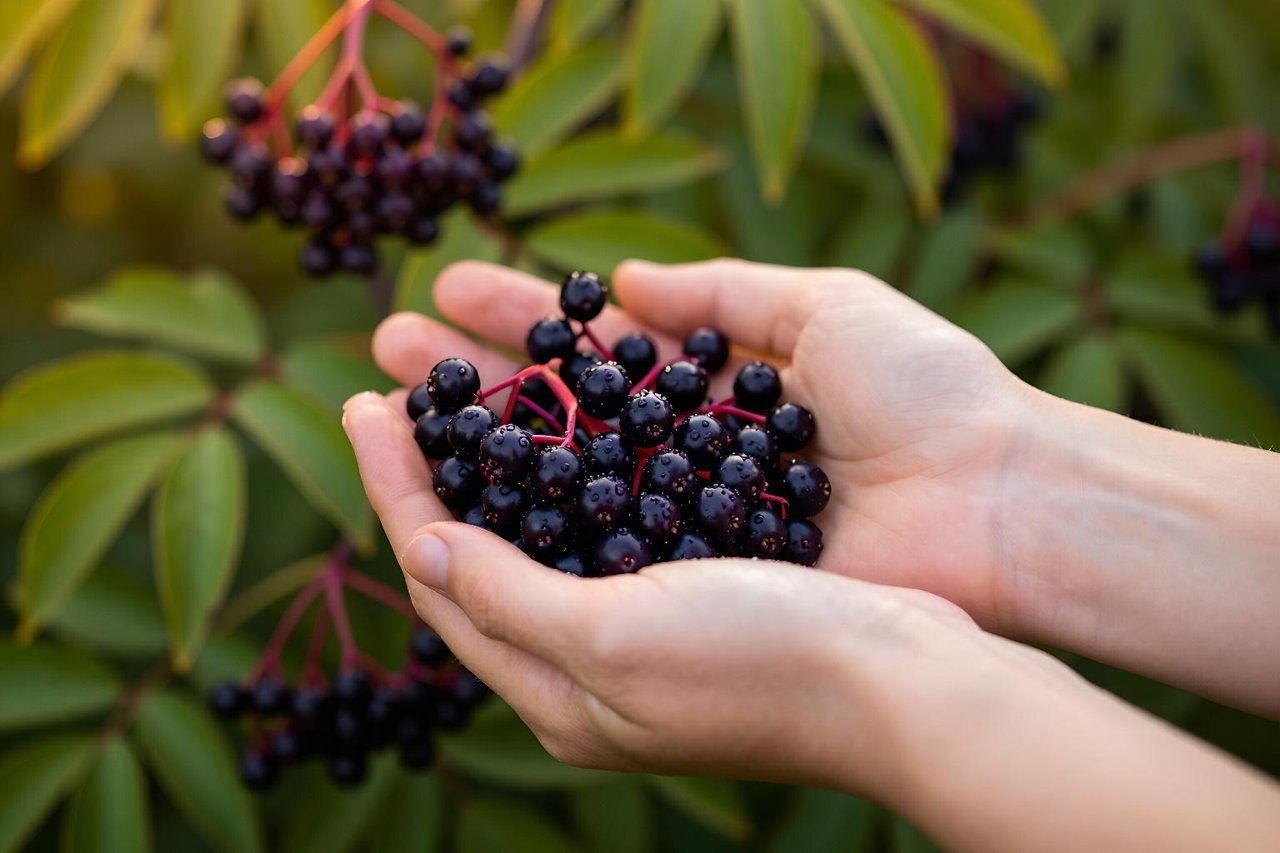
In late August, hedgerows across Britain and much of Europe bend under drooping clusters of tiny purple-black berries. They look harmless. They are not, at least not straight off the branch. Raw elderberries contain cyanogenic glycosides, the same family of compounds that makes bitter almonds risky, and eating a handful uncooked can leave you nauseous for a day. Cook them properly, though, and you get one of the oldest preserved foods in European and North American kitchens.
That split personality is the whole story of elderberry: food products, traditional uses, and safety all hang on one question — how the berry was handled before it reached your spoon.
What plant you are actually dealing with
Most commercial products use Sambucus nigra, the European black elder, or Sambucus canadensis, its close North American cousin. Both produce flat-topped sprays of creamy white flowers in June and those drooping berry clusters by late summer. The berries are small, maybe 5mm across, and taste tannic and faintly bitter, closer to a wild blackberry than a blueberry.
The rest of the plant matters just as much. Leaves, stems, bark, and roots contain higher concentrations of toxins than the fruit, and red elderberry (Sambucus racemosa) is generally treated as unfit for eating altogether. Foragers learn quickly to strip berries from the stems with a fork, never to simmer the stems for flavour, and never to assume a red-berried shrub is dinner.

Elderberry food products, from cordial to chewable gummies
Elderberry has moved a long way from the jam pan. Walk into a health food shop and you will find it in almost every delivery format imaginable.
- Syrup — the bestseller. Berries simmered, mashed, strained, and preserved with honey, glycerin, or cane sugar. A typical 120ml bottle sells for £10–£20 in the UK and holds roughly 24 adult teaspoon doses.
- Gummies and lozenges — convenient for children and for people who dislike the syrupy texture. Sugar content is worth reading: some gummies carry 3–4g of sugar per two-piece serving.
- Juice concentrate and shots — concentrated, pasteurised, and often blended with echinacea or vitamin C.
- Jam, chutney, and pie filling — the traditional kitchen uses. Elderberry jam sets well thanks to natural pectin and pairs sharply with game and strong cheese.
- Wine, port-style liqueurs, and vinegar — elderberry wine was a cottage staple for centuries, and infused vinegar makes a bright, almost balsamic dressing.
- Freeze-dried powder — stirred into smoothies or yoghurt, though the anthocyanin content varies wildly between brands.
The flower is half the harvest
Elderflower gets less attention in supplement aisles but more in restaurants. The tiny blossoms are steeped into cordial, fermented into a lightly sparkling champagne-style drink, or dipped in batter and fried as fritters — a Scandinavian and English summer ritual. The flavour is muscat, lychee, and honey all at once, which is why elderflower liqueurs appear in so many cocktail lists. Pick flowers on a dry, sunny morning when the pollen is heavy, and use them the same day; they blacken fast.
Traditional uses that go back further than the supplement industry
Hippocrates reportedly called the elder his “medicine chest,” and that reputation stuck for two thousand years. In European folk practice, elderflower tea was the standard response to a cold or a feverish chill, often drunk hot before bed to encourage sweating. Elderberry rob — berries cooked down with sugar into a thick, dark preserve — was kept in kitchen cupboards and spooned out through winter.
Indigenous communities in North America used Sambucus canadensis for similar purposes, preparing bark and berry decoctions for fevers and joint complaints. Herbalists bundled elder with yarrow and peppermint into what became known as the traditional European cold tea. German regulatory authorities later approved elderflower for colds and catarrh, though elderberry fruit itself has stayed in the food-and-supplement category rather than becoming an approved medicine.
What the research actually supports
The strongest evidence sits with elderflower. A randomised trial published in 2019 found elderflower extract improved symptoms in people with chronic sinusitis compared with placebo. For the berry, most clinical work is small and short. Two Israeli trials, in 1993 and 2004, reported that a standardised elderberry extract shortened influenza symptoms by roughly three to four days, but both involved fewer than 100 participants and the 2004 study used a symptom score that has been criticised.
Laboratory studies show elderberry anthocyanins and lectins interfere with viral entry into cells. That is interesting biology, not a guarantee about your sore throat. Reviewers keep concluding the same thing: promising signals, thin evidence, and a real need for larger trials. Elderberry is best understood as a pleasant, food-derived addition to a sensible winter routine, not a substitute for vaccination or medical care.
Elderberry safety, without the hand-waving
The safety question splits neatly into the berry itself and the product around it.
Cooking is not optional
Raw berries and raw juice can cause vomiting, diarrhoea, and abdominal cramps. A documented outbreak in Wyoming sickened eleven people who drank fresh-pressed elderberry juice at a gathering, and similar reports have appeared in Europe. Heat destroys the cyanogenic glycosides, so simmering for at least 10–15 minutes is standard practice. Freeze-drying raw juice is not the same as cooking it. Homemade fermented syrups are a particular gamble, because fermentation does not reliably remove the compounds.
Who should think twice
- Pregnant and breastfeeding women — there is no good safety data on concentrated supplementation, so culinary amounts are the sensible ceiling.
- People with autoimmune conditions — elderberry appears to stimulate cytokine production, which is theoretically unhelpful in conditions like rheumatoid arthritis or lupus.
- Anyone on immunosuppressants or diuretics — potential interactions are plausible and poorly studied; ask a pharmacist.
- Children under one — the issue is usually the honey in the syrup, not the berry.
- People managing blood sugar — a teaspoon of syrup can carry 3–4g of sugar, and daily dosing adds up.
Product quality is a genuine problem
Independent testing of commercial elderberry supplements has repeatedly found products with far less elderberry than the label implies, sometimes bulked out with grape juice concentrate or coloured with black rice extract. Look for a stated berry quantity per serving, a named species, and a manufacturer willing to publish a certificate of analysis. Cheap gummies are cheap for a reason.
If you plan to forage and cook your own
Harvest fully ripe, deep purple berries from clean hedgerows away from busy roads and spraying. Strip them from the stems with a fork, discard any green or red unripe fruit, and rinse. Simmer with a splash of water until the berries collapse, then strain through muslin without pressing hard, which keeps the bitterness down. A kilo of berries yields roughly 500ml of strained juice; sweeten to taste, bottle hot, and refrigerate after opening. Wear old clothes. Elderberry juice stains permanently, and it does so within seconds.


