
Table of Contents
Ask ten historians to name the biggest empires ever established and you will get ten different answers, often with a caveat. The British Empire covered more ground than any other in history. The Mongol Empire stitched together the largest continuous block of land. The Qing ruled more people than any empire before the industrial age. Size depends on whether you count square kilometres, subjects, tax revenue, or the ability to make a rival king nervous. What follows is a tour through the heavyweights, judged on the measures that matter most.
How Do You Measure an Empire’s Size?
Empires are not countries with better branding. They are political systems that extract resources, soldiers, and loyalty from conquered peoples. Historians usually reach for four yardsticks:
- Land area: square kilometres tell you how much territory a capital could claim, but deserts and steppe count the same as fertile river valleys.
- Population: the number of subjects matters more for taxation and armies than empty space on a map.
- Duration: some empires burned bright for a century, others lasted six hundred years.
- Influence: language, law, religion, and trade routes often outlive the state that created them.
Each metric produces a different champion. A sprawling empire in Siberia might control fewer people than a compact one in the Ganges plain. That is why the list below includes obvious giants and less famous powers that dominated their worlds.
The Mongol Empire: The Largest Contiguous Land Empire
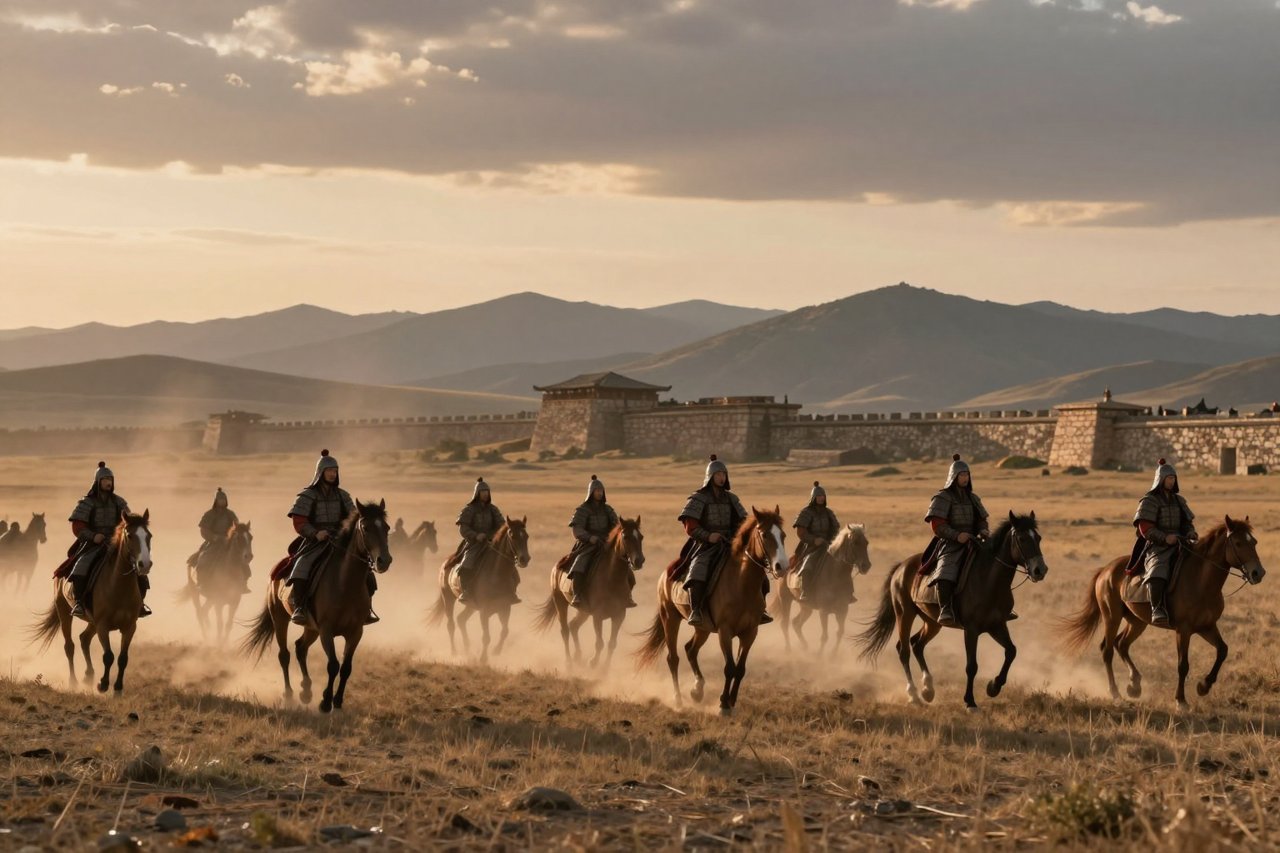
At its peak in the late 13th century, the Mongol Empire stretched from Korea to Hungary, roughly 24 million square kilometres. Genghis Khan’s armies moved faster than most settled states could react. They used coordinated cavalry, terror as a tactic, and a messenger system called the Yam that could carry news 200 miles a day. The empire’s reach made the Silk Road safer for merchants and helped move gunpowder, paper, and plague across Eurasia. It did not hold together. After Möngke Khan died in 1259, succession disputes split the realm into four khanates. The Mongols still left a deep mark on Russia, China, Persia, and Central Asia, and their horseback traditions survive in festivals and competitions.

The British Empire: The Biggest by Area and Population
The British Empire is the usual answer to the size question. In the 1920s it governed about 35.5 million square kilometres, roughly a quarter of the world’s land surface. It held around 412 million people, also about a quarter of humanity. The phrase ‘the empire on which the sun never sets’ was not marketing fluff; at any hour, some part of the empire was in daylight. India was the crown jewel, supplying soldiers, revenue, and markets. Canada, Australia, South Africa, and a chain of African and Asian territories added strategic ports and resources. The empire ran on telegraph cables, steamships, and a professional civil service. It also ran on coercion. The 1857 rebellion in India, the Boer War, and the Mau Mau uprising in Kenya all exposed the violence beneath the administrative calm. Royal tours and imperial exhibitions turned monarchy into public theatre, feeding a press culture that looks familiar to anyone who follows entertainment gossip today. Decolonisation after 1945 dismantled most of the empire within three decades, but its borders, legal systems, and English language remain.
The Russian Empire and the Soviet Union: Continental Giants
Russia’s imperial story is one of endless expansion by land. The Russian Empire covered 22.8 million square kilometres by 1900, second only to the British and Mongol empires in raw area. It stretched from Poland to the Pacific, with a population of about 125 million by the 1897 census. The Soviet Union, which replaced it after 1917, held 22.4 million square kilometres and around 286 million people at its peak. Siberia’s oil, gas, and minerals made it a resource superpower. Central Asia supplied cotton and soldiers. The state built railways, canals, and forced-labour camps with equal enthusiasm. The Soviet system exported ideology to Eastern Europe, Cuba, Vietnam, and parts of Africa. It collapsed in 1991, but Russia’s landmass remains the largest of any country.
The Qing Dynasty: China’s Last Imperial Giant
The Qing Dynasty ruled China from 1644 to 1912 and reached its greatest extent under the Qianlong Emperor in the 18th century. At its peak the empire covered roughly 14.7 million square kilometres, including Manchuria, Mongolia, Tibet, and Xinjiang. It governed about a third of the world’s population at the time, perhaps 300 million people. The Qing used a civil service exam system, a tribute network, and a complex bureaucracy to hold this together. They also presided over a cultural golden age in porcelain, painting, and literature. The Opium Wars and internal rebellions, especially the Taiping Rebellion, weakened the dynasty in the 19th century. Foreign concessions and unequal treaties followed. The last emperor abdicated in 1912, ending more than 2,000 years of imperial rule in China.
The Spanish Empire: The First Truly Global Empire
Spain gets less attention than Britain, but it built the first empire with a serious claim to global reach. At its height in the late 16th and early 17th centuries, the Spanish Empire covered about 13.7 million square kilometres. It held territory in Europe, the Americas, Africa, and Asia. The Philippines was administered from Mexico City, and the Manila galleon carried Asian goods to Acapulco. Silver from Potosí in modern Bolivia and Zacatecas in Mexico funded Habsburg wars in Europe. The empire also exported disease, forced labour, and Christian missions. Spanish remains the second most spoken native language in the world, and its colonial cities still shape architecture from Lima to Manila.
The Achaemenid Persians and Romans: Influence Beyond Borders
Not every giant needs the biggest map. The Achaemenid Persian Empire, founded by Cyrus the Great in 550 BCE, covered around 5.5 million square kilometres. It was the first state to govern such a diverse mix of peoples through satrapies, local elites, and a royal road running 1,600 miles from Sardis to Susa. The Romans held about 5 million square kilometres at their peak, with a population near 70 million. Rome’s legal code, road network, and Latin language shaped Europe long after the western empire fell in 476 CE. The eastern Roman or Byzantine Empire survived until 1453, nearly a thousand years longer. By almost any cultural measure, Rome punched far above its square mileage.
The Umayyad and Abbasid Caliphates: Trade, Faith, and Scale
The Umayyad Caliphate, based in Damascus, stretched from Spain to India at its peak around 750 CE. It covered roughly 11.1 million square kilometres and governed around 62 million people. The Abbasids moved the capital to Baghdad and presided over a trading network that reached China, East Africa, and Scandinavia. Baghdad’s House of Wisdom translated Greek, Persian, and Indian texts. Islamic scholars advanced algebra, optics, and medicine. The caliphates were not a single continuous state for long, but their cultural and religious influence extended far beyond any border. Arabic became a shared language of science and commerce from Córdoba to Samarkand.
The Ottoman Empire: Six Centuries on Three Continents
The Ottoman Empire lasted from around 1299 to 1922, one of the longest-running imperial projects in history. At its peak under Suleiman the Magnificent, it covered about 5.2 million square kilometres across southeastern Europe, the Middle East, and North Africa. It controlled the eastern Mediterranean, the Black Sea, and the pilgrimage routes to Mecca and Medina. The conquest of Constantinople in 1453 gave the Ottomans a capital that straddled two continents. Their millet system allowed religious communities to manage their own legal affairs. Turkish oil wrestling, which survives today, began as a court and military sport. You can find similar traditions in a guide to unusual sports around the world.
Other Heavyweights Worth Knowing
The list could run much longer. The Mughal Empire covered about 4 million square kilometres and governed 158 million people by the late 17th century. The French colonial empire reached 11.5 million square kilometres in the 1920s, mostly in Africa and Indochina. The Portuguese Empire was the first global maritime empire, with trading posts from Brazil to Macau. The Japanese Empire controlled about 7.4 million square kilometres at its peak in 1942, including occupied China and Southeast Asia. The Ming Dynasty, the Vijayanagara Empire, and the Aksumite Empire all dominated their regions for centuries. Each one has a case for inclusion depending on what you value.
What the Numbers Miss
Statistics hide the human cost. Every empire on this list was built on conquest, taxation, and some form of coerced labour. The British Empire’s railways in India came with famines. The Mongol conquests killed millions. The Spanish silver mines consumed Indigenous lives. The Qing expansion involved brutal campaigns in Xinjiang. At the same time, empires created shared languages, legal systems, trade routes, and infrastructure that outlasted their governments. The biggest empires ever established are not just historical trivia. They explain why so many countries share English, Spanish, Arabic, or Russian as official languages. They explain why borders in Africa and the Middle East often follow lines drawn in distant capitals. They explain why a Mongolian horse festival, a Turkish wrestling match, or a British royal wedding can still draw a global audience. Size is only one measure. The shadow is the other.


