
Table of Contents
You have probably seen the small brown capsules near the ashwagandha at the pharmacy, usually with words like “adaptogen” and “stress support” on the label. Rhodiola rosea is one of the oldest medicinal plants in the Northern Hemisphere, and one of the few with a decent stack of human trials behind it. It also has one of the biggest gaps between what the marketing promises and what the studies can honestly support.
Here’s what the science does and doesn’t say about this herb, based on the trials themselves rather than the label copy.
A plant that grows where little else does
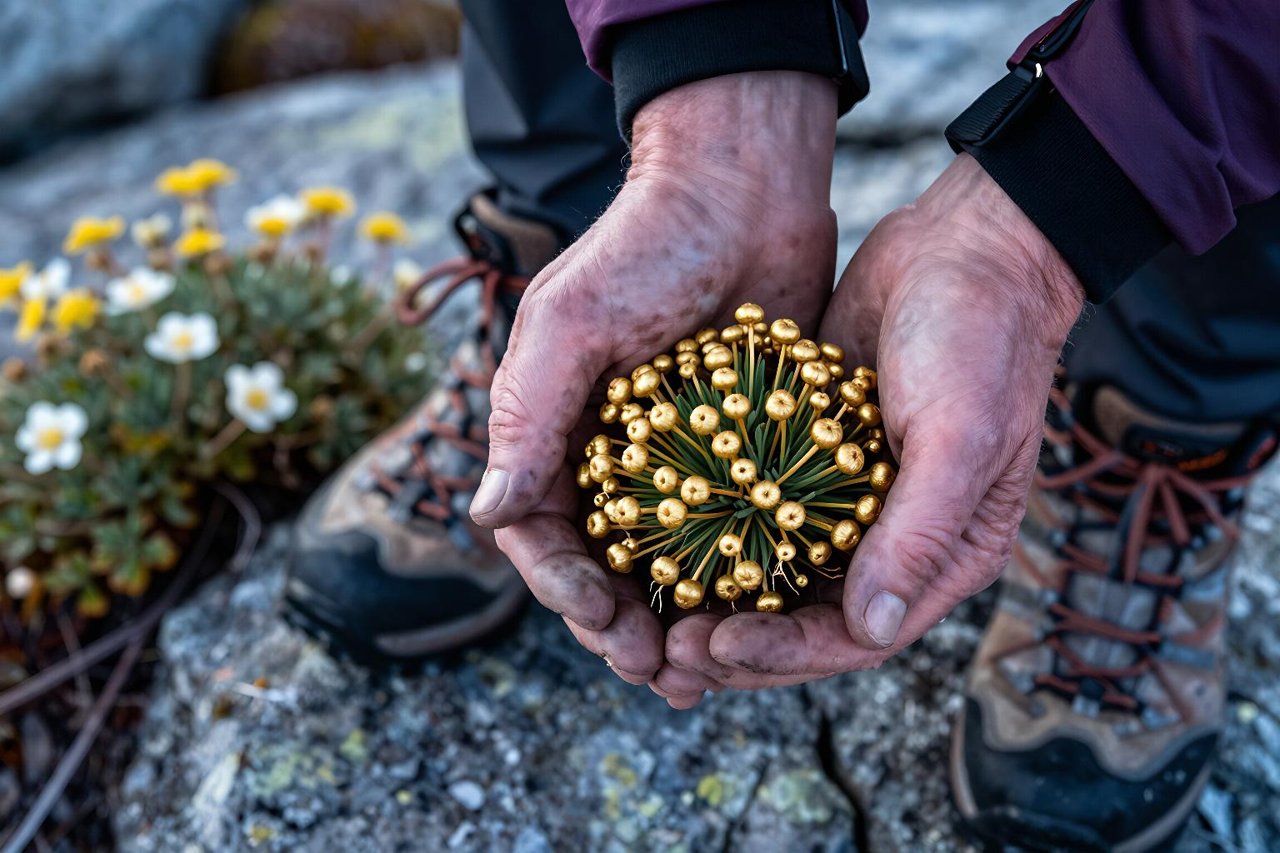
Rhodiola rosea is a hardy perennial with a thick, woody root that smells faintly of roses when it is cut, which is where the name comes from. It grows in rocky, high-altitude terrain across Scandinavia, Siberia, Central Asia and parts of the Arctic. The root is the useful part, and traditional medicine in Russia and Scandinavia has used it for centuries for tiredness, cold climates and general resilience.
The plant is sometimes sold as golden root or arctic root. Its activity is generally credited to two groups of compounds: rosavins (rosavin, rosarin and rosin) and salidroside. If you want to compare products intelligently, these two numbers on the label matter more than the grams of raw herb on the front.

What human trials have found
Most of the clinical research uses a handful of specific extracts, the most studied being SHR-5, a Swedish extract standardised to rosavins and salidroside. That detail matters, because a trial of 576 mg of SHR-5 doesn’t tell you much about a cheap powder from an unregulated supplier.
Fatigue in people who are genuinely worn down
The most cited study is a 2009 trial of 60 adults with stress-related fatigue, published in Planta Medica. Participants took 576 mg a day of SHR-5 or a placebo for 28 days. The rhodiola group reported better improvements in fatigue, energy and mood, and their cortisol response to a waking-up test normalised more than the placebo group’s. It was a small study, but the population is closer to real life than the usual sample of healthy university students.
An earlier trial from 2000 followed 56 young physicians working night shifts. Those given rhodiola scored better on measures of mental fatigue and general wellbeing over two weeks. Night-shift workers are a practical testing ground for any anti-fatigue intervention, and the effect showed up in tasks that required sustained attention.
Stress hormones and the cortisol curve
Cortisol is not simply bad. A healthy pattern is a sharp rise within half an hour of waking, followed by a gradual fall through the day. Chronic stress tends to flatten that curve. Several trials, including the 2009 study above and a 2015 trial of 400 mg a day in adults with mild stress, reported modest changes consistent with a more normal cortisol response rather than a blanket suppression. That is a subtle finding and easy to overstate. Rhodiola is not a sedative and it does not switch your stress response off.
Mood and low-grade anxiety
A small open-label study from 2008 gave 340 mg a day to ten people with generalised anxiety disorder. Symptoms dropped, but with no placebo group you can’t separate the herb from the natural fluctuation of anxiety. A follow-up trial at the University of California, Los Angeles, used a placebo but was tiny and short. Reviews of rhodiola for depression describe the evidence as promising but preliminary, based on samples of under 100 people in most cases.
There is a genuine caution here for anyone with bipolar disorder. Rhodiola has the mild stimulant quality of the Rhodiola family and there are case reports of it triggering mania in people already vulnerable.
Physical performance and altitude
This is where things get muddled. Rhodiola has a history of use by Soviet military and Olympic-era athletes, but legends are not data. Reviews of endurance and strength trials have found mixed results, with a few studies showing small improvements in time-to-exhaustion, several showing nothing, and a recurring problem of poor methodology. A 2017 review concluded the ergogenic evidence is limited and inconsistent.
Altitude research is similarly thin. There are plausible mechanisms around oxygen efficiency, and some small trials hint at benefits, but no large well-controlled study confirms a meaningful effect on performance at altitude.
Focus and mental fatigue
Studies in cadets and students have reported improvements in short-term attention and accuracy on repetitive tasks, particularly under sleep deprivation. The effects are small and dose has varied wildly between trials. It is fair to say rhodiola may help you stay alert on a dull task when you are short on sleep, and not fair to say it makes you sharper in general.
Where the evidence gets thin
A surprising amount of the rhodiola literature has structural problems that are worth knowing before you spend money:
- Sample sizes are small. Many trials enrol 30 to 60 people. That is enough to spot a strong effect and not enough to reliably detect a modest one.
- Extracts differ. SHR-5 is not the same as the 3% rosavin extract in a supermarket bottle, and some studies give no full chemical profile at all.
- Results are not always replicated. Several positive findings have not been repeated in independent labs.
- Industry funding is common. Not disqualifying, but the strongest results tend to come from studies connected to the extract’s manufacturer.
- Follow-up is short. Most trials run four to eight weeks. Nobody knows much about six months of daily use.
Dosing and how to read a label
The doses used in research cluster between 200 mg and 600 mg of extract per day, usually taken in the morning or split into a morning and midday dose. Later doses can interfere with sleep, which is ironic given the point of the herb.
Check for a standardisation figure, ideally in the range of 3% rosavins and 1% salidroside, which is what the clinical extracts were built around. A bottle that lists 500 mg of “rhodiola root powder” without stating rosavins is selling you plant material, not a studied extract. Look for a batch or lot number too. Independent testing programmes have found rhodiola products with far less of the active compounds than the label claims, and a few with none at all.
Who should skip it
Rhodiola is generally well tolerated. The most common complaints in trials are dry mouth, dizziness and a jittery feeling, usually mild. It is not recommended during pregnancy or breastfeeding because there is no safety data. It has mild MAO-inhibiting activity and can interact with antidepressants, stimulants and blood pressure medication, so a conversation with a pharmacist is sensible if you take anything prescription. Also relevant if you have an autoimmune condition: some adaptogens affect immune signalling, and rhodiola has been flagged as a theoretical concern for immunosuppressant users.
Testing it honestly on yourself
If you have read this far and still want to try it, run it like a small experiment. Buy one product with a clear rosavin figure, take 300 to 400 mg in the morning, and give it a full four weeks without changing anything else significant in your sleep or caffeine habits. Rate three things each evening on a simple one-to-ten scale: how tired you felt by mid-afternoon, how well you slept, and how hard the day’s hardest task felt.
Two things tend to happen. Some people notice a real change by day ten or twelve, usually described as an easier time getting going in the morning rather than any dramatic lift. Others notice nothing at all, and a smaller group gets a headache or feels wired. All three outcomes are legitimate results of the trial data as it stands. Rhodiola rosea is not a cure for a heavy workload or bad sleep, and expecting that is how a decent herb ends up in the drawer with the other half-used bottles.


