
Table of Contents
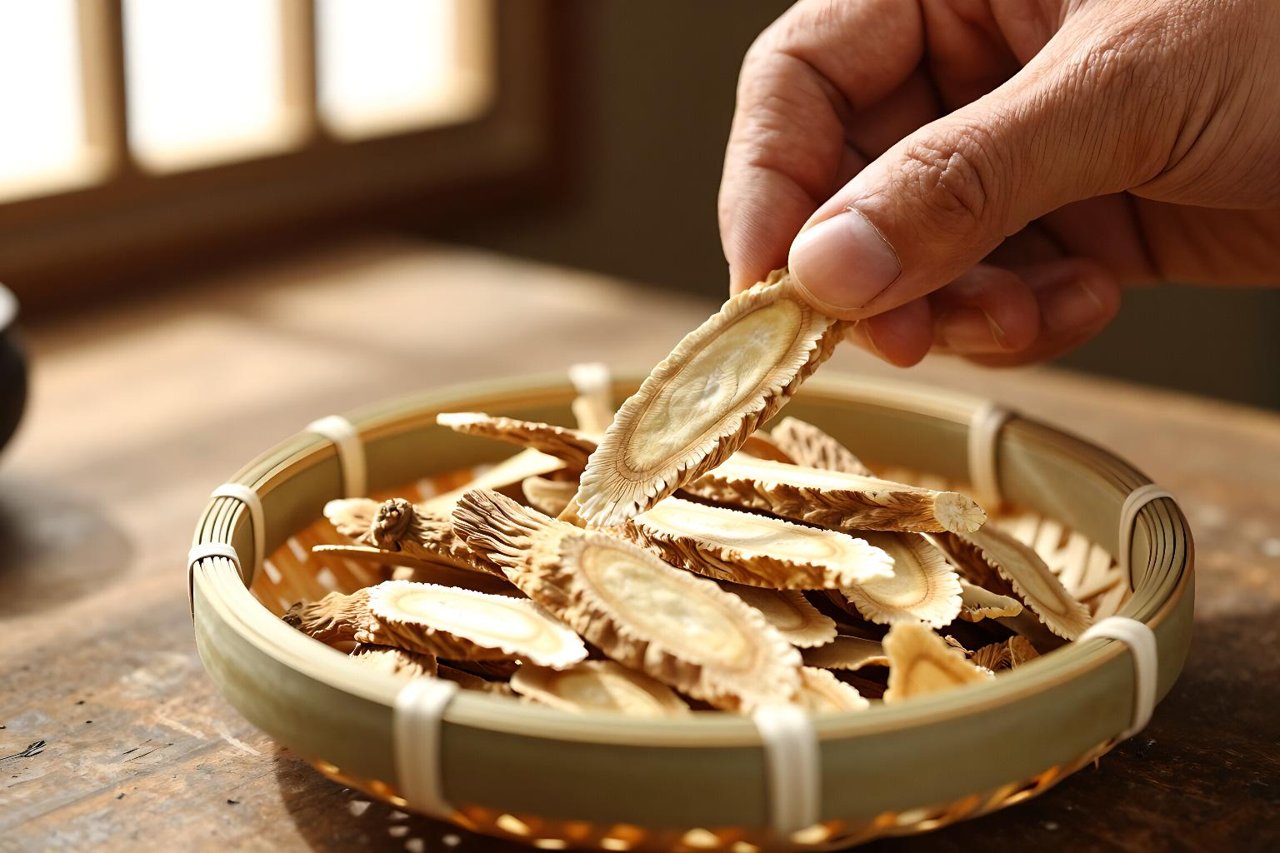
The first thing that strikes you about dried astragalus root is how light it is. A handful of the pale, cream-coloured slices weighs almost nothing, like a stack of tongue depressors, and they smell faintly sweet, somewhere between fresh hay and a toasted biscuit. Drop one into a pot of chicken broth and it softens into something chewy and mild, more texture than flavour.
That unremarkable slice has one of the longest paper trails in herbal medicine. Astragalus root, known in Chinese as huang qi, has appeared in Chinese materia medica for roughly two thousand years, and it still turns up in home kitchens from Beijing to San Francisco. What follows is a look at how it was actually used, how practitioners prepared it, and what the historical record does and does not support.
A legume with a long paper trail
Astragalus membranaceus, sometimes listed as Astragalus propinquus, is a hardy member of the pea family, native to the dry grasslands of northern China, Mongolia and Siberia. The plant sends up ferny leaves and small yellow pea flowers. The valuable part is the taproot, lifted in autumn from plants four to six years old, then sliced and dried.
The Greek name astragalos means “vertebra,” a reference to the knucklebones used as dice in antiquity. It is a name that wandered. European plants labelled astragalus, including the species that yields gum tragacanth, are not the medicinal root at all, which causes endless confusion in old herbals and on a fair number of modern supplement labels.

Huang qi in traditional Chinese medicine
Classical texts place huang qi among the qi tonics: sweet in taste, slightly warm in nature, entering the Spleen and Lung channels. The name itself is telling. Huang means yellow, a nod to the root’s colour and its association with the Spleen in five-phase theory. Qi here carries the sense of “leader” or “senior.”
Practitioners reached for it in a specific cluster of complaints: persistent fatigue, poor appetite, loose stools, spontaneous daytime sweating, shortness of breath on mild exertion, swelling in the legs, slow-healing wounds, and a tendency to catch every cold going around. Later texts extended its use to organ prolapse, including uterine and rectal prolapse, and to numbness or weakness in the limbs.
Underneath all of that sits the concept of wei qi, the defensive energy that circulates at the body’s surface. Astragalus was understood to strengthen that outer layer rather than fight an invader directly, which is why it was given preventively through winter and rarely at the height of a fever.
Three formulas that made it famous
Most of what we know about dosing comes from compound formulas rather than single-herb use.
- Yu Ping Feng San (Jade Windscreen Powder) pairs astragalus with atractylodes and siler, a three-herb mix traditionally taken by people who caught colds constantly or had year-round allergic rhinitis.
- Bu Zhong Yi Qi Tang gives astragalus the largest role, often 15 to 30 grams in a day’s dose, alongside ginseng, angelica and small amounts of cimicifuga and bupleurum, for sinking qi and prolapse patterns.
- Dang Gui Bu Xue Tang uses a striking five-to-one ratio, roughly 30 grams of astragalus to 6 of angelica, for the deep weariness that follows blood loss or a long illness.
Raw versus honey-fried
Pharmacies in China stock two versions. Sheng huang qi is simply dried root, favoured for swelling, non-healing sores and surface defence. Zhi huang qi has been stir-fried with honey until the slices darken and turn sticky. The honey shifts it warmer and deeper, and it is the form chosen for exhausted digestion and chronic lung weakness. The difference is not cosmetic. Honey-frying measurably changes the polysaccharide and flavonoid profile, and practitioners noticed the clinical gap long before anyone measured it.
The root outside China
Astragalus travelled along two quite different routes. Soviet researchers in the 1950s and 1960s, hunting for adaptogens across Central Asia, screened several Astragalus species alongside the more famous Eleutherococcus, and their reports helped push the herb into Western awareness decades later.
Western herbalists picked it up largely through Chinese medicine in the 1970s and 1980s, and it now sits in immune-support blends next to echinacea and elderberry. Ayurvedic practice has its own tonic roots, and astragalus is not part of the classical Indian repertoire. Anyone claiming a 5,000-year Ayurvedic history for it is improvising.
How it was actually prepared
Traditional use was rarely a capsule with breakfast.
- Long decoctions. Slices go into cold water, come to a simmer, and stay there 40 minutes or more. Typical daily doses run 9 to 30 grams, with classical texts pushing higher for acute situations.
- Everyday soup. In southern China, 15 to 30 grams of root goes into chicken or lamb broth with ginger, jujube dates and goji berries. This is food rather than medicine-cabinet stuff, and it is how most people actually consume the herb.
- Powders and pills. Ground root pressed into small pills suited long, low-dose courses for fatigue or recovery.
- Porridge. A gentler option for convalescents: root simmered in water, strained, then cooked with rice.
- Tinctures and extracts. A modern convenience, though alcohol pulls a different fraction of the chemistry than hot water does.
What modern research has chased
Chemistry-wise, the root is rich in polysaccharides, astragaloside IV, calycosin and other flavonoids. Laboratory work shows the polysaccharides nudging macrophages and T cells into activity. Chinese hospitals have used astragalus granules and injections as an adjunct to chemotherapy under the heading of fu zheng therapy, meaning roughly “support the upright.” Reviews of that work report less fatigue and better quality of life, though the trials are often small, unblinded, and hard to separate from the rest of the treatment protocol.
One much-cited 2013 study linked a lifestyle programme that included astragalus to longer telomeres in 35 men with prostate cancer. It was a pilot, not proof, and the headlines ran a long way ahead of the data.
Practical points before you buy
A few things are worth knowing. People on immunosuppressants after a transplant should avoid the herb without medical sign-off, since the entire point of astragalus is immune stimulation. The same caution applies to autoimmune conditions, where the evidence is thin but the theoretical risk is not zero. It can interact with warfarin and with cyclophosphamide, and Chinese practice avoids it during acute febrile illness with heat signs.
On quality, the Chinese Pharmacopoeia sets minimum markers of 0.040% astragaloside IV and 0.020% calycosin-7-glucoside. You cannot test that at home, but you can look for slices with a firm, deep yellow core and a distinct sweet, beany smell. Faint, woody or bleached-looking root is likely old, or cut with cheaper Astragalus species or Hedysarum root sold as hong qi.
Where the herb fits best is unglamorous. A pot of broth on a Sunday, 20 grams of sliced root simmered for an hour with ginger and a handful of dates, drunk through the week by someone run down from work or shaking off a chest infection. That is the traditional application in its most ordinary form, and after two thousand years it remains the one people actually keep.


