
Table of Contents
Somewhere around your 40th birthday, the sports you played at 22 stop being free. The Tuesday five-a-side game that used to cost you a shower and a can of drink now costs you two days of walking like a man who has borrowed someone else’s hips. That’s not a reason to quit moving. It’s a signal to change the sport, not the habit.
The best sports for adults over 40 have a few things in common: they work the heart and muscles hard, they don’t slam the joints for no reason, and they let you dial the effort down on a bad week. Here are eight that fit that brief, plus the sports worth treating with caution and a realistic plan for starting without ending up in a physio’s waiting room.
Why your forties actually change the rules
Cardiovascular fitness declines by roughly 1% a year from your thirties onward, and muscle mass drops somewhere between 3% and 8% per decade after 30 unless you’re doing something to resist it. Tendons lose elasticity and adapt more slowly than muscle, which is why the injury you pick up at 44 is usually a tendon rather than a muscle belly.
None of that is destiny. A consistently trained 50-year-old will out-work a sedentary 35-year-old every day of the week. The point is to choose something you can keep doing for a decade, not something you can survive for six weeks before your knee files a complaint.

What makes a sport a good fit after 40
- Real cardio with tolerable impact. You want to finish out of breath, not out of action.
- Scalability. A sport you can play at 60% on a tired Wednesday and 95% in a match on Sunday.
- A skill ceiling. Something to get better at holds your interest far longer than pure fitness does.
- Other people. A standing game with names attached to it beats a gym membership you quietly stop using in March.
- Proximity. Anything more than 25 minutes from your door tends to fall off the calendar.
It’s close to the checklist parents use when picking a sport a child will actually stick with, which is slightly humbling. Humans of any age keep doing things that are fun, social and easy to get to.
Eight sports that age well
Swimming
Water supports most of your body weight, so you get a hard cardiovascular session with almost no pounding through the knees and hips. Two 30-minute sessions a week is enough to move the needle. Join a masters club if there’s one nearby; structured sets beat swimming up and down aimlessly, and the coach will fix the head-up breaststroke that’s quietly annoying your neck.
Cycling
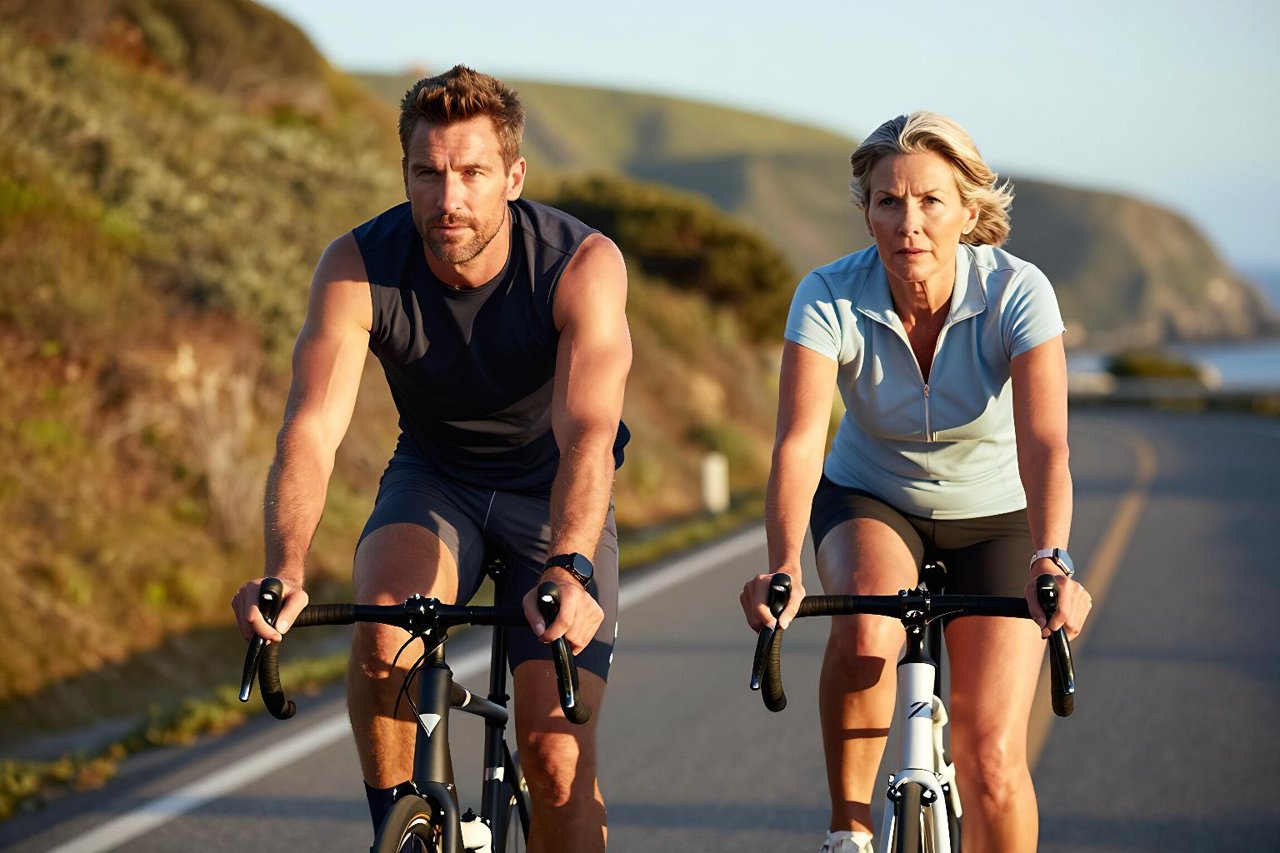
Most of your weight sits on the saddle and bars rather than driving through your joints, which makes cycling one of the few activities you can do hard three times a week at 45. Sixty to ninety minutes at a steady pace builds a big aerobic base, and a cheap indoor trainer keeps it going through winter. Spend money on a bike fit before you spend it on carbon wheels.
Rowing
An erg session recruits around 85% of your muscle mass, which is why 20 minutes on a rowing machine feels like a punishment you didn’t earn. It’s low impact and brutally efficient. Learn the sequence properly, legs then body then arms, and keep sessions to 20-30 minutes with some 500m intervals mixed in. Your lower back will thank you for the technique work.
Pickleball and tennis
A pickleball court is roughly a third the size of a tennis court, so there’s far less flat-out sprinting and stopping. If you played tennis seriously in your twenties, keep playing it, but warm up properly and accept that the drop shot you used to chase is now a ball you watch go past. Both sports are sociable, easy to schedule and genuinely good interval training.
Strength training
Lifting is a sport with weight classes and age brackets, and masters competitions are full of people in their fifties and sixties hitting personal bests. Two 40-minute sessions a week covering a squat, a hinge, a push, a pull and a carry will do more for your bone density and future independence than anything else on this list. The main risk isn’t the barbell, it’s your ego loading it.
Golf
Walking 18 holes covers roughly 6 to 8 kilometres, and carrying your bag adds a decent strength component. Golf is also famously one of the hardest sports to master, which is exactly why it holds people for 40 years. Take a lesson early; the swing you self-taught at 30 is the reason your back aches on the 14th.
Trail walking and hill hiking
The lowest barrier to entry of anything here. A 90-minute walk with 300 to 400 metres of climbing is a legitimate training session, and it doubles as the best thinking time you’ll get all week. Build up with a weighted pack and you’ve added a strength session for free.
Brazilian jiu-jitsu and judo
Grappling is a chess match with sweat, and plenty of people start in their forties. Choose a gym with older members and a sensible warm-up, tap early and tap often, and expect the first three months to feel like learning to breathe underwater. The skill curve is steep enough to keep you interested for years.
Sports to treat with respect
Rugby, boxing, basketball and weekend five-a-side aren’t banned, just more expensive. Achilles tendon ruptures in men aged 40 to 60 are overwhelmingly a weekend-sport injury: cold legs, a sudden sprint, a sharp pop, six months of rehab. If you’re keeping one of these, train for it during the week rather than treating Saturday as your only exercise.
How to start without breaking yourself
Start at about 60-70% of what you think you can handle, twice a week, for the first three weeks. Add no more than 10% to your weekly volume after that, and take every fourth week lighter. Keep two hard sessions of the same type at least 48 hours apart.
If you’re over 45, carrying extra weight and about to start something strenuous, get your blood pressure checked first. It takes ten minutes and it’s the cheapest insurance you’ll buy all year.
The unglamorous part that decides everything
Recovery is the sport now. Seven to nine hours of sleep, protein somewhere around 1.4 to 1.6 grams per kilo of bodyweight, and a genuine rest day where you actually rest rather than doing a slightly easier workout. The 40-somethings who progress are rarely the ones training hardest; they’re the ones who recover on purpose.
Playing a sport also makes watching one better. Once you know what a decent second serve looks like or why a rowing crew’s rhythm matters, matches stop being background noise. Keeping half an eye on the latest sports news gives you a reason to care about events you’d otherwise skim past, and you’ll pick up ideas to steal for your own game.
Pick one this week
Choose one cardio sport and one strength session. Book a trial or a single lesson rather than a 12-month contract, because you’re testing whether you enjoy it, not whether you’re committed. Put both sessions in your calendar as if they were meetings with someone who outranks you. Tell one person what you’re doing so there’s a witness.
Then go, and go badly. The first swim will feel clumsy, the first row will leave your legs shaky, and the first golf lesson will make you worse for a fortnight. Turn up again the following week anyway. That second visit is the one that decides whether you’re a 45-year-old who used to play sport or a 45-year-old who plays one.


