
Table of Contents
Most species vanish. The fossil record suggests a typical mammal species lasts about a million years, and plenty of invertebrates do better. The top 7 animals that have survived for millions of years take that endurance to another scale: lineages that have been around for 200, 300, even 500 million years. They have watched continents collide, oceans acidify, and dinosaurs arrive and disappear. Some are familiar; some are almost impossible to see. All offer a useful lesson in what survival actually requires.
1. Horseshoe Crabs: 450 Million Years of Blue Blood
Horseshoe crabs are not crabs. They belong to a group called xiphosurans, closer to spiders and scorpions than to the crustaceans they resemble. Their fossil record stretches back roughly 450 million years, through the Ordovician and every mass extinction since. Four species remain: one on the Atlantic coast of North America and three in Asia.
Their survival kit is unglamorous. They spawn in huge numbers on beaches, laying eggs that feed migrating shorebirds and fish. Their blue, copper-based blood contains a clotting agent that detects bacterial contamination, which is why pharmaceutical companies have used a derivative for decades to test vaccines and IV drugs. That usefulness has also been a problem: harvesting and habitat loss have reduced some populations. The animal that outlasted the dinosaurs now depends on careful beach management and synthetic alternatives to its blood.
2. Coelacanths: The Fish That Came Back From the Fossil Record
For most of the 20th century, coelacanths were known only from fossils. The lineage appeared about 400 million years ago, and scientists assumed it died out with the dinosaurs around 66 million years ago. Then, in 1938, a South African museum curator named Marjorie Courtenay-Latimer spotted an unusual fish in a trawler catch. It became one of the most famous zoological discoveries of the century.

Living coelacanths are not identical to their ancient relatives. Their genome and anatomy have changed, and calling them living fossils can be misleading. What matters is that the lineage persisted. They live deep, often below 100 metres, in cold water with low oxygen. They grow slowly, reproduce slowly, and give birth to live young. That low-key lifestyle helps in a stable deep-sea habitat, but it makes them vulnerable to accidental fishing.
3. Sharks: 450 Million Years of Teeth
Shark-like fishes appear in the fossil record around 450 million years ago. Modern sharks are not the same animals, but the lineage has survived all five major mass extinctions, including the end-Permian event that wiped out most marine life. Cartilage rarely fossilises, so much of what we know comes from teeth, scales, and rare preserved skeletons.
Sharks are often described as perfect predators, yet that reputation hides a more practical survival strategy. Many species grow slowly, mature late, and produce few young. That works in stable ecosystems but leaves them exposed to industrial fishing. Today, sharks face their own modern terror from finning, bycatch, and habitat loss. The group that survived the asteroid that ended the dinosaurs is now losing species to human appetite and carelessness.
4. Crocodilians: 200 Million Years of Ambush
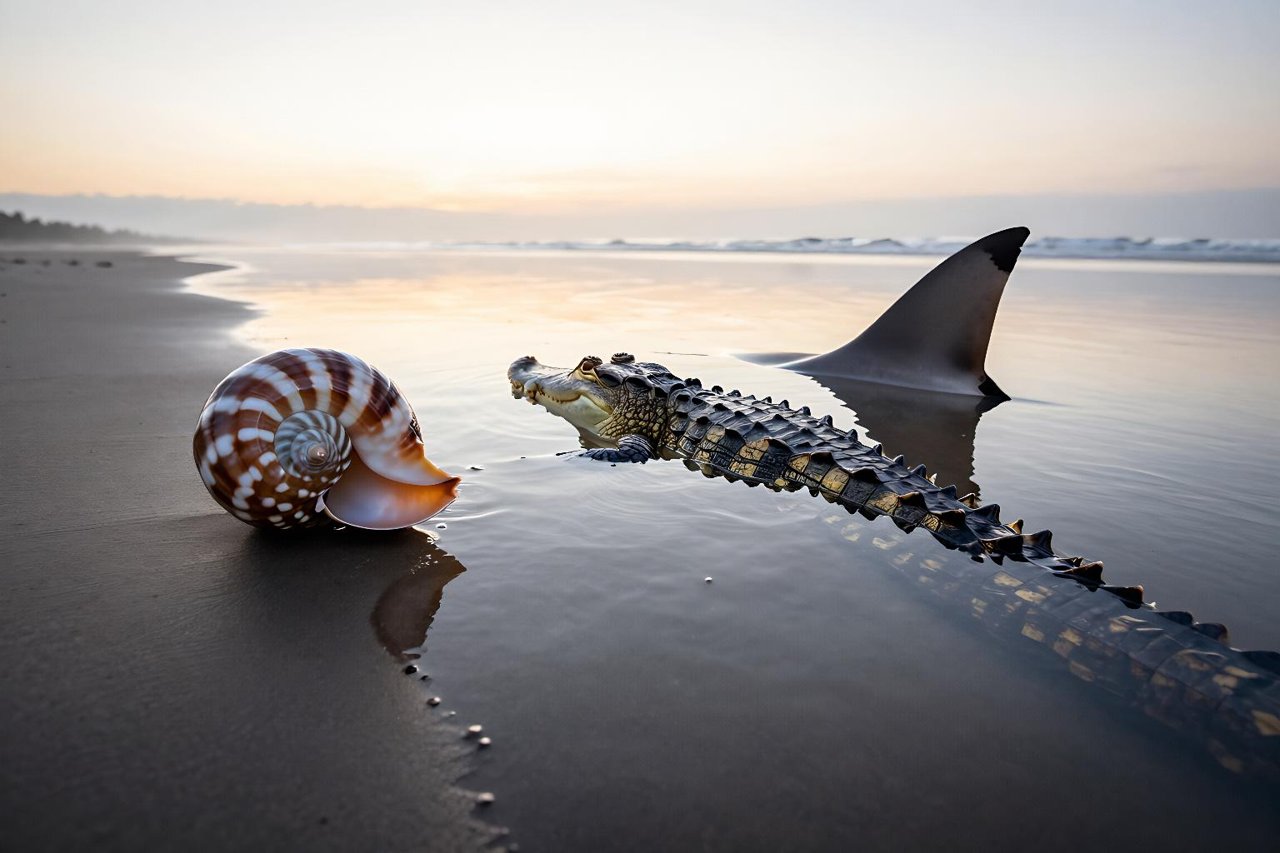
Crocodiles, alligators, caimans, and gharials belong to a lineage that dates back roughly 200 million years, to the Late Triassic. They survived the end-Triassic extinction and the end-Cretaceous asteroid. Their basic body plan of armour, semiaquatic habits, and ambush hunting has proved remarkably durable.
Part of the secret is low metabolism. Crocodilians can go weeks without eating and months without breathing hard. They bask to warm up, then slip into water to hunt. Their four-chambered heart and strong immune system help them handle wounds and infections. Some ancient relatives were enormous, including Deinosuchus, a Cretaceous crocodilian that may have reached 10 metres. The survivors are smaller, but they still occupy the same ecological role: wait, then strike.
5. Nautilus: A 500-Million-Year-Old Shell
Nautiloids appeared around 500 million years ago, before sharks and long before dinosaurs. The modern nautilus is a cephalopod, related to squid and octopus, but it still carries an external chambered shell. By adjusting gas and fluid in those chambers, it controls its buoyancy, hovering in the dark at depths of 200 to 800 metres.
Nautiluses have up to 90 tentacles, poor eyesight, and a slow reproductive rate. They scavenge and hunt small crustaceans and fish. The shell that helped them survive for hundreds of millions of years is now a liability. The wildlife trade values their shells, and fishing pressure has depleted populations in parts of the Indo-Pacific. A creature that survived several mass extinctions is now threatened by souvenir shops.
6. Tuatara: 240 Million Years on New Zealand’s Islands
Tuatara look like lizards, but they are not. They belong to the order Rhynchocephalia, a lineage that split from squamates, the group that includes lizards and snakes, about 240 million years ago. Today, only one genus survives, and only in New Zealand.
Tuatara have a third eye on top of their head, a parietal eye that senses light and helps regulate daily rhythms. They grow slowly, live for decades, and reproduce less often than most reptiles. Those traits helped them persist in cool, predator-free island ecosystems. They did not cope well with rats, stoats, and habitat loss. Conservation teams now manage island populations and incubate eggs to protect them from introduced predators. The lineage is ancient; its current survival is hands-on.
7. Cockroaches: 320 Million Years of Cleaning Up
Cockroaches appeared in the Carboniferous period, around 320 million years ago. They have survived the Permian extinction, the dinosaur extinction, and everything since. Roughly 4,600 species exist today, and only about 30 live around humans.
Their success is a masterclass in flexibility. They eat almost anything organic, hide in cracks, reproduce quickly, and adapt to new environments. They are nocturnal, fast, and hard to catch. The species in your kitchen is a nuisance, but most cockroaches live in forests and caves, breaking down plant material. Their ancient lineage has outlived countless so-called superior competitors by being small, adaptable, and unbothered by change.
What These Ancient Survivors Have in Common
Shared survival traits
No single trick explains 500 million years of survival. But the long-lived lineages tend to share a few traits:
- Low metabolic demands. Crocodilians and coelacanths do not burn energy quickly, which helps when food is scarce.
- Flexible diets. Cockroaches and horseshoe crabs eat what is available rather than specialising.
- Refuge habitats. Deep water, burrows, and isolated islands buffer against climate swings and predators.
- Slow reproduction, long lives. Tuataras and nautiluses invest less often but over longer periods.
- Dumb luck. Survivors were often in the right place when a mass extinction changed the rules.
The role of luck
That last point is easy to forget. Survival for millions of years is not a medal for superiority. It is a mix of biology, location, and timing. Horseshoe crabs were not better than trilobites; they happened to keep breeding in habitats that persisted. Sharks were not invincible; many species disappeared. What remains is a set of animals that made it through, often by being modest, widespread, and hard to kill.
Their presence also puts modern conservation in perspective. A species can survive an asteroid and still be pushed to the edge by fishing nets, beach development, or the shell trade. The top 7 animals that have survived for millions of years are not museum pieces. They are living tests of how much change an ecosystem can absorb, and how quickly human pressure can undo deep time.


