
Table of Contents
Most people who abandon an instrument don’t lack talent. They pick something that feels like homework for the first month: sore fingertips, notation they can’t decode, and scales that never turn into a song. The easiest instruments to learn are the ones that give you a recognizable tune while your hands are still clumsy. That early reward matters because it buys the repetition that real progress needs.
Not everyone finds the same instrument easy. A 10-year-old with small hands, a shift worker with 15 minutes a night, and a retiree with arthritis need different things. Still, some instruments have shorter runways to a first song. Here are seven of the most beginner-friendly picks, with honest costs and realistic timelines.
Ukulele: four strings and a fast first win
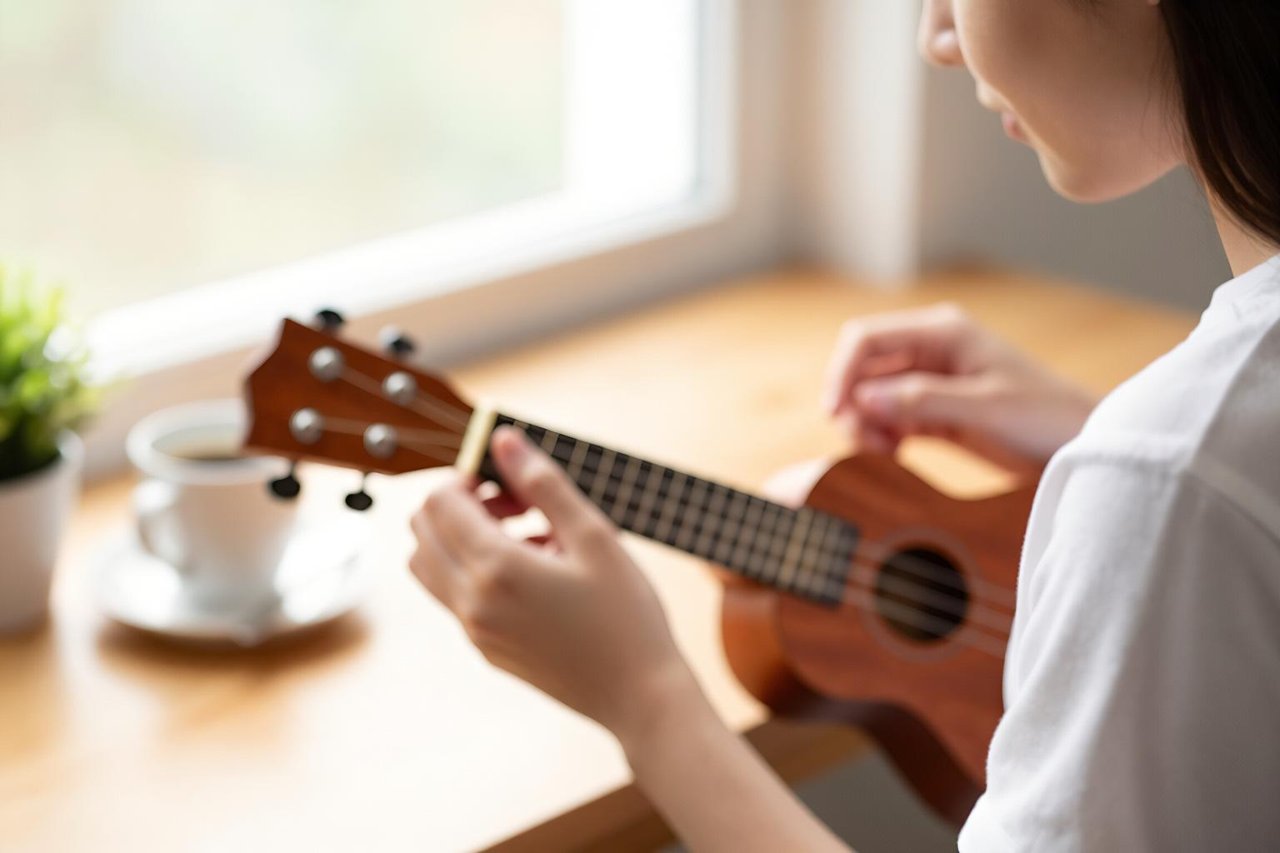
A ukulele is the classic first recommendation, and it earns the reputation. Four nylon strings mean less finger pressure than a steel-string guitar. The most common chords, C, F, G7, and Am, use one to three fingers. With those four shapes you can play ‘Riptide,’ ‘I’m Yours,’ and a long list of pop songs.
Expect to pay $50 to $100 for a playable soprano or concert model. Avoid the $20 toy aisle version; it won’t stay in tune. Your fingertips will be sore for about a week, then calluses form. Tuning takes 30 seconds with a clip-on tuner, and strumming patterns are easy to find on YouTube.

Biggest limitation: four strings limit harmony, and barre chords still take work. But for a first month, few instruments deliver more music per minute.
Harmonica: the pocket-sized beginner instrument
A 10-hole diatonic harmonica in C is small enough to keep in a jacket pocket. You don’t need finger strength or chord shapes. You breathe in and out, and a note comes out. Simple folk and blues lines can sound convincing on day one.
Buy a real instrument from Hohner, Lee Oskar, or Suzuki for $30 to $50. Toy harmonicas leak air and sound wheezy. The tricky part is bending notes, the technique that gives blues harmonica its vocal cry. That can take weeks of careful listening. Clean it by tapping out moisture and letting it air-dry, not by soaking it.
Good fit if you like blues, folk, or country and want something you can practice in a parked car without annoying anyone.
Kalimba: quiet, forgiving, and surprisingly musical
A kalimba, or thumb piano, has metal tines mounted on a wooden box. You press the tines with your thumbs. Most 17-note models are tuned to C major, so random plucking tends to sound pleasant. Tabs are simple number sequences, not staff notation.
Prices run $35 to $80 for a decent model. It’s quiet enough for an apartment and needs no embouchure, no calluses, and no tuning every week. The downside is range and harmony. You can play melodies and simple patterns, but not a full pop arrangement with bass and chords.
Great for anxious beginners, kids, and anyone who wants a five-minute creative break rather than a band practice.
Bass guitar: one note can carry a song
Bass looks intimidating because it’s a guitar, but the job is simpler at first. Most beginner bass lines use root notes: one finger, one note per chord, locked to the drummer. In a band, you can support a song before you can play a solo.
A used four-string bass costs $150 to $250, and a small combo amp adds $80 to $150. The strings are thick, so fingertips take a little longer to toughen than on ukulele. Muting, timing, and stamina separate a beginner from a solid bassist, but the first month is encouraging.
Choose bass if you like rhythm, want to play with others, and don’t mind carrying slightly heavier gear.
Bongos and cajon: rhythm without chords
Hand percussion is underrated for beginners. Bongos and cajons don’t require melody or chords. You learn two or three strokes, keep a steady pulse, and you’re making music. A cajon is especially practical: you sit on the box and play with your hands.
Bongos cost $60 to $120; a cajon runs $80 to $150. The catch is volume and technique. Cheap bongos can sound flat, and hand drums can be loud in a flat. A cajon is more forgiving for neighbors because you control the attack.
These are great second instruments for singers, songwriters, or anyone who freezes when asked to ‘play something.’ Rhythm is a portable skill.
Recorder: cheap, logical, and better than its reputation
The recorder gets mocked because schools hand them to children, but that’s the point: the fingering is logical, the plastic models are cheap, and you can make a clean sound within a week. A Yamaha YRS-23 costs about $10 to $25.
It teaches breath control, melody, and reading simple notation. The sound can be shrill, and expressive range is limited. If you want to play pop songs, a recorder won’t get you far. If you want a low-cost way to learn melody and music reading, it’s hard to beat.
Skip the dollar-store version. A decent plastic recorder is in tune and easy to clean.
What makes an instrument easy to start
Difficulty isn’t one thing. An instrument can be easy on the fingers but hard on the ear, or simple to hold but awkward to tune. The beginner-friendly ones tend to share a few traits.
- You can produce a clean note without unusual strength or breath control.
- The first chords or fingerings repeat across many songs.
- You get clear feedback: a wrong note sounds wrong, a steady beat feels right.
- You can practice in short sessions without setting up a full studio.
- Replacement strings, reeds, or tines are cheap and easy to find.
One more factor matters more than any list: the sound you actually want to make. A person who loves blues will practice harmonica bends for weeks. A person who loves indie rock will push through ukulele chord changes. The instrument that fits your taste is easier than the one that wins internet arguments.
A 20-minute practice plan that beats marathon sessions
Short, regular practice wins. Three 20-minute sessions a week for 12 weeks will take you further than one three-hour Sunday cram session. Your brain needs sleep between repetitions to turn finger movements into habits.
The 20-minute split
Spend five minutes on one technical thing: chord changes, a clean single note, or a steady pulse. Spend ten minutes on a song you actually like. Spend the last five minutes playing slowly with a metronome or drum loop. If you only have ten minutes, cut the technical work to two minutes and keep the song.
Track one thing
Pick a single measure, not a whole song. Count how many clean chord changes you can make in 60 seconds. Write the number down. Next week, try to beat it by two. This turns vague progress into something you can see.
Record 30 seconds on your phone every Friday. You’ll hear timing improve before your fingers feel different. Keep the recordings; in month three, the comparison is a motivation boost.
Match the instrument to your hands, ears, and neighbors
Small hands do better on ukulele, kalimba, or harmonica than on a full-size steel-string guitar. If you have wrist pain, avoid heavy barre chords and consider kalimba or harmonica. If you live in a thin-walled flat, cajon and bongos will make enemies; kalimba and a muted harmonica won’t.
Think about your goal. Want to sing around a campfire? Ukulele. Want to jam with friends? Bass. Want a quiet five-minute reset after work? Kalimba. Want to understand melody and notation on a tiny budget? Recorder. Want to play blues in a parked car? Harmonica.
Budget matters too, but the entry point is lower than most people expect. A playable ukulele, harmonica, or recorder costs less than a night out. You can upgrade after 90 days, once you know you’ll stick with it.
Pick one and give it 30 days before buying another
Choose one instrument, set a $100 budget, and buy used if you can. Find three songs or exercises at your level. Practice 15 minutes on four days each week. At the end of 30 days, decide whether to continue, switch, or add a second instrument.
The easiest instrument to learn is not the one with the shortest Wikipedia learning curve. It’s the one you’ll pick up on a Tuesday when you’re tired, the one that makes a sound you want to hear again. Start there, and the practice takes care of itself.


