
Table of Contents
Some dates live in human memory because armies clashed and futures shifted. The famous battles we read about today aren’t just lists of generals and casualty figures. Each one carries political grit, personal courage, and tactical genius. They show how one hundred men or a single storm can flip the fate of an empire. But they also leave us with questions we can’t always answer: what would have happened if Xerxes had waited? Or if Napoleon had rested at Waterloo? These are the turning points that historians love to revisit.
Ancient Clashes: Marathon, Thermopylae, and Cannae
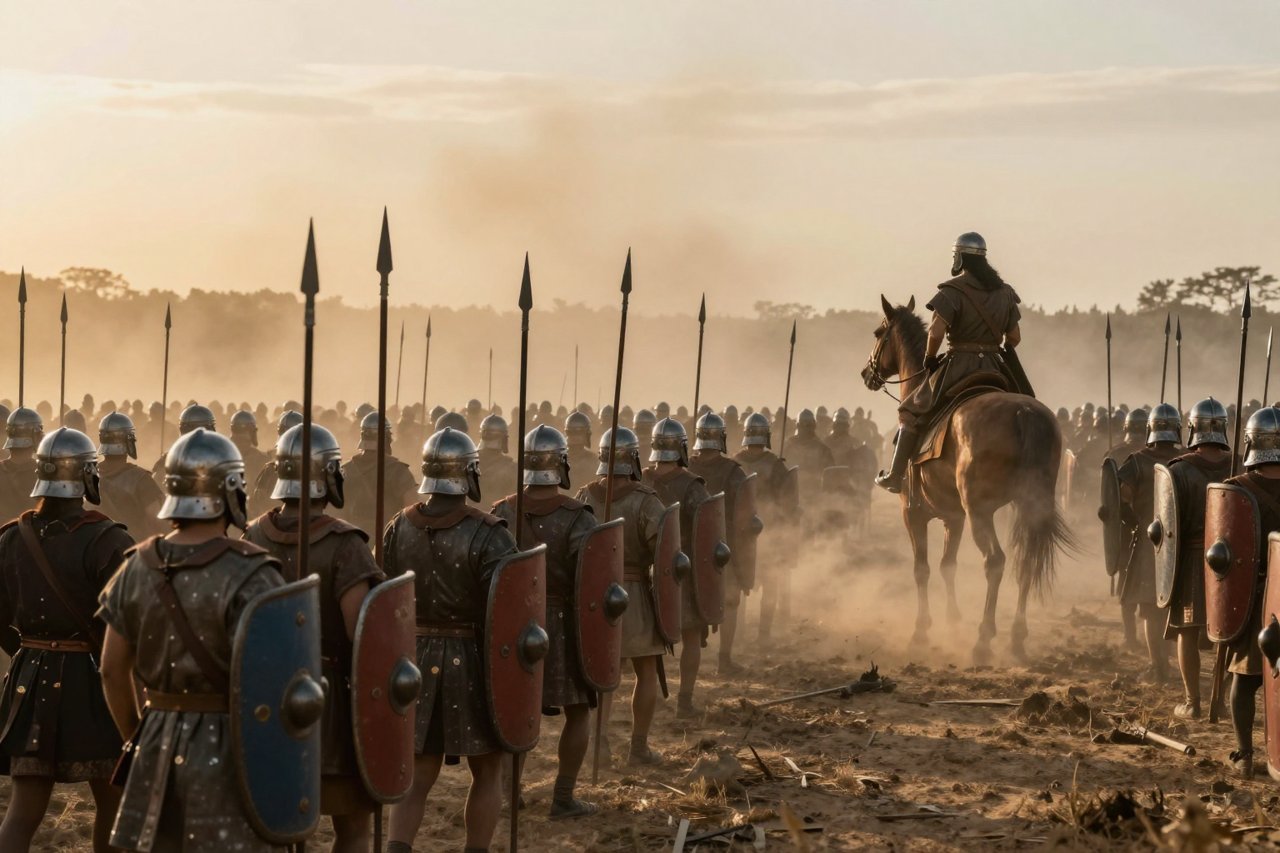
Ancient warfare was often a head-on affair, but the best commanders thought differently. In 490 BCE, the Athenians ran straight at a larger Persian force and used a deliberate retreat in the center to double-envelop the enemy. The victory at Marathon saved the Athenian experiment in democracy. A decade later, the Persian king Xerxes returned with an enormous army. At Thermopylae, a small Greek force—most famously 300 Spartans—held a narrow pass for three days. Their sacrifice bought Athens time to evacuate and prepared the stage for a naval victory at Salamis.
The ideas and innovations of the ancient Greeks resonate far beyond military history, and if you want to explore the broader impact of that world, our guide to Ancient Greece offers a complete picture. More than 200 years later, Hannibal made his own mark at Cannae, encircling a vastly larger Roman army. The double pincer movement is still taught today as the archetype of military encirclement.
Naval Battles: Where Strategy Meets the Sea
The ocean adds an extra layer of uncertainty. Fickle winds, currents, and the sheer emptiness of the horizon turn every naval fight into a puzzle. At Salamis in 480 BCE, the Greek fleet lured the Persians into a narrow channel where their superior numbers became a liability. For centuries afterward, admirals used the same trick. At the Battle of Trafalgar in 1805, Nelson broke the enemy line with two columns sailing straight at the Franco-Spanish fleet. It was bold, reckless, and it worked. A century later, the Battle of Midway in 1942 changed the Pacific war through air power and code-breaking.

And even in these strategic battles, the ocean remains a hostile character—a realm we are still discovering, from the surface down to its darkest trenches. For a glimpse of that alien world, you can read about the strangest deep sea creatures that survive in the abyss. In a way, naval commanders of the past had to anticipate a similar kind of unpredictability.
The Firepower Revolution: From Crécy to Waterloo
Gunpowder and better missile weapons changed the math of battle. At Crécy in 1346, English longbowmen mowed down French knights who had been the ultimate shock troops of the Middle Ages. The lesson was clear: range and discipline could beat brute force. By the time of Waterloo in 1815, heavy artillery and infantry squares had turned the battlefield into a brutal industrial process. Napoleon’s final defeat was the result of his own fatigue, a rain-soaked ground, and the timely arrival of Prussian reinforcements. It was a battle of furious timing.
What Makes a Battle Famous?
We remember some battles for their lopsided victories, others for their courage against impossible odds. Common ingredients include:
- Decisive stakes – the result changes who rules a continent or which way a civilization develops.
- Individual moments – a commander’s decision, a standard bearer’s stand, a last-minute relief.
- Innovation – the first use of a weapon, formation, or time of day that flips an old rule.
- Human endurance – when soldiers fight through starvation, disease, mud, or bitter cold.
- Echoes – poems, paintings, films and books that keep the story alive in our culture.
Twentieth-Century Turning Points: The Somme, Stalingrad, and D-Day
The scale of suffering in the twentieth century made older battles look almost ritualistic. The Battle of the Somme in 1916 began with 19,000 British dead on the first day. It was a bloodbath that reshaped public opinion about war. Two decades later, Stalingrad became a name for extreme urban combat, where soldiers fought floor by floor in freezing ruins. Almost two million people died or were wounded there. D-Day, on June 6, 1944, was arguably the most complex operation ever attempted—more than 150,000 Allied troops landed on contested beaches along a fifty-mile stretch. It cracked the German defenses and opened a second front in Europe.
These events fit into a broader sequence of political shifts, and you can trace the whole arc of those changes in our history timeline. But no timeline can capture the smell of the fields or the trembling hand of a young soldier.
Why Famous Battles Still Matter
Studying famous battles isn’t about glorifying conflict. It’s about understanding that when diplomacy fails, the cost is staggering. We learn from the courage and blunders of those who fought, and we carry the responsibility to remember them accurately. Every conflict has a context, a set of decisions, and a moment when everything tips. The generals made plans, the soldiers made sacrifices, and the world changed—sometimes for the better, sometimes not. That is why we still argue about these battles. That is why we study them.


