
Table of Contents
In 2015, a team working at a site called Lomekwi 3 in northern Kenya prised stone tools out of sediment dated to 3.3 million years ago. Before that season, the oldest accepted tools were roughly 2.6 million years old. One excavation pushed the date back by 700,000 years, and the hominins who made those tools may not even have belonged to our genus.
Africa covers about 30 million square kilometres and preserves evidence of every phase of human existence, from the first flaked cobbles to the mud-brick mosques of the Sahel and the coral-stone towns of the Swahili coast. Finds turn up constantly, and each one nudges a key moment in the history timeline a little further back.
Early Humans in the Rift Valley
Olduvai Gorge in Tanzania is where palaeoanthropology as a modern science really started. Louis and Mary Leakey worked the gorge for three decades; in 1959 Mary found a fossil skull nicknamed Nutcracker Man, a Paranthropus boisei individual dated to roughly 1.8 million years. Olduvai also produced the first stone tools anyone recognised as deliberately shaped rather than naturally broken.
Ethiopia’s Afar region gave the world Lucy in 1974, an Australopithecus afarensis skeleton about 3.2 million years old and roughly 40% complete. She walked upright on a brain a third the size of ours.

Rising Star Cave and Homo naledi
In 2013, cavers in South Africa’s Rising Star system squeezed through a chute barely 18 centimetres wide and came back with photographs of bone. The Dinaledi Chamber eventually yielded more than 1,500 fossil elements from at least 15 individuals of a species nobody had seen before: Homo naledi. The awkward part was the dating. The bones turned out to be only 236,000 to 335,000 years old, which means a small-brained hominin was living in southern Africa while early Homo sapiens was already around. A second chamber, Lesedi, added more individuals and more questions.
Jebel Irhoud and the Age of Our Species
A cave in Morocco produced the oldest Homo sapiens fossils known, at roughly 300,000 years, published in 2017. That was 100,000 years older than anything previously accepted and moved the origin of our species away from a single East African birthplace towards a patchwork across the whole continent.
Rock Art: The Longest Visual Record on Earth
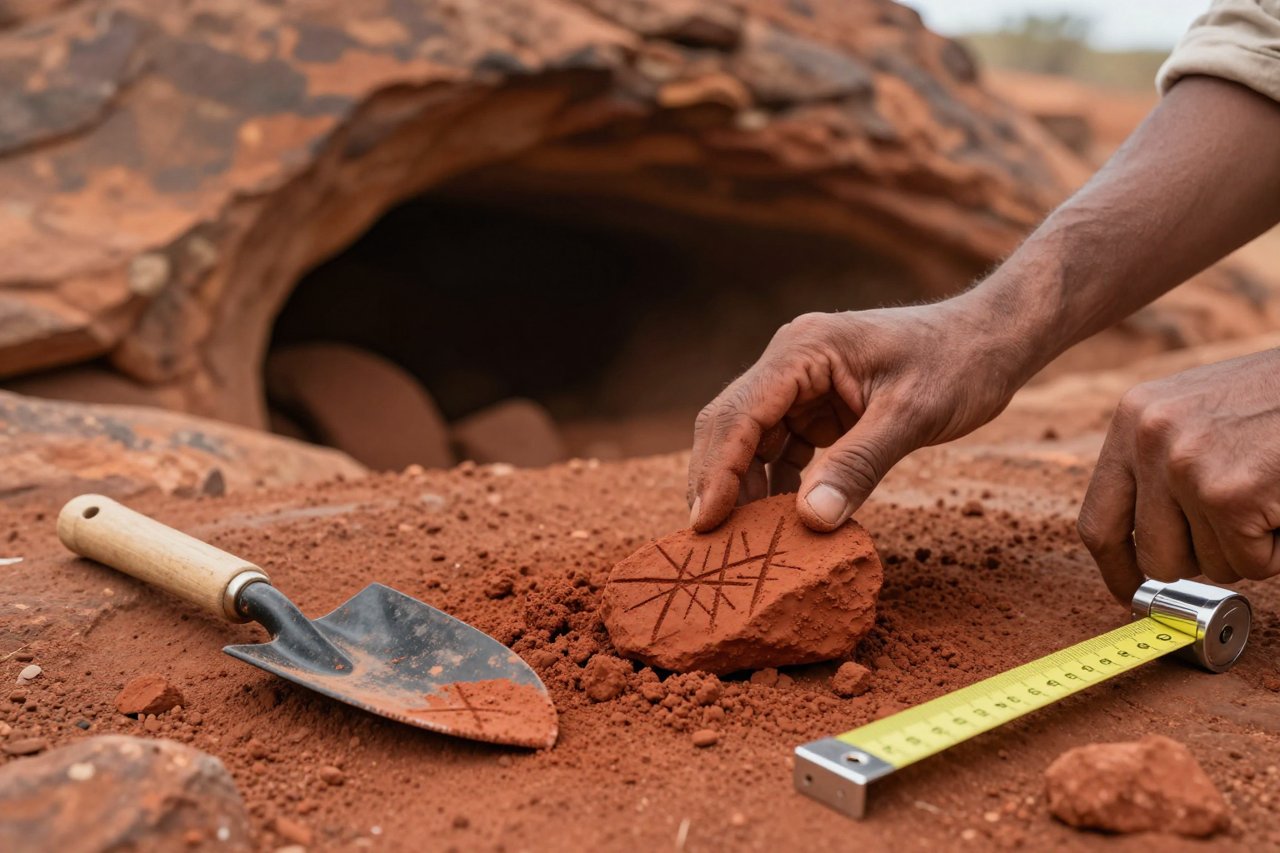
In 2018 a team led by Christopher Henshilwood reported a fragment of ochre from Blombos Cave scratched with a cross-hatched pattern and dated to about 73,000 years. It is one of the earliest abstract drawings anyone has found. In Namibia, the Apollo 11 shelter produced painted stone slabs roughly 27,000 years old, and the Tassili n’Ajjer plateau in Algeria holds thousands of images of cattle herders, giraffes and crocodiles from the centuries when the Sahara was grassland and shallow lakes.
Interpreting those walls is its own discipline and its own argument, as this piece on what ancient rock art actually means makes clear: separating a hunting scene from a ritual symbol is guesswork when nobody left a written explanation.
Stone Cities and Trading Kingdoms
Great Zimbabwe is the headline act. Between the 11th and 15th centuries, builders raised granite walls up to 11 metres high from more than 250,000 blocks, fitted without a drop of mortar. Its rulers traded gold and ivory through the Swahili coast, and excavations have turned up Chinese celadon, Persian glass and Arab coins. For decades colonial-era scholars insisted the walls could not possibly be African work. David Randall-MacIver in 1905 and Gertrude Caton-Thompson in 1929 put that to rest with plain stratigraphy.
The Swahili Coast
Kilwa Kisiwani and Songo Mnara, off the Tanzanian coast, were built of coral rag and lime mortar. Kilwa’s Great Mosque was expanded in the 14th century into one of the largest in East Africa, and the sultanate minted its own coins. Monsoon trade linked these ports to Arabia, India and China long before Europeans rounded the Cape.
The Niger Bend and the Sahel
Djenné-Djenno in Mali was occupied from roughly 250 BC, making it one of the oldest known urban settlements in sub-Saharan Africa. Nearby Timbuktu became a manuscript city, and libraries there still hold hundreds of thousands of handwritten pages on astronomy, law and medicine.
Aksum
In northern Ethiopia, Aksumite masons carved granite stelae up to 24 metres tall in the 4th century AD. Aksum was among the first states anywhere to mint its own coinage and adopted Christianity while Rome was still arguing about it.
- Lomekwi 3, Kenya — stone tools at 3.3 million years
- Rising Star, South Africa — over 1,500 Homo naledi fossils
- Jebel Irhoud, Morocco — Homo sapiens at 300,000 years
- Blombos Cave — engraved ochre at 73,000 years
- Great Zimbabwe — mortarless granite walls, 11 metres high
- Sungbo’s Eredo, Nigeria — around 160 km of rampart and ditch
New Instruments, New Discoveries
LiDAR has been the quiet revolution. Flown over Benin City and over Sungbo’s Eredo in south-western Nigeria, it revealed earthworks that had been dismissed as natural ridges, including a rampart and ditch system of roughly 160 km enclosing Ijebu territory. Isotope analysis of tooth enamel now tracks childhood diet and migration. Ancient DNA recovered from Taforalt in Morocco, at about 15,000 years, and from Hora in Malawi has redrawn population movements across the continent.
This is the same pattern seen elsewhere: better instruments finding what eyes missed. A wider look at how archaeological discoveries keep rewriting the past shows the technique repeating from Britain to Peru.
Who Gets to Tell the Story
Archaeology in Africa has a looting problem and a capacity problem, and both are political. Sites in conflict zones suffer badly; Sudan’s museums have been ransacked during the current war, and Sahelian tell sites are dug over by treasure hunters chasing terracotta figurines for European auction houses. Rescue work at dams such as Merowe on the Nile saved thousands of records before the water rose, but only because teams moved fast.
The encouraging shift is institutional. National museums in Nairobi, Dakar, Accra and Cape Town now run their own excavations, African universities train their own doctoral students, and communities near sites like Mapungubwe and Great Zimbabwe are involved in interpretation rather than treated as obstacles. Repatriation of human remains and artefacts taken during the colonial period has moved from rhetoric to actual returns, and it changes what questions get asked.
Where the Evidence Lives
Most of these finds are not locked away in European basements. The Turkana Boy skeleton is in the National Museums of Kenya in Nairobi. The gold rhinoceros from Mapungubwe, hammered from thin sheet in the 13th century, sits in a dedicated museum at the University of Pretoria. Iziko in Cape Town holds the Blombos material, and the manuscript collections of Timbuktu are largely in Bamako, digitised and slowly being conserved after being smuggled out of the city in 2012.
Visiting matters more than it sounds. Ticket revenue funds conservation, and local guides tend to know which walls are stabilised and which are off-limits. Go early in the morning, bring water, and expect the best panels at places like Twyfelfontein or Drakensberg to be reached on foot rather than from a car park.


