
Table of Contents
Standing in a beauty aisle with forty nearly identical beige bottles in front of you is a special kind of overwhelming. Everyone tells you to find the best foundation. Nobody explains what that even means. Best for what? Best for whom?
Here’s the honest answer, and it’s less exciting than the marketing suggests: a great foundation disappears on your face. It doesn’t crease under your eyes by lunchtime, doesn’t turn orange at 3pm, doesn’t sit on dry patches like a coat of emulsion. Clear those three hurdles and you’ve found your winner. The brand name and the price tag are noise until then.
This guide assumes you’ve never bought foundation, or you bought one, hated it, and quietly gave up. We’re starting from zero: what you’re actually putting on your skin, which choices genuinely change the result, and how to leave a shop with something you’ll wear more than twice.
Foundation is one product doing a hundred different jobs
Strip away the claims and a foundation has one core purpose: evening out your skin tone. Everything else is a variation on that theme. Some formulas add pore-blurring powders, some add sunscreen filters, some add enough pigment to cover acne scars and melasma, and some just add a wash of tint so you look less tired than you feel.

Search any list of top-rated foundations and you’ll notice something odd. Nobody agrees. That’s because the product that wins depends entirely on the one that fits your skin, not the one with the best reviews. Oily, dry, sensitive, textured, calm: each of those skins wants something different from the bottle.
The three decisions that matter more than the brand
When you’re new to this, it helps to think of foundation as three separate choices stacked on top of each other. Get these right and almost any decent product will work. Get them wrong and a £50 bottle will look worse than a £9 one.
Coverage
Coverage is how much your natural skin shows through. Sheer formulas (tinted moisturisers, skin tints) even out redness while letting freckles stay visible. Light-to-medium is the everyday sweet spot for most people. Full coverage hides almost everything, but it also hides the texture of real skin, which is why it can look flat in photos. Estée Lauder’s Double Wear sits firmly at the full end; a tinted moisturiser sits at the other.
Finish
Finish is how the surface looks once it’s dry. Matte is flat and shine-free, great for oily skin and long days. Natural (sometimes called satin) looks like skin with better lighting. Radiant or dewy catches the light and suits dry or mature skin, but it will slide around on an oily forehead by mid-afternoon.
The base it’s built on
Every liquid foundation is a mix of pigment suspended in water, silicone, oil, or a blend of those. Water-based formulas feel light and work well layered over water-based skincare. Silicone-based ones glide, blur pores, and last longer but can pill if what’s underneath doesn’t agree with them. Oil-based options are rarer now and suit very dry skin. If you want the full picture without the sales pitch, this no-hype comparison of every foundation base breaks down the differences properly.
Finding your shade without guessing
Most first-time foundation fails aren’t about formula. They’re about colour. Shade has two parts: how light or dark you are, and your undertone, which is the subtle warmth or coolness underneath. Undertones fall into warm (golden, peachy), cool (pink, rosy) and neutral (a bit of both).
To swatch properly, draw three stripes along your jawline, not your hand. Hands are almost always a different colour from your face. Then walk outside and look in natural daylight, because shop lighting is designed to flatter product, not tell you the truth. The stripe that vanishes is your match. Give it ten minutes before deciding, since some formulas darken as they settle, a process called oxidation. If you’d rather follow a structured process from start to finish, this step-by-step method to find your best foundation takes the guesswork out of it.
What the label is actually telling you
- Long-wear or 24-hour: built on silicone and film-forming ingredients that lock pigment down. Brilliant for a twelve-hour shift, less kind to dry or dehydrated skin.
- Hydrating, radiance, or glow: contains glycerin or oils and dries with a visible sheen. Flattering on dry skin, slippery on oily skin.
- Oil-free or non-comedogenic: formulated without heavy oils, and tested to be less likely to clog pores. Worth prioritising if you break out easily.
- Buildable: means it starts sheer and layers up. A safe first buy when you’re unsure how much coverage you want.
- SPF 15 or 20: a nice bonus, not sun protection. Getting the stated number would require applying far more product than anyone actually does.
Match the formula to your skin type
Oily skin wants oil-free, matte or natural finishes and something with staying power. Dry skin wants hydration and a satin or radiant finish, plus gentle exfoliation beforehand so the product doesn’t catch on flakes. Combination skin usually does best with a natural finish and a mattifying primer down the T-zone. Sensitive skin should avoid heavy fragrance and look for shorter ingredient lists.
If you’re in the oily camp, these foundations for oily skin that hold up all day are a sensible starting point. There’s also a useful guide to matching foundation to your skin type if you want a second opinion on which direction to head.
Application changes the result as much as the product
You can own the perfect foundation and still make it look bad. A few things make an outsized difference.
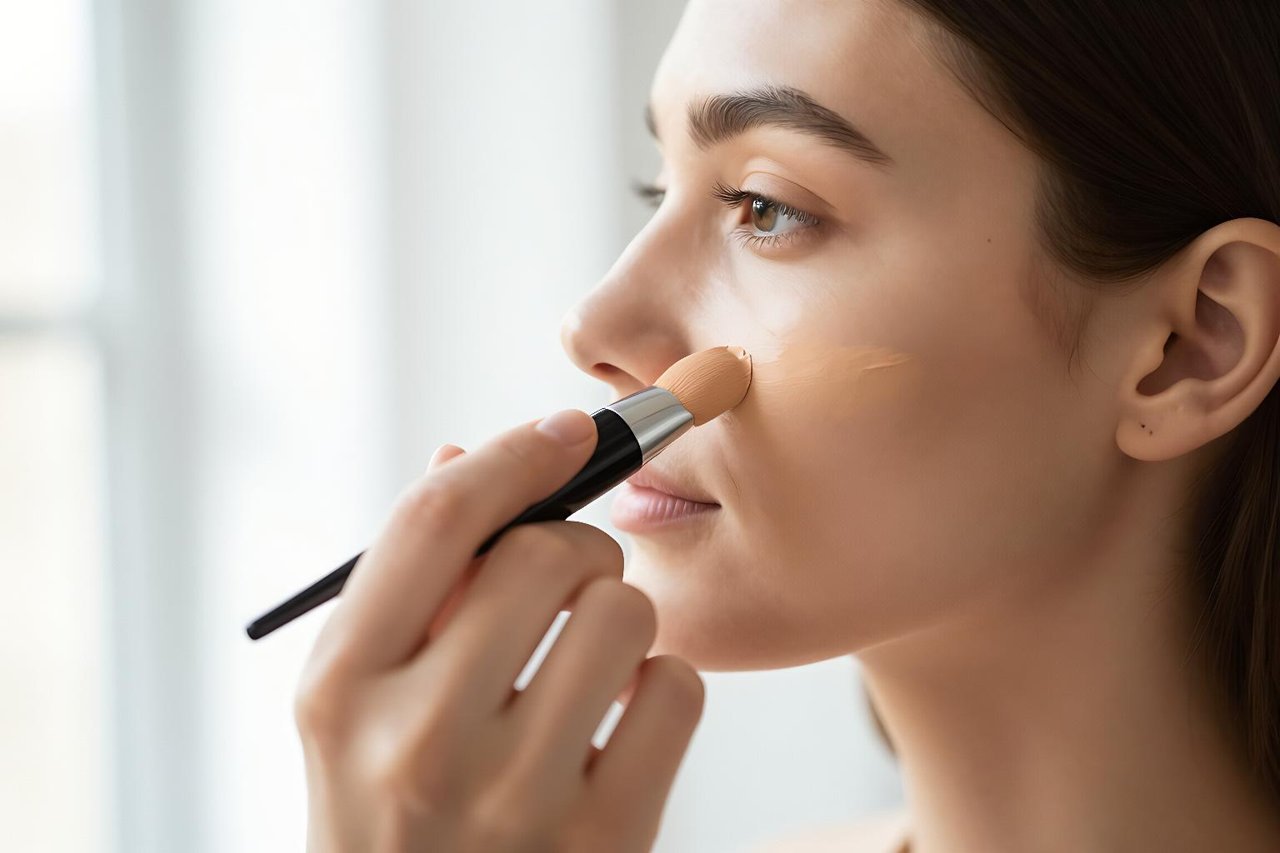
Start with two pumps, not four. You can always add more; taking it away is much harder. Apply to the centre of your face first, where redness usually lives, and blend outward with whatever you have to hand. Fingers warm the product and give the most natural finish. A damp sponge sheers things out and softens edges. A dense brush gives the most coverage but shows texture fastest.
Wait thirty seconds between your moisturiser and your foundation. Applying to skin that’s still tacky is the fastest route to patchiness. And if you’re layering over a water-based primer with a silicone foundation, expect pilling. Those two don’t always mix.
Test it for a full day before you commit
Never judge a foundation in the shop. Ask for a sample pot, which most counters will happily give you, and wear it for a proper day: a commute, a few hours indoors, some time outside. Check it in three lights, ideally daylight, office overheads, and a phone selfie, because each one reveals something different. Look for oxidation, creasing around the nose, dryness on the cheeks, and whether your skin feels comfortable rather than tight.
If it fails, take it back. Plenty of retailers accept opened foundation returns within a set window, and a bad shade is exactly the kind of thing a refund policy exists for. The best foundation is rarely the first one you buy, and it’s almost never the one a stranger on the internet swears by. It’s the bottle you forget you’re wearing.


