
Table of Contents
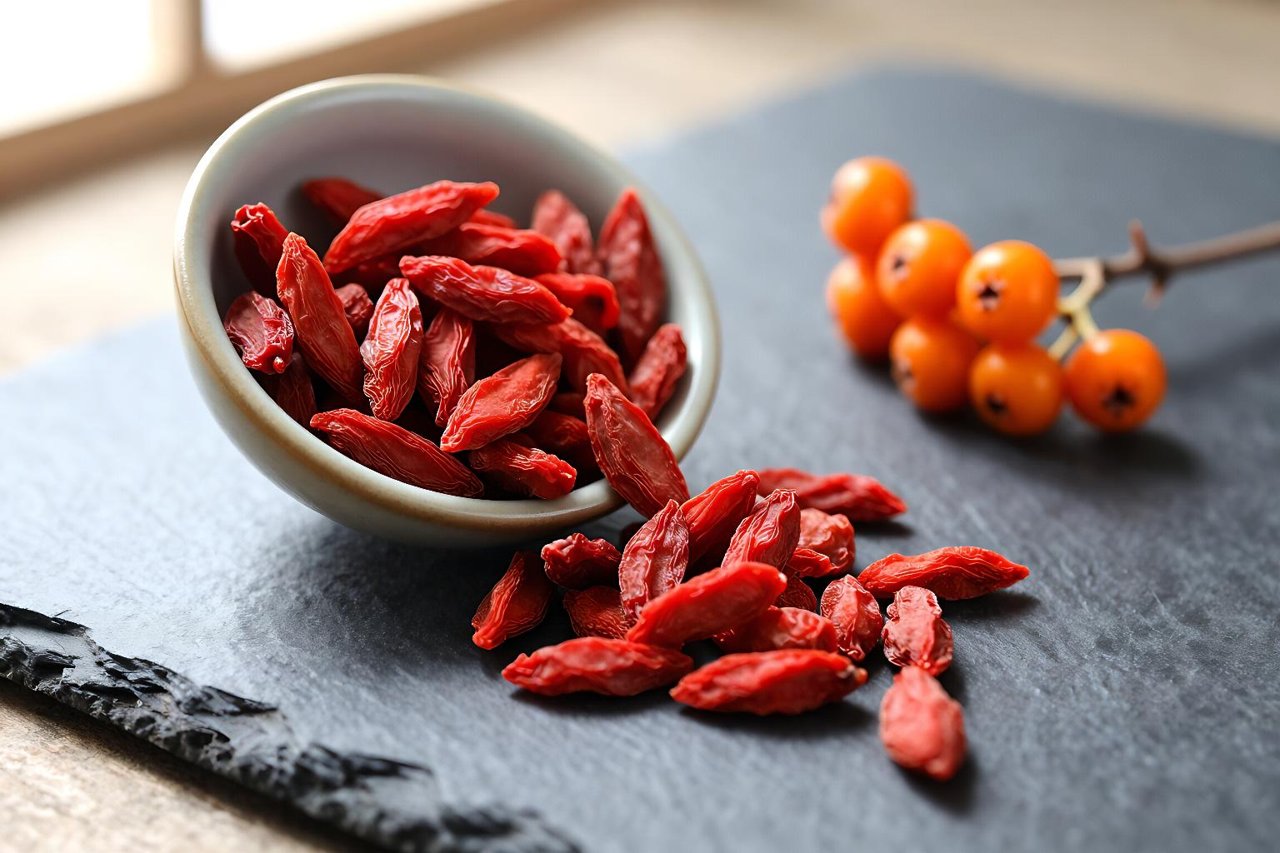
Goji berries turn up in £9 smoothies, in the bulk bins of health food shops, and in clay soup pots in northwest China where they have been simmering for centuries. It is the same fruit in every case: Lycium barbarum, a thorny shrub that grows happily on dry, alkaline ground along the Yellow River. Pick the berries in late summer, dry them until they are chewy like a raisin, and you get something with a tang somewhere between a dried cranberry and a cherry tomato.
The nutrition story is genuinely interesting. The traditional food story is older and, in my view, more useful. Here is what the numbers actually say, and how cooks from Ningxia to Kathmandu have been using these berries long before anyone put them in a protein ball.
A nightshade, not a berry in the supermarket sense
Botanically, goji is a nightshade, sitting in the same family as tomatoes, potatoes and peppers. Two species are sold commercially: Lycium barbarum and the slightly smaller Lycium chinense. Most of what you buy dried is barbarum, and much of it comes from Zhongning County in Ningxia, where the fruit is a protected local crop and the harvest runs from July into October.
Fresh goji berries are soft, bright orange-red and extremely perishable, which is why they rarely travel. Dried is the default, and drying concentrates everything: flavour, sugar, and nutrients, all in a berry the size of a small sultana.

What the nutrition label doesn’t tell you
Per 100g of dried berries you are looking at roughly 349 calories, 77g of carbohydrate (about 45g of it sugars), 13g of fibre, 14g of protein, 9mg of iron and around 7mg of beta-carotene. That protein figure is unusual for a fruit and worth noting, although nobody eats 100g in one go. A realistic portion is 15g to 30g, about one to two tablespoons, which lands at 50 to 100 calories.
Vitamin C: the claim that shrinks with drying
Fresh goji berries carry 40 to 50mg of vitamin C per 100g, comparable to a lemon. Drying at 40 to 50°C destroys a large share of it, and many dried samples test below 10mg per 100g. So if a bag promises a vitamin C boost, treat it with a raised eyebrow. Buy them for what survives the drying process, not for what doesn’t.
Zeaxanthin, the standout compound
Goji is one of the richest food sources of zeaxanthin, the carotenoid that accumulates in the macula at the back of the eye. Published figures vary widely, from around 25mg to well over 100mg per 100g of dried fruit, and much of it exists as zeaxanthin dipalmitate, a form that holds up to heat better than plain zeaxanthin. A small trial in 2011 gave volunteers 15g of dried goji daily for 28 days and found measurable rises in plasma zeaxanthin and in macular pigment density. Small study, encouraging result, not a cure for screen strain.
The polysaccharides everyone cites
Goji polysaccharides, usually shortened to LBP, make up roughly 5 to 8% of the dried berry by weight and are the focus of most of the research you’ll see quoted online. Fair warning: the bulk of that work is in cells and animals, not people. The traditional use case, a small handful in a long-simmered broth, is a far more modest proposition than the supplement aisle suggests.
Traditional food uses, from Ningxia to Kathmandu
In Chinese kitchens, goji (枸杞, gǒuqǐ) is treated as an ingredient rather than a health product. It goes in at the end of cooking because it softens fast and turns mushy if you boil it hard.
Chinese soups, teas and congee
Snow fungus soup is the classic: dried silver ear rehydrated and simmered with rock sugar and red dates, with a spoonful of goji stirred in for the last few minutes so they plump but keep their shape. Steamed chicken with shiitake and goji is standard home cooking in the south. Millet congee gets a scattering just before serving. In Ningxia itself, the local ritual is eight-treasure tea, a glass packed with goji, red dates, longan, rock sugar, sesame seeds, walnut and tea leaves, topped up with hot water again and again through the afternoon until the fruit is eaten with a spoon.
Himalayan and Central Asian tables
Further west, dried berries are folded into roasted barley flour for tsampa, dropped by the handful into butter tea, and carried in trail mixes across Nepal and Tibet. The logic is practical: they are light, keep for a year and give a hit of sweetness at altitude when little else does.
The leaves are eaten too
Goji shoots, sold in spring in Chinese markets as 枸杞叶, are stir-fried with garlic or blanched into pork soup in Guangdong. They taste faintly bitter and spinach-like, and they are a completely different food from the dried berry.
Buying and storing them well
Quality varies enormously, and the difference shows up in the pan.
- Colour: deep, slightly matte red. Neon-bright berries often mean sulphur dioxide or dye.
- Texture: they should fall apart loosely in the bag. A solid clump means damp storage or sugar syrup.
- Size: Zhongning berries are small and slightly elongated. Giant berries are usually a different cultivar bred for looks.
- Label: check for added sulphites, and pay for organic if you eat them daily, since the skin is thin and the fruit is dried whole.
- Storage: an airtight jar in the fridge keeps them good for a year. Freeze for longer.
- Prep: rinse briefly and soak in warm water for ten minutes before cooking. The soaking liquid is sweet and makes a decent base for tea.
Who should be cautious
Goji has a real, documented interaction with warfarin. Case reports published in 2001 and 2009 described sharp rises in INR after people drank goji tea or juice alongside a stable warfarin dose. If you take a blood thinner, speak to your doctor or pharmacist before making them a daily habit, and mention it before surgery. Allergic reactions are rare but reported, and people with strong reactions to other nightshades might want to start small.
The sugar content is the other practical point. At roughly 45g of sugar per 100g, a tablespoon is a sensible sprinkle and a cereal-bowl-sized portion is a dessert. Anyone managing blood glucose should count them the way they would count raisins.
Working them into an ordinary week
None of this needs to be complicated. Drop a tablespoon into a mug with three red dates and a few longan berries, pour over water just off the boil, and refill the mug three or four times before eating the softened fruit. Stir a handful into porridge or congee in the last five minutes of cooking. Toast them for a minute in a dry pan to deepen the flavour, then scatter over yoghurt or roasted squash. They bake well in flapjacks and energy bars if you keep the oven at 180°C or below and fold them in at the end, since the sugars catch and burn quickly. Steeping a jar of them in rice wine for a fortnight gives you the infused liqueur that shows up on Chinese dinner tables at New Year.
A 250g bag lasts most households about six weeks at a tablespoon a day, which is roughly the pace the traditional recipes assume. Start there rather than with the supplement capsules, and you’ll get the flavour, the zeaxanthin and the small ritual of a mid-afternoon glass of tea that keeps giving refills until four o’clock.


