
Table of Contents
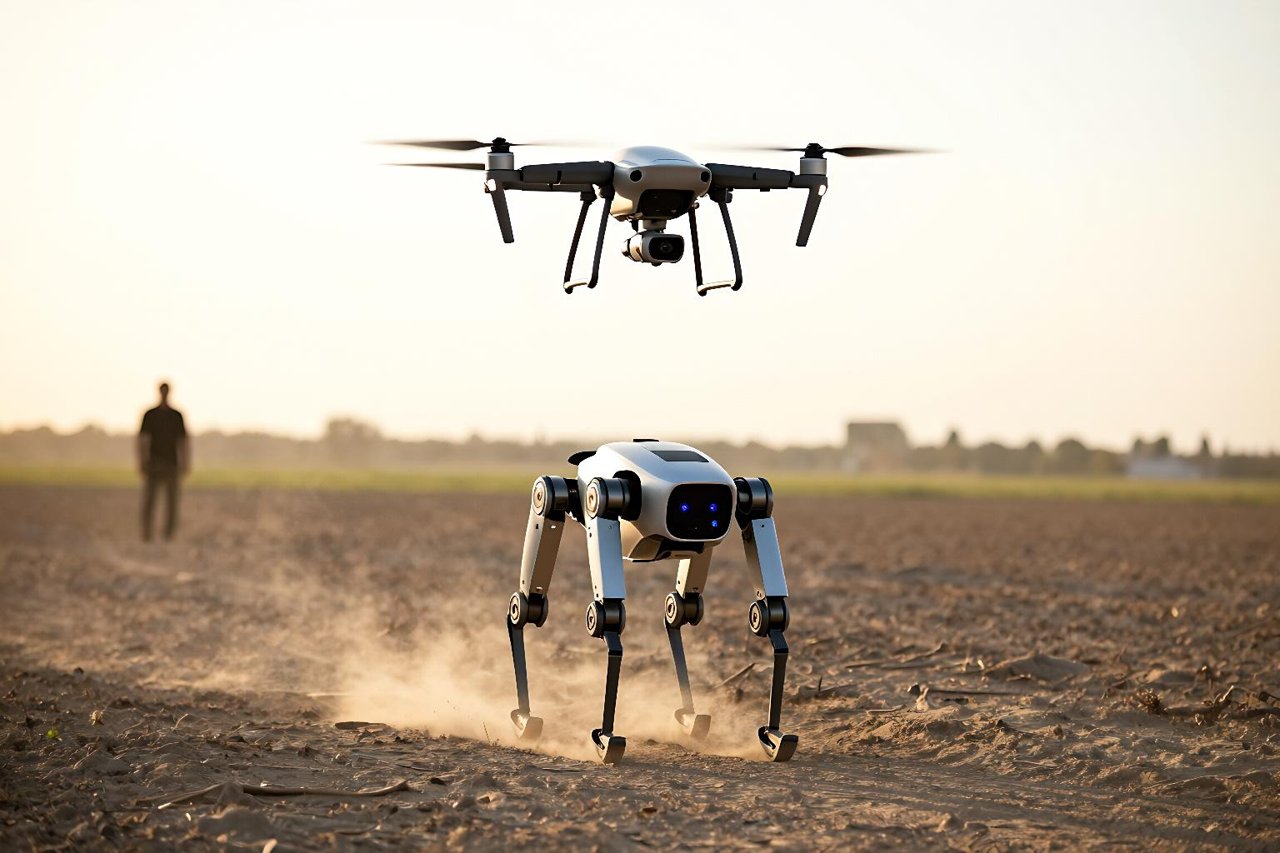
A quadcopter lifts off the back of a flatbed, climbs to 120 metres and starts stitching together a map of 60 hectares of maize. Two kilometres away, a wheeled robot the size of a ride-on mower rolls down a row, stopping every few seconds to spray a single weed it has identified. Neither machine has a person standing next to it. They are not doing the same job twice, and they are not really doing separate jobs either.
That division of labour is the whole point. Drones and ground robots fail at very different things, which is exactly why pairing them works better than buying two of either. A drone can cover a field in minutes but cannot pull a lever or carry a toolbox. A ground robot can push, lift, spray and drill for eight hours, but its view of the world is about 30 centimetres off the floor.
Eyes Above, Hands Below
Strip away the marketing and most drone-and-robot teams come down to a simple split: the aerial machine handles perspective and speed, the ground machine handles contact and endurance.
Drones are unmatched at seeing a lot of ground quickly. A fixed-wing survey drone mapping at 2 cm per pixel can cover several square kilometres in a single 40-minute flight. That is a map a ground robot would need days to build, and it is the map the ground robot actually needs to plan a route, avoid a flooded corner of a field, or find the one broken panel in a 400-metre row of solar arrays.

Ground robots bring what flight does not allow: payload, torque, and time on task. A quadruped carrying a thermal camera can walk into a substation and climb stairs. A tracked crawler can drag a hose. The drone spots the problem from above, the ground unit goes and touches it.
Where This Already Happens
Agriculture
Large-scale farming is the clearest case. A mapping drone flies a field and produces a vegetation index that flags nitrogen-stressed patches. That map gets pushed to an autonomous sprayer, which slows down and applies variable rates over exactly those patches. In practice this cuts herbicide use by 20% to 60% on weedy fields, because the sprayer is only treating plants that exist rather than blanketing the whole paddock.
Spray drones now carry 40 to 50 litres and fly pre-programmed lanes up to about 30 hectares per hour. They are increasingly used to scout and to treat small hotspots that the ground fleet either cannot reach (too wet, too steep) or cannot justify driving into.
Warehousing and logistics
Indoor drones flying inventory checks are a quiet success story. A small quadcopter with a camera flies a grid above racking, reading barcodes on pallets at heights a forklift operator would need a cage to reach. Some operations report cycle counts finishing in a few hours rather than a full shift, and accuracy climbing because the drone does not get bored at aisle 40.
The same facility usually runs autonomous floor robots and increasingly humanoid or wheeled picking assistants working alongside people. If you want a sense of how that interaction actually looks in practice, there’s a good collection of delivery robots and human-robot interaction footage worth watching before you design a floor plan.
Inspection and infrastructure
Ships, storage tanks and wind turbines get the same treatment. A drone photographs a hull’s exterior and builds a 3D model good to a couple of millimetres. A magnetic crawler is then sent to the specific weld or valve the drone flagged, rather than sending a human into a ballast tank on a guess. The inspection goes from a week of confined-space work to a day, and the crawler only goes where the drone said it was needed.
Search and rescue
Disaster response teams fly mapping drones over collapsed buildings within minutes, then send ground robots into voids too small or too hot for people. The drone establishes where the collapsed structure is stable enough to walk on, and the ground robot confirms whether someone is inside. The two machines are never more than a radio link apart.
The Communications Layer Nobody Notices
None of this works if the machines cannot share a coordinate frame. Three things make it possible.
- Centimetre-level positioning. RTK GPS gets a drone’s position down to about 2 cm, which means a ground robot can treat the map as a literal set of instructions rather than a rough sketch.
- Mesh radios. Teams use self-forming radio networks so each machine relays through the others. If the drone flies behind a hill, the ground robot’s radio can carry the signal.
- Shared map servers. A cloud or on-vehicle service holds the live occupancy grid. Every machine reads and writes to the same one, so a drone that spots a new obstacle updates the ground robot’s plan without a human touching anything.
Latency budgets are tighter than people expect. For a landing on a moving platform, you need a control loop under 100 milliseconds. For a mapping handoff, five seconds is fine. Knowing which is which saves a lot of over-engineering.
Where Teaming Goes Wrong
The failure modes are predictable, and they are usually boring rather than dramatic.
- Dust on the drone’s camera ruins the map the whole team depends on.
- Battery mismatch: the drone has 25 minutes, the ground robot has six hours, so the team covers less than either would alone unless the drone has a docking station.
- GPS denial under canopy or inside a building, which forces vision-based navigation and shrinks the working envelope.
- Two machines disagreeing about where the map origin is, which produces a ground robot confidently driving to the wrong field.
Perception is where most of the engineering money goes, and it is changing fast. Work on new sensor architectures that could change how robots see is relevant here, because better low-light and depth sensing directly widens the conditions in which a drone-robot team can operate. Related research on vision-based systems that teach machines to understand their own bodies matters too. A robot that knows exactly where its arm ends will not grasp a drone that landed 15 cm off its marker.
The Software Is Where the Teamwork Actually Lives
Two autonomous machines in the same field are not a team. A team shares intent. That means a task allocator that can hand work between air and ground depending on conditions: drone sees the weed, ground robot sprays it, drone re-flies the row to confirm the kill. The bottleneck is rarely hardware. It is the scheduling layer and, increasingly, agentic software that can negotiate those handoffs on its own. The wider direction of that technology, where intelligent agents take on coordination and decision-making, is a decent proxy for where multi-robot fleets are heading.
Supply-chain operators have been doing a version of this for years without drones, and the lessons transfer. If you are planning a fleet, it’s worth reading up on using technology to overcome supply chain challenges, particularly the parts about interoperability and data standards. The same trap catches robot fleets: three vendors, three map formats, three battery standards, and no system that can allocate a single task across all of it.
What to Ask Before You Buy In
Anyone demoing a drone-and-robot combination will show you a slick video. The questions that separate a real system from a promotional one are duller:
- Does the ground robot accept the drone’s map directly, or does someone convert a file by hand?
- What happens when the radio link drops for 60 seconds?
- Who is responsible for a collision between the two machines?
- Can the drone land safely if the ground robot is not where it should be?
- How many hours of human intervention per 24 hours of operation?
If the answers involve a person with a laptop standing between them, you have bought two robots, not a team. The genuinely useful pairings, on farms and in tank farms and along warehouse racking, are the ones where the handoff happens without anyone noticing it, and where the only evidence a human was involved is a battery swap at lunchtime.


