
Table of Contents
Walk into almost any salon and you’ll hear the same offer: a hair straightening treatment that promises silky, glass-like hair for months. But the word treatment covers a lot of ground. Some options chemically break the bonds that make hair curly. Others just coat the strand in keratin. Before you spend three hours in a chair and several hundred dollars, it’s worth understanding what each method actually does to your hair.
The main categories of hair straightening treatment
Relaxers
Relaxers are the oldest, most aggressive option. Most use sodium hydroxide or guanidine hydroxide to break disulfide bonds in the hair, permanently re-arranging the curl pattern. For tight curls, a relaxer gives the smoothest, straightest result. But permanent means what it says: once the bond is broken, washing won’t bring the curl back. You’ll need touch-ups every six to eight weeks on the regrowth, and the treated ends get more brittle with every application.
Keratin-based smoothing treatments
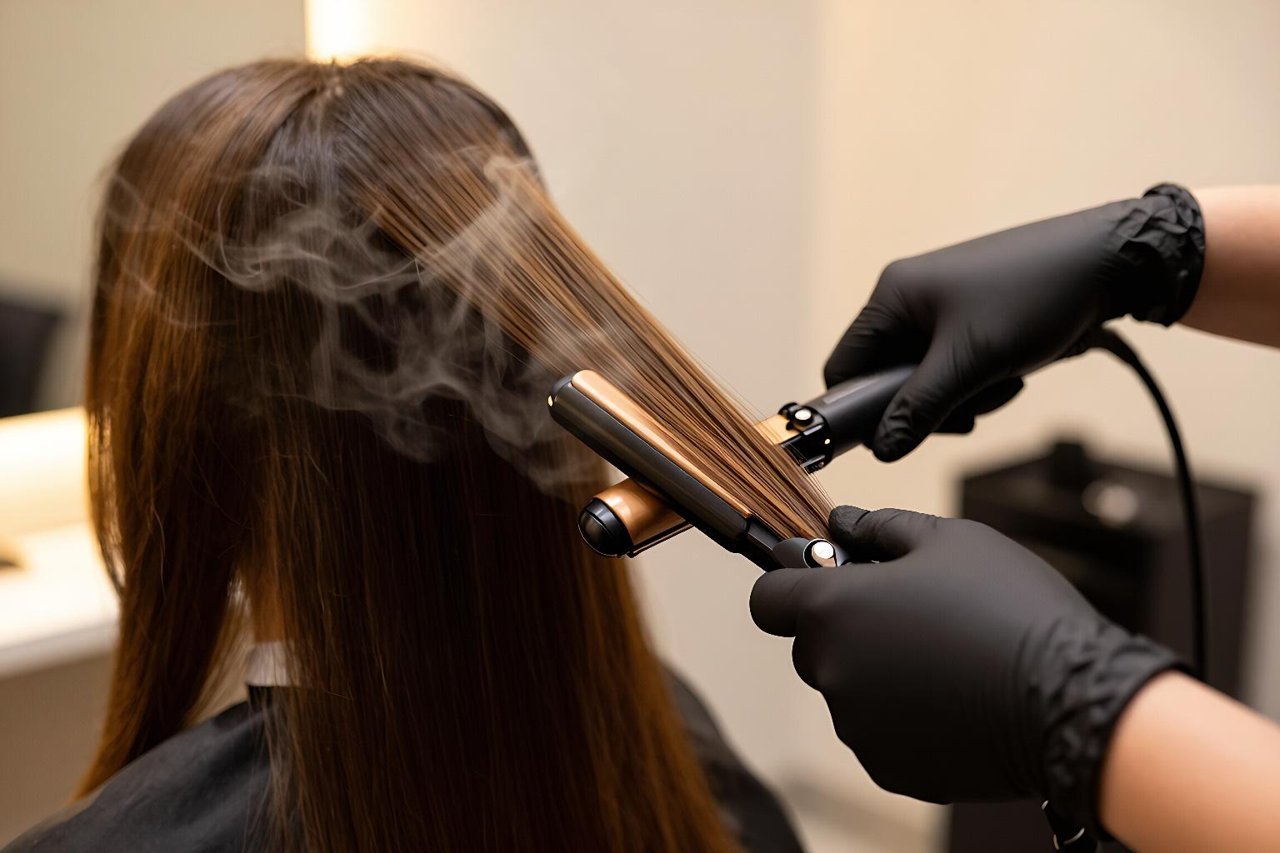
These are often called Brazilian blowouts, keratin treatments, or smoothing treatments. They coat each hair with a layer of hydrolysed keratin and other polymers, then seal it in with heat at 230°C. The result is sleeker, less frizzy hair that still has some wave and movement. It lasts about two to five months, depending on how often you shampoo. Prices typically run $150 to $450. The trade-off: many formulas contain formaldehyde or formaldehyde-releasing chemicals, which are the only reason the coating bonds to the hair.
Japanese thermal reconditioning
Also known as Yuko, this is the original permanent straightening method. It combines a softening lotion, a flat iron pass, and a neutraliser to rebuild the hair’s bonds in a perfectly straight position. Because it permanently rearranges the internal structure, results last until the hair grows out, usually six to twelve months at the ends. It’s also the priciest, often $300 to $800, and demands top hair quality to begin with. On damaged or porous hair, it can leave straw-like strands behind.

The formaldehyde problem
What the FDA missed, and why it matters
In 2022, the FDA announced it would propose a ban on formaldehyde in hair straightening products by April 2024. It never happened. Many salon lines continue to sell straighteners that release formaldehyde when exposed to a heated flat iron. You can read the full breakdown of why the FDA missed its self-imposed deadline to ban formaldehyde in hair straighteners, but the short version is that consumer safety ended up behind industry lobbying. The International Agency for Research on Cancer classifies formaldehyde as a known human carcinogen, and salon workers have filed thousands of lawsuits over respiratory damage and scalp burns.
Check the ingredient list before you book. Avoid anything that mentions formalin, methylene glycol, quaternium-15, DMDM hydantoin, or formaldehyde-releasing preservatives. If the salon won’t show you the bottle, that’s a reason to leave.
How to choose the right hair straightening treatment
Curl type and density
Finer, looser waves usually respond well to keratin smoothing without much damage. Dense, tight coils need a relaxer or Japanese straightening to get a pin-straight finish. But if your main issue is frizz rather than curl, you might not need a straightening treatment at all. Our tested roundup of the 7 best products for wavy hair can define your natural texture and cut down the puffiness without touching a single bond.
How straight is ‘straight’?
Be honest with your stylist about what you want. If you ask for sleek, you’ll get a smoothing treatment. If you ask for pin-straight, you’ll get something more heavy-duty. Take a photo of your dream result. A vague description on the consultation sheet leads to disappointment.
Budget and maintenance
A $90 relaxer seems cheaper than a $400 keratin treatment, but you’ll pay again every two months. And the stylist fees, specialist shampoos, and deep conditioners add up. Calculate the cost over a year, not just the single appointment.
What to know before you book
The process is not a one-hour errand
Straightening treatments take time. A keratin service can be 90 minutes to three hours. Japanese straightening is often four to five hours across two visits. If you have a long bob or layers, ask for the exact timing before the chair.
Chemical damage is real
No matter how gentle the marketing sounds, every straightening treatment stresses the hair. Over-processed hair can stretch, snap, or matte. If you already notice shedding or a widening part, adding a hydroxide root relaxer on top is risky. There are simpler ways to protect your scalp; read through the simplest hair loss treatment and prevention guide before you risk further thinning.
Ask these questions
- Does your formula contain formaldehyde or any kind of formaldehyde-release preservative like quaternium-15 or DMDM hydantoin?
- Do you do a strand test, or just apply directly to the scalp?
- How long should I wait before washing my hair?
- What happens if my hair gets sticky or gummy?
Aftercare that keeps it straight but doesn’t kill it
For the first 72 hours, you won’t be able to wash, pin, or tuck your hair behind your ears. After that, switch to a sulfate-free shampoo and avoid chlorine as much as possible. Heat styling from a curling iron will reduce the treatment’s lifespan, so keep the iron below 180°C if you want the smooth finish to last. And if you decide to chop it all off later, know that straight hair makes a blunt bob look particularly sharp. Bob haircuts aren’t going anywhere for 2026, so ask for a one-length cut and the treatment will feel even more polished.
Signs your hair is struggling after a treatment
Normal hair snaps occasionally, but when breakage becomes a pattern, the treatment is too much. Pay attention to excessive shedding in the shower, a spongy or gummy texture when wet, and a part that gets wider even though you haven’t lost hair before. If those show up, stop applying any further straightening chemicals and switch to bond-repair treatments. Don’t panic. Get advice from a trichologist or dermatologist, and cut off the worst of the damage before it spreads to healthy regrowth.


