
Table of Contents
Your cat notices the moment you skip a scoop. You might not, especially if the box sits in a spare room or a corner of the laundry. But a cat’s nose is doing roughly forty times the work of yours, and a litter box that smells faintly used to you can read as genuinely unpleasant to them.
Here’s the short version before we get into the details: scoop twice a day, swap out the litter completely every one to two weeks, and scrub the box itself once a month. Those three numbers handle almost every situation. The rest of this article is about where you can bend the rules, where you absolutely shouldn’t, and how to tell when your current routine has stopped being good enough.
Scooping: Twice a Day Isn’t Overkill
A healthy adult cat urinates two to four times a day and defecates once or twice. On a single-cat, single-box setup, that’s up to six deposits in 24 hours. Scoop once a day and each of those sits for an average of twelve hours. Scoop once every other day, which plenty of people quietly do, and you’re asking your cat to walk on a surface that’s better than half waste.
Two passes a day fixes it. Morning before you leave and evening before bed takes about sixty seconds each. If you have two cats sharing one box, double the deposits and the urgency.

What a real scoop actually involves
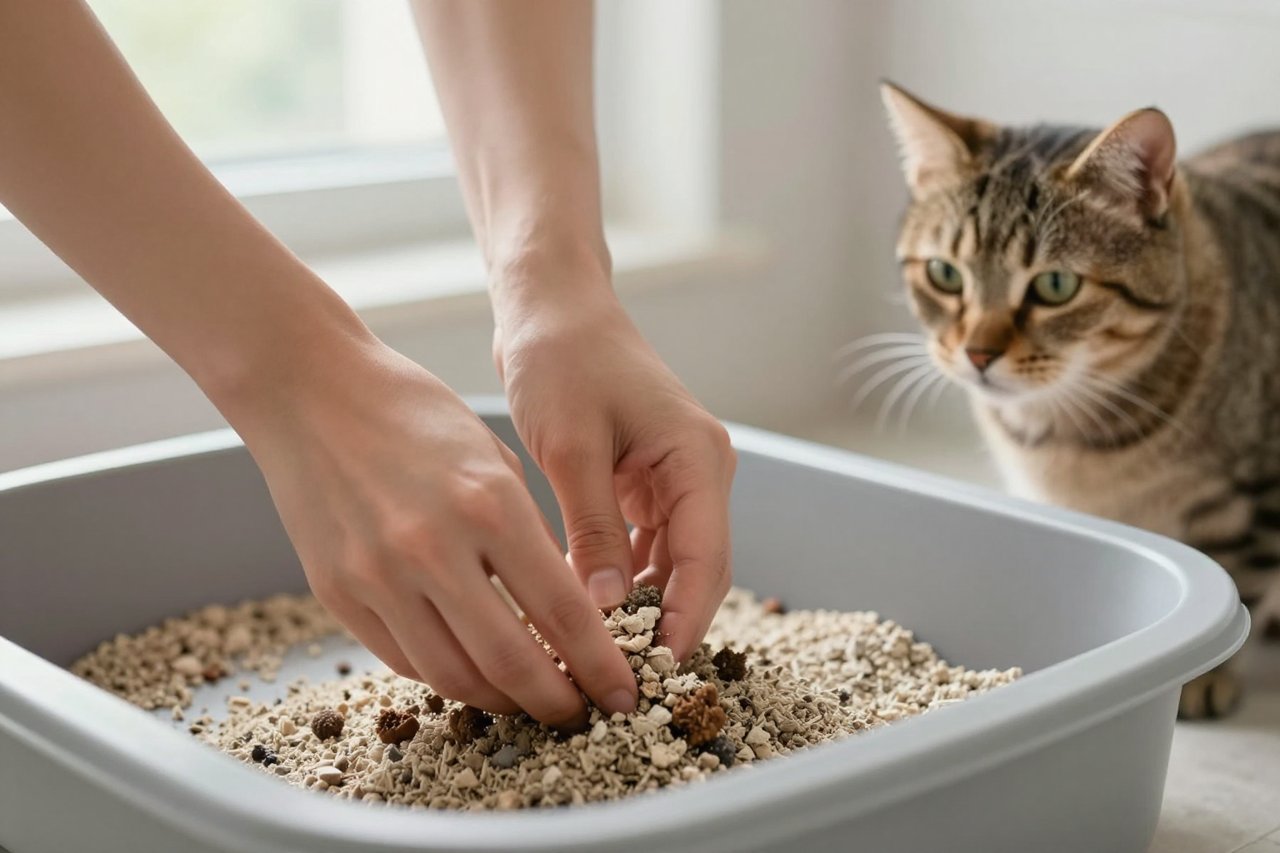
Scooping isn’t just lifting clumps out. Do these four things and a daily pass will keep the box usable for a full week:
- Remove every solid clump and piece of waste, including the small broken fragments that fall through the slots.
- Stir the remaining litter so the clean grains redistribute across the bottom.
- Top up to maintain 2 to 3 inches of depth. Shallow litter lets urine reach the plastic, where it cakes and holds odor.
- Wipe the inside rim and the scoop itself if anything has stuck there.
Litter depth is the detail most people skip, and it’s the one that stretches your litter budget. A well-maintained 3 inches of clumping litter absorbs liquid before it hits the base of the box, so the box stays cleaner between full changes.
How Often to Change the Litter Completely
This depends heavily on what’s in the box. Non-clumping litter cannot be scooped properly because there are no clumps to remove, so urine saturates the whole bed of litter and it needs dumping far more often.
- Clumping clay: every 1 to 2 weeks. Weekly in a multi-cat home.
- Non-clumping clay: every 3 to 5 days. There’s no way around this one.
- Pine pellets: every 1 to 2 weeks. Sift out the sawdust that forms as pellets break down, and top up the intact pellets.
- Silica crystal litter: every 2 to 4 weeks. Stir it daily so the crystals keep drying evenly and don’t sit saturated at the bottom.
- Tofu, corn, and paper-based litter: every 1 to 2 weeks, similar to clumping clay but often with more tracking and faster breakdown.
One reliable signal: if you can smell the box from more than a metre away when it’s otherwise clean, the litter has passed its useful life regardless of what the calendar says.
Washing the Box Itself
Emptying the litter doesn’t clean the plastic. Urine leaves a residue in the microscopic scratches that form over months of scooping, and that residue is what keeps the box smelling stale even after a fresh bag of litter goes in.
Once a month, take the box outside or to a bathtub, empty it fully, and wash it with warm water and a few drops of mild unscented dish soap. Scrub with a dedicated brush that never touches your dishes, rinse thoroughly, and let it dry completely in the sun if you can. Skip bleach, ammonia-based cleaners, and anything heavily perfumed. Cats have an outstanding sense of smell and an understandable objection to a box that reeks of lavender.
Plastic boxes should be replaced every 12 to 18 months. Once the surface feels rough or chalky when you run a hand across it, it’s holding bacteria no amount of scrubbing will reach. Stainless steel pans cost more up front and last for years.
Signs Your Cat Thinks You’re Falling Behind
Cats rarely complain loudly. They send signals, and most of them are easy to miss if you’re not watching for them:
- Hovering over the litter rather than settling, or balancing on the rim with all four paws.
- Bursting out of the box the second they finish, sometimes with a shake of the paws.
- Eliminating just outside the box, on a bath mat, or on laundry. Soft absorbent surfaces feel cleaner underfoot.
- Scratching the floor or wall beside the box instead of the litter.
- Crying or pacing near the box before using it.
- A strong ammonia smell when you open the door to the room.
Any of these is worth a week of twice-daily scooping and a full litter change before you assume the problem is behavioural. In many cases, it is the box.
The Multi-Cat Maths
The standard rule is one box per cat, plus one. Two cats means three boxes. Three cats means four. This isn’t a marketing trick; it’s because cats in the same household often prefer not to share, and a subordinate cat will avoid a box that a more confident cat has claimed.
In a three-cat household, you’re looking at roughly fifteen deposits a day across four boxes. Scoop twice, change all the litter weekly, and spot-wash the boxes monthly. It sounds intensive until you do it for a fortnight and realise each pass takes under two minutes.
When to Clean More Often Than the Baseline
Several situations call for a tighter schedule:
- Kittens: small bladders, more frequent trips, and a higher chance of missing the target.
- Senior cats with arthritis: they may struggle to climb into a high-sided box, so keep the entry low and the litter shallow and extra clean.
- Cats with diabetes, kidney disease, or hyperthyroidism: these conditions increase urine volume substantially. Some cats on diuretics will need a full litter change every three or four days.
- Pregnancy in the household: toxoplasmosis is a real concern. Have someone else handle the box if possible. If not, wear gloves and change clumping litter daily, since the parasite’s eggs need 24 to 48 hours in the environment before they become infectious.
A Sixty-Second Test That Settles It
Walk into the room where the box lives, get down to about knee height, and take a slow breath. If you catch anything beyond a faint scent of the litter itself, it needs attention today, not at the weekend. Cats experience that same air at nose level every time they step in.
Put a sealed waste pail and a scoop caddy right beside the box, and the daily pass stops feeling like a chore. Two sixty-second visits beat one grim three-minute session every time, and your cat will notice the difference long before you do.


