
Table of Contents
Most kitchens have a jar of oregano in them that stopped tasting of anything roughly two summers ago. You keep using it because it’s there, and because throwing out a nearly-full jar feels wasteful. So the pasta sauce gets a spoonful of green dust and you wonder why it’s flat.
Dried herbs and spices are concentrated flavour, but only while their volatile oils stay inside them. Store them badly and those oils evaporate or oxidise within weeks. Store them well and a modest supermarket jar can hold its character for a year or more. The difference isn’t expensive equipment. It’s a handful of habits.
What’s actually happening inside an old jar
A spice is plant material loaded with aromatic compounds. Those compounds are volatile, which is exactly why they smell good and why they don’t stick around. Once the oils oxidise, you’re left with cellulose, colour and a faint memory of the original thing.
Ground spices suffer worst because grinding multiplies the surface area exposed to air. A whole nutmeg can sit in a cupboard for three years and still grate into something fragrant. The same nutmeg, pre-ground, will be noticeably dull by month eight. Leafy herbs such as basil, dill and parsley are the most fragile of all: they lose their colour first, going from green to grey-olive, then their flavour.

Nothing here is a food safety issue. A five-year-old jar of cinnamon won’t hurt you. It will simply contribute nothing, and you’ll compensate by adding more, which changes the texture of a dish without improving the taste.
Light, heat, air and moisture do the damage
Light
Ultraviolet light breaks down the pigments that make paprika red, turmeric gold and saffron scarlet. That’s why a fading colour is such a reliable warning sign. Clear jars displayed on an open shelf look wonderful and are close to the worst possible storage for anything you plan to keep longer than a month.
Heat
Every 10°C of extra warmth roughly doubles the rate of the chemical reactions that flatten a spice’s aroma. A cupboard directly beside the oven, or the shelf above the hob, is a warm place that gets warmer every time you cook. It is the single most common mistake in home kitchens.
Air
Oxygen is the other half of oxidation. A half-empty wide-mouth jar holds a lot of air, and every time you open the lid you swap the atmosphere inside for a fresh batch. Decanting a large bag into one enormous jar is worse than splitting it into three small ones.
Moisture
Steam is the quiet killer. Shaking spice into a pot over boiling water, using a damp measuring spoon, or storing jars above the kettle all introduce water. The first sign is clumping; the second is mould in a jar of ground coriander you thought was fine.
The container matters more than you’d think
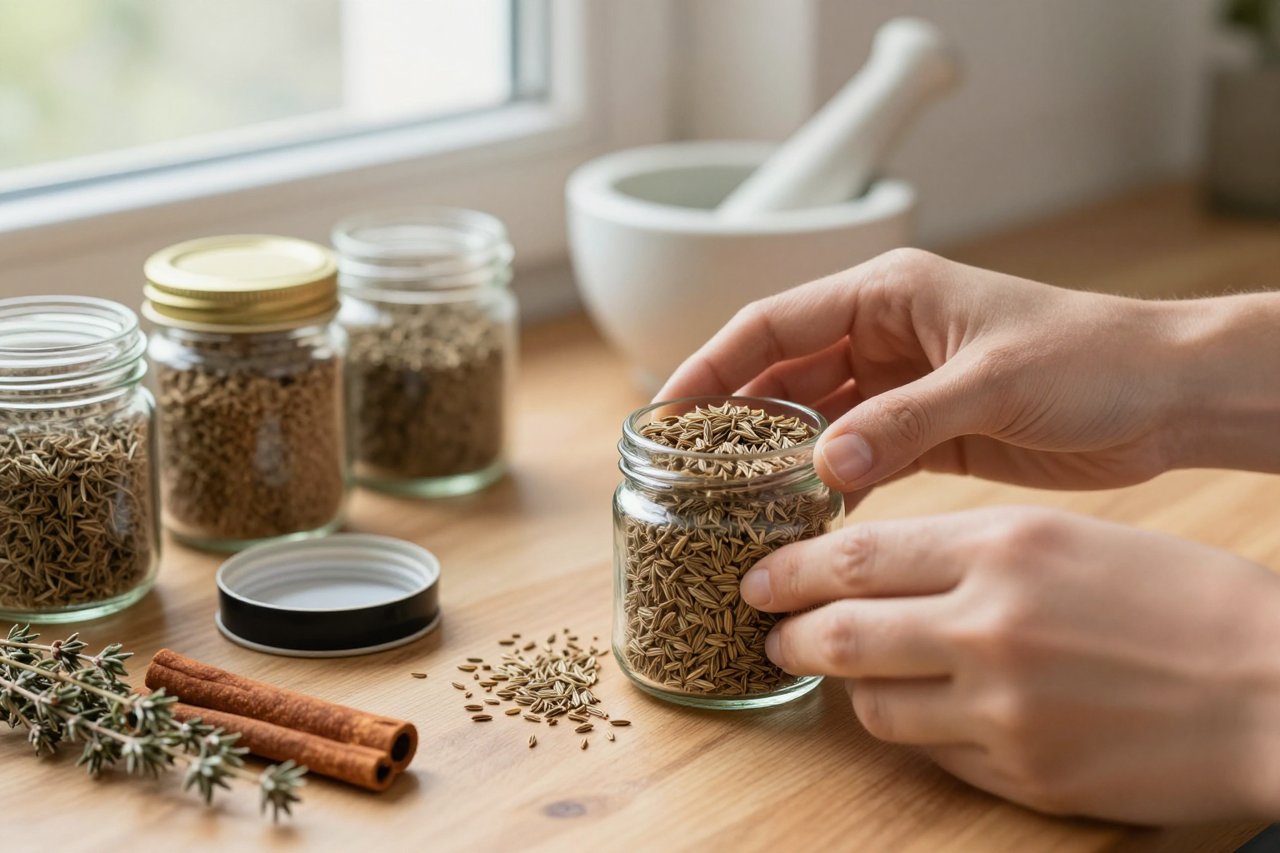
Airtight, opaque-ish, and correctly sized. Small glass jars with screw lids or clamp seals work well, and dark glass is better still. Metal tins are excellent for blocking light, though strong-smelling spices can pick up a metallic edge over a couple of years. What you want to avoid:
- Bags folded over with a clip, which let air in and spill constantly
- Decorative open-topped jars with a spoon jammed in them
- Big catering tubs kept for daily use, where the headspace is mostly air
- Anything plastic that has held something pungent before, unless it’s food-grade and properly washed
- Shakers with wide holes, which dispense too fast and let in damp air
Keep the jar, ditch the tub
Supermarket jars are usually fine if the lid still seals properly and there’s no rust around the rim. Large 500g catering packs are not. Buy big to save money, then split the contents into two or three smaller jars, keeping one in the kitchen and the rest sealed away somewhere cool.
Where in the kitchen they should live
Cool, dark, dry, and as far from the hob as the room allows. A closed cupboard on the far side of the kitchen beats a beautiful rack next to the stove every time. A shallow drawer with a divider works beautifully if you’re short of wall space, since it stays dark and doesn’t collect steam.
If you’re building a collection from scratch, there’s a sensible order of priorities in this guide to buying culinary spices and storing them well: buy fewer, buy whole where you can, and keep them where you’ll actually reach for them.
The fridge and freezer exceptions
Most spices don’t need refrigeration and will suffer from the humidity every time you take them out. A few benefit: paprika, chilli powder and turmeric hold their colour far longer in the fridge, and anything you buy in bulk can go in the freezer in a sealed bag for years. Let a frozen jar come fully to room temperature before opening it, or condensation will form inside the lid.
Ground spices fade much faster than whole ones
As a rough guide to how long flavour actually lasts rather than how long the jar stays safe to eat:
- Whole spices (peppercorns, cumin seeds, cloves, cinnamon sticks, nutmeg): two to four years
- Ground spices (cumin, coriander, cinnamon, turmeric): six to twelve months at peak, usable beyond
- Sturdy dried herbs (rosemary, thyme, bay, oregano): one to two years
- Delicate dried herbs (basil, dill, parsley, chives): six to twelve months
- Spice blends: three to six months, since they’re ground by definition
This is the strongest argument for buying whole spices and grinding them as needed. A coffee grinder or a mortar earns its place fast, and toasting seeds before grinding deepens the flavour in a way no jar can preserve. There’s more on matching each spice to the right moment in the pot in this breakdown of what to buy and when to add it.
Write the date on the bottom
You will remember what’s in the jar. You will not remember when it went in. A strip of masking tape on the base with the month and year takes four seconds and settles every future argument about whether the cumin is worth using. Shop-bought jars usually carry a best-before date on the base too, though that’s a quality date rather than a flavour guarantee.
The five-second test before you cook
Tip a pinch into your palm and crush it with your thumb. A live spice releases a clear smell straight away. If you have to hold it to your nose and guess, it’s finished. For powders, look at the colour against a white plate: dull brown where you expect orange means the paprika is done. For anything borderline, taste a little in a spoonful of plain yoghurt or warm water.
What to do with spices that have gone quiet
Don’t throw them out on principle. A tired spice still has colour and some bitterness, both of which have uses.
- Toast whole spices in a dry pan for 60 to 90 seconds before grinding, which revives more than you’d expect
- Bloom ground spices in oil or butter at the start of cooking, where fat carries aroma that water can’t
- Simmer exhausted spices into stock, brines, poaching liquid or the water you cook rice in
- Blend the dregs of several jars into a house rub or curry mix, then use it within a month
- Add them to a simmer pot with citrus peel when the house needs to smell better than the jar does
If you dry your own herbs, seal late rather than early
Home-dried rosemary and thyme fail for a different reason than shop-bought ones: trapped moisture. A leaf should snap cleanly between your fingers, not bend. Strip the leaves from the stems only after drying, keep them whole rather than crumbled, and leave the jar lid ajar for the first day or two so any residual damp can escape. If condensation appears on the glass, tip everything out onto a tray and give it another few hours somewhere warm and airy.
Buying in bulk without watching it die in the cupboard
Bulk buying is where the savings are, but only if you split the purchase immediately. Portion into small jars, seal the rest in a heavy freezer bag with the air pressed out, and store it dark and cool. If you’ve ever found webbing or small moths in a bag of flour or paprika, put new bulk purchases in the freezer for 48 hours before storing, which kills pantry pest eggs that came in with the shipment.
The ten-minute spice reset
Once a year, empty the whole cupboard onto the counter. Wipe the shelves, since spice dust and condensation build up quietly. Smell every jar, and put anything that fails the thumb-crush test into a ‘use up’ pile rather than back on the shelf. Relabel what survives. Then adopt a one-in, one-out rule for the year ahead: no new jar goes in until an old one comes out, which keeps the collection honest and roughly the size of the space you actually have.
Ten minutes, once a year, plus small jars and a dark cupboard. That’s the whole system, and it’s the difference between cooking with cumin and cooking with brown powder.


