
Table of Contents
Your phone runs roughly a billion operations a second and never breaks a sweat, and it does all of them with one stubbornly simple alphabet: zeros and ones. A quantum computer also uses two states, but it handles those states in a way that would look like a manufacturing fault to any classical chip designer. A qubit pushed into superposition sits in a weighted blend of both states until you measure it. That single difference ripples outward into the hardware, the programming model, the error budget, and the kinds of problems each machine can realistically attack.
Bits and Qubits Are Different Kinds of Objects
A classical bit is physical but forgiving. It might be a capacitor holding charge on a memory chip, a magnetic domain on a hard drive, or a voltage level inside a processor. It is definitively 0 or 1, and you can read it, copy it, and back it up as many times as you like without altering it.
A qubit is a quantum system coaxed into two usable levels: the spin of an electron, the energy state of a superconducting loop, the polarization of a photon. Its condition is described by amplitudes rather than a definite value. Measure it and you get a single 0 or 1, but the probability structure collapses the instant you look. You also cannot clone an unknown qubit. That no-cloning rule isn’t a limitation engineers forgot to fix; it’s baked into the physics, and it shapes everything from error correction to how you debug a program.
Scaling makes the contrast sharper. Three classical bits hold exactly one of eight possible values at any moment. Three qubits hold a weighted superposition of all eight, described by eight complex amplitudes. Add ten more qubits and the classical bookkeeping needs more than 32,000 amplitudes. That exponential growth is why simulating a 50-qubit circuit already strains the best supercomputers on Earth.

Superposition Is Not “Trying Every Answer at Once”
That phrase shows up in almost every explainer, and it quietly sets the wrong expectation. A quantum algorithm does not sift through every possible answer and hand you the right one. You get exactly one measurement, one bit string. The useful work happens through interference: amplitudes for wrong answers cancel out, amplitudes for correct ones reinforce. Designing a quantum algorithm is largely the art of arranging that cancellation.
Grover’s search algorithm shows the ceiling clearly. Searching a list of 100 million entries classically takes about 50 million checks on average. Grover’s does it in roughly 10,000 steps. That’s a genuine quadratic speedup, and it is nowhere near the fantasy of infinite parallelism. For some problems, like factoring large numbers with Shor’s algorithm, the advantage is exponential. For most everyday computing tasks, there is no advantage at all.
Entanglement Has No Classical Equivalent
Two entangled qubits share a joint state that cannot be written down as two separate descriptions. Measure one and you instantly know something about the other that you could not have known beforehand, and the correlation is stronger than any classical hidden-variable explanation allows. Bell test experiments have confirmed this for decades.
Entanglement is also the raw material for quantum error correction, which spreads one logical qubit across many physical ones so that a single failure doesn’t destroy the information. It’s equally the reason these machines are hard to build, because entanglement leaks into the surrounding environment and returns as noise. Small engineering choices, such as a simple design twist in how qubits are coupled together, can meaningfully extend how long those fragile correlations survive.
The Hardware Could Not Look More Different
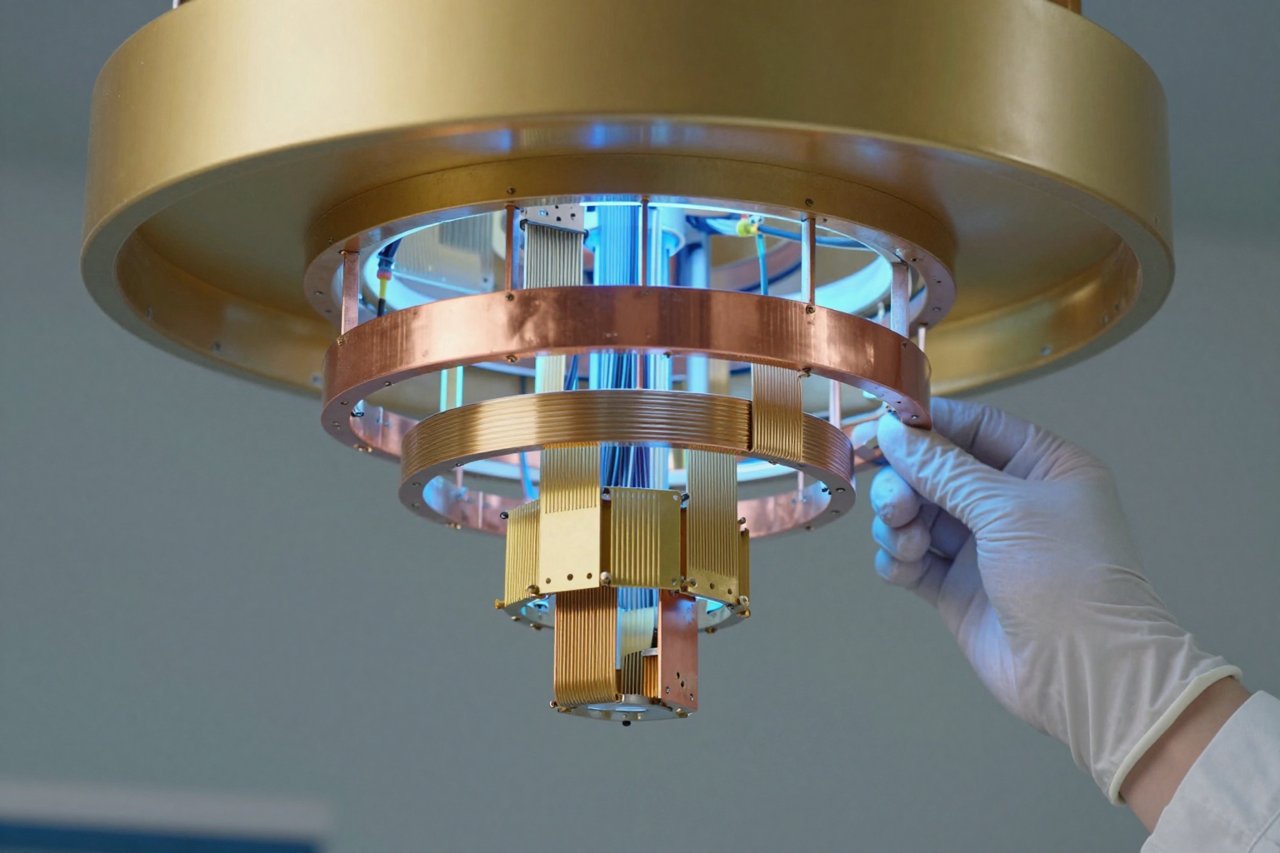
Inside a superconducting quantum computer
Most leading machines hang inside a dilution refrigerator, a nested stack of gold-plated plates and coiled wiring that cools the chip to around 15 millikelvin. That is colder than the cosmic microwave background at 2.7 kelvin, colder than anything naturally occurring in the universe. Each qubit is a tiny circuit resonating in the 4 to 8 gigahertz range, manipulated with microwave pulses and read out through the same wiring. Coherence times, the window before a qubit forgets its state, are measured in microseconds to a few hundred microseconds.
Inside the laptop on your desk
Silicon at room temperature, billions of transistors patterned at a few nanometres, and an error rate so low it’s effectively zero for a single operation. Engineers treat electricity here as a commodity. Nobody schedules maintenance around a transistor losing coherence. Some teams are trying to close the gap with optical approaches, and tiny light rings used as quantum hardware point toward a future where at least part of the stack behaves more like photonics than like cryogenics.
What Each Machine Is Genuinely Better At
- Molecule and material simulation: predicting how electrons behave in a catalyst or a battery electrolyte, which is exponentially expensive on classical hardware.
- Factoring and discrete logarithms: Shor’s algorithm threatens RSA and elliptic-curve cryptography once error-corrected machines get large enough.
- Structured optimisation and sampling: narrow classes of problems in logistics, finance, and physics that map cleanly onto qubit architectures.
- Classical machines: everything else, including your spreadsheet, your video call, your database query, and 99% of the code running in the world right now.
Chemistry is the application with the shortest path to usefulness, because nature is quantum mechanical and simulating it with classical approximations is inherently lossy. Work on quantum-enhanced supercomputers tackling chemistry problems has already produced results that classical methods struggle to match, even if the systems remain small.
Error Rates Rewrite the Scorecard
Here is the number most headlines skip. A good superconducting qubit has a two-qubit gate error rate around 1 in 1,000. A classical transistor is closer to 1 in 1015. That gap of roughly twelve orders of magnitude is why a 100-qubit chip is not a 100-qubit computer. Useful algorithms need error correction, and error correction needs many physical qubits to protect one logical qubit. Estimates for breaking RSA-2048 sit around 20 million noisy qubits running for several hours, not the few thousand chips announced at press events.
Some researchers sidestep the problem by avoiding universal quantum computing altogether. Analog approaches that map a problem directly onto a physical system can be far easier to build, and progress in silicon-based analog quantum simulation suggests that useful results may arrive before fully fault-tolerant machines do.
Where the Two Worlds Are Starting to Blend
Very few quantum programs are pure. The dominant model today is hybrid: a classical processor handles the setup, the optimisation loop, and the data handling, while a quantum processor handles a specific subroutine inside that loop. National laboratories are wiring quantum processors into high-performance computing clusters the same way they once added GPUs. Industry watchers tracking technology radar trends have flagged this integration as the more consequential story, since a quantum chip that sits on a bench is a research project while one plugged into a supercomputer is infrastructure.
Reading Quantum Headlines Without Being Fooled
Three questions separate a real milestone from a press release. First, is the claimed advantage checked against the best classical algorithm, or against a deliberately weak baseline? Quantum supremacy demonstrations have been beaten by classical simulations within a few years, twice.
Second, are the qubits physical or logical? A logical qubit that survives error correction is worth hundreds of physical ones, and very few labs have demonstrated even a single reliable logical qubit that outperforms its constituent parts.
Third, does the problem matter to anyone outside the field? A random circuit sampling result proves the hardware works. It doesn’t help design a drug or schedule a supply chain. The honest state of play in the mid-2020s is that quantum computers are real, expensive, and improving fast, while remaining specialised instruments rather than replacements for the machine you’re reading this on. They don’t compete with your laptop. They sit beside it, in a different building, at a temperature your laptop would not survive for a millisecond.


