
Table of Contents
Plenty of people say they want to rap. Very few finish a song. That gap is the entire game. The rappers who get anywhere, including the ones who never leave their home city, are the ones who sat down on a Tuesday night and wrote sixteen bars when nobody was watching.
There’s no application form and no gatekeeper waiting to tap you on the shoulder. Rapping is a craft you build in public, one average verse at a time, and the entry cost is lower than most hobbies. Here’s what the process actually looks like, minus the fantasy version.
Start writing before you feel ready
Nobody’s first verse is good. Not yours, not anyone’s. The first fifty will be rough, and that’s the point, because writing is a muscle that only responds to repetition.
Write badly on purpose
Set a rule you can genuinely keep: sixteen bars a day, no editing while you write. Open the notes app on the bus, in a queue, on a lunch break. You’re training your brain to produce on demand instead of waiting for inspiration to arrive on a cloud.

Learn to finish things
An unfinished verse is worth nothing. Give yourself 48 hours to write, record and export a demo, even if the mix sounds like it was recorded inside a tin can. Volume beats perfection early on. You can re-record a great song badly; you can’t rescue a song that never got finished.
Study flow like a musician, not a fan
Anyone can memorise lyrics. Far fewer people can hear what’s happening rhythmically underneath them. Take a song you love, count the bars, then map where the rapper lands ahead of the beat and where they sit behind it. That push and pull is the pocket, and it’s usually the difference between sounding professional and sounding like karaoke.
Practical drill: rap the same eight-bar verse over three different tempos. Try a triplet cadence, then a straight one. Record it and listen back with headphones, wincing as required. Studying the people at the top of the field helps too, and this breakdown of the best rappers and most famous rap artists of all time is a decent starting map for whose technique is worth pulling apart.
Find a voice that could only be yours
Generic rap is invisible. The details that make people remember you are usually the ones you’re tempted to leave out: the specific street, the specific shift pattern, the specific family situation. Regional accents that new rappers try to sand off are often the exact thing that gets them noticed.
Here’s a test. Write a verse about a real day you had last week. Name the bus route, the price of the thing you bought, the shop it came from. Specificity reads as confidence, and confidence is half of what an audience responds to.
Build a home setup for under $300
You don’t need a studio. You need a room that isn’t a bathroom and a microphone that isn’t your phone’s built-in one. This is enough to make records people will actually stream:
- A condenser mic: the Audio-Technica AT2020 sits around $99 and handles rap vocals perfectly well.
- An audio interface if you go the XLR route: a Focusrite Scarlett Solo costs about $120 and ships with recording software.
- Closed-back headphones at $50 to $80. You need to hear yourself, not your flatmate’s TV.
- A pop filter and mic stand: roughly $25 combined. Plosives kill more takes than bad writing does.
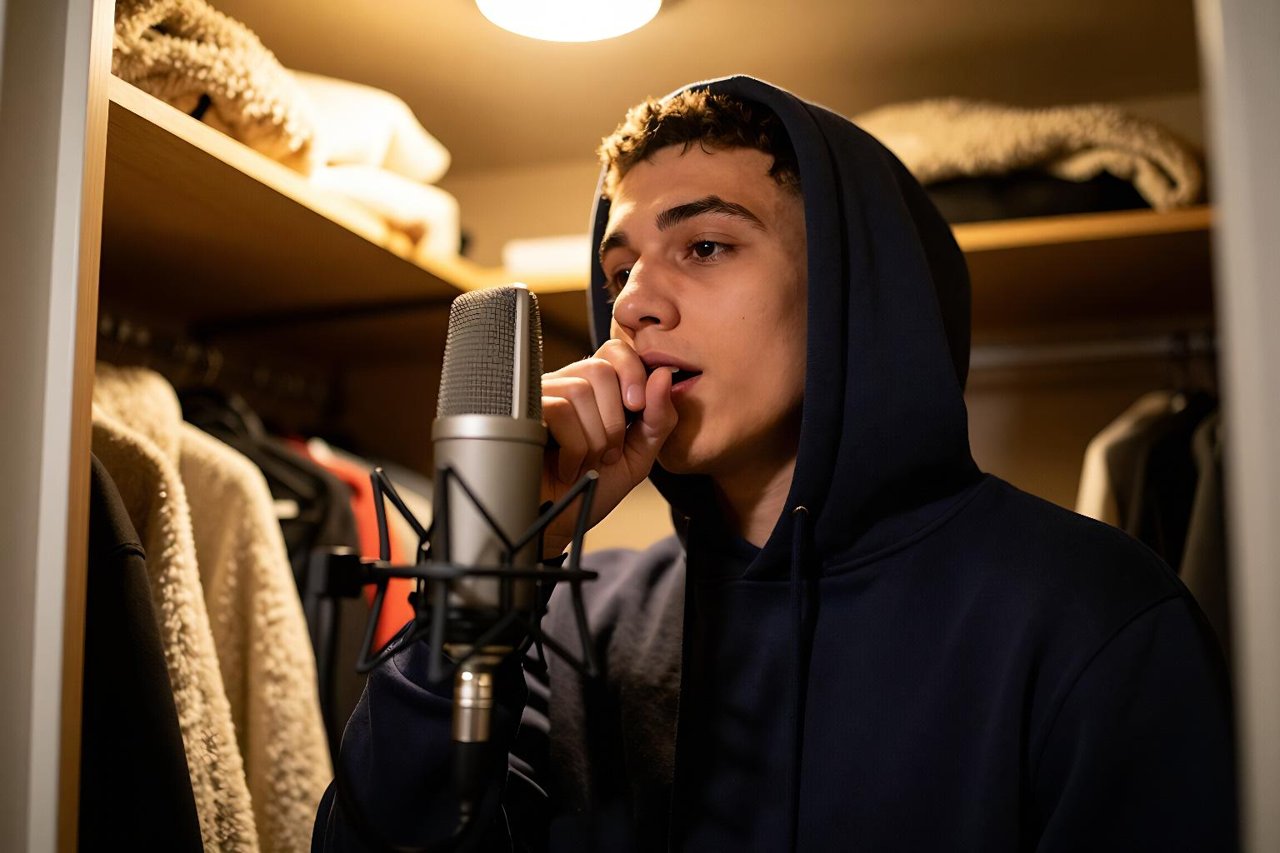
- Something to absorb reflections: a duvet hung behind you, or record inside a wardrobe full of coats. Costs nothing.
Free software gets you further than you’d expect. GarageBand, Audacity, or Reaper (about $60 for a licence after an unlimited trial) will capture a clean vocal. A rapper’s needs are simple: a quiet room, a decent take, and a compressor doing gentle work.
Get in rooms with other rappers
Rap is a social sport. Open mics, local cyphers, youth clubs, Discord servers built around beat packs, anywhere you can stand in a circle and take eight bars. You will be nervous and you will be average, and then one night you won’t be.
Collaboration also solves a boring problem. Every feature puts your voice in front of someone else’s audience for free. Send beats back and forth, jump on a friend’s hook, show up to the shows nobody’s asking you to attend yet.
Release music on a schedule, not a mood
Distribution is the easy part now. DistroKid runs about $23 a year for unlimited uploads, Amuse has a free tier, TuneCore charges per release. Pick one, upload, and claim your Spotify for Artists profile the same day.
What separates the people who build something from the people who don’t is cadence. One or two tracks a month for a year is twelve to twenty-four songs, which is a catalogue. A single every eight months is a hobby with a SoundCloud account.
Learn the unglamorous details as well: consistent artwork, a clean artist name that’s actually available, correct metadata, and a hook audible inside the first fifteen seconds. Most skips happen before the verse even starts.
Grow an audience without becoming spam
Short-form video is the cheapest distribution that has ever existed. Film a thirty-second clip of one bar, recorded on the walk somewhere. Post the process, not just the product: the take that went wrong, the beat you nearly deleted, the verse you rewrote four times. People follow people, and a finished song on its own tells them nothing about you.
One rule worth keeping: reply to comments for the first hour after posting, and ignore anyone who tells you to buy followers.
Know what the money actually looks like
Streaming pays somewhere between $0.003 and $0.005 per stream. A hundred thousand streams is a few hundred dollars, not a living. If you want the numbers behind the headlines, this look at musicians’ net worth and the real story behind the six-figure headlines is a sobering read.
The serious income sits elsewhere: live shows, merch, features, sync licensing, and teaching. Artists who build lasting wealth tend to run it as a business with several revenue streams, which is basically what this step-by-step playbook on how the richest singers actually get rich lays out.
Ignore the lifestyle until it’s affordable
Music videos full of borrowed cars and rented mansions are marketing, not a scoreboard. Plenty of artists with a million streams are broke because the advance went on a chain. Even the genuinely wealthy treat the flash as a business expense, as this tour through celebrity cars from Jay Leno to Post Malone makes fairly obvious. Your first $500 of income is better spent on a better mic and a mixing course than on a rental for a shoot.
What your first twelve months should look like
Months 1 to 3: write daily, record ten rough demos, perform at three open mics. Release nothing unless one track genuinely holds up.
Months 4 to 6: drop two singles, learn basic mixing (compression, EQ, a touch of reverb, stop there), and start posting clips weekly.
Months 7 to 9: book two support slots or local showcases, arrange three collaborations, and build a twenty-minute set you could perform without thinking.
Months 10 to 12: release a small project of five or six tracks and play a headline show in a hundred-capacity room. Charge for tickets. Even five dollars changes how both you and the audience treat the night.
Do that and by the end of the year you’ll have a catalogue, a modest audience, and an honest answer to whether you’re built for this. That’s more than most people who say they want to rap ever get.


