
Table of Contents
Milo is a 70-pound lab mix who treats the first block of every walk like the start of the Iditarod. His owner has the technique down to a science: right arm braced against her hip, left hand gripping the loop, heels dug in. It works, sort of. She gets 20 minutes of walking and 40 minutes of water skiing.
If that sounds familiar, you’re in good company. Leash pulling is the most common reason people call a trainer, and the fix has surprisingly little to do with strength. It’s about teaching a dog that a loose leash is the only thing that gets him where he wants to go.
Why Dogs Pull, in Plain Terms
A dog pulls because pulling works. Every time the leash goes tight and the human follows, the dog learns that forward pressure is the price of forward motion. That’s a slot machine that pays out on every single pull.
There’s also a reflex at play. Pull a dog backward and his opposition reflex kicks in, so he leans harder into the collar. Yanking the leash to stop pulling is a bit like pushing a door that says pull.

Then there’s speed. A relaxed dog on a sniff-heavy walk covers ground at roughly 2 to 3 mph with frequent stops, and a determined dog moves faster than you do. You are, physically, the slowest thing on the walk.
Swap the Retractable Lead Before Anything Else
If you’re using a retractable lead, change that first. These leads sit under constant tension, so your dog spends every walk learning that a tight line is the normal state of affairs. He never finds out what “loose” feels like. They’re also genuinely risky: a 16-foot cord can open a leg or snap a finger if a squirrel appears.
A fixed 5 or 6-foot lead gives your dog room to sniff without enough rope to build real speed. Leather or a climbing-rope style, doesn’t matter much. Just make it a fixed length.
Gear That Makes Training Easier
Equipment won’t train the dog for you, but the wrong gear makes every session harder than it needs to be.
- Front-clip harness. The leash attaches at the chest, so a forward surge turns your dog back toward you. It won’t stop pulling, but it cuts the force on your shoulder dramatically while you teach the behavior.
- Head halter. The most effective mechanical option for a hard puller. Introduce it slowly, 30 seconds indoors with treats, then a few minutes, then short walks. Most dogs accept one within a week if you don’t rush.
- 6-foot flat lead. Cheap, simple, clean feedback.
- Skip: prong and choke collars. They can suppress pulling fast, but they pile pain onto a dog who may already be uneasy about the world, and uneasy dogs are the ones who start reacting.
The Be-a-Tree Method, and the Part Most People Miss
The basic drill is simple. The moment the leash goes tight, stop. Plant your feet, say nothing, wait. The instant your dog turns back or the line softens, mark it with a quiet “yes” and step forward.
Where people get stuck is the waiting. The usual advice says to stand there until your dog looks at you, which can take four minutes with a determined husky and teaches nothing except that walks are boring. You’re not waiting for eye contact. You’re waiting for slack. A slight softening in the line is plenty to earn a reward and a step forward.
Two things happen in the first week. Your dog gets frustrated, and your walks get very short. Both are fine. Ten minutes of a dog learning that tension stops the world beats an hour of being towed.
Teach a Default Position, Not Just “Don’t Pull”
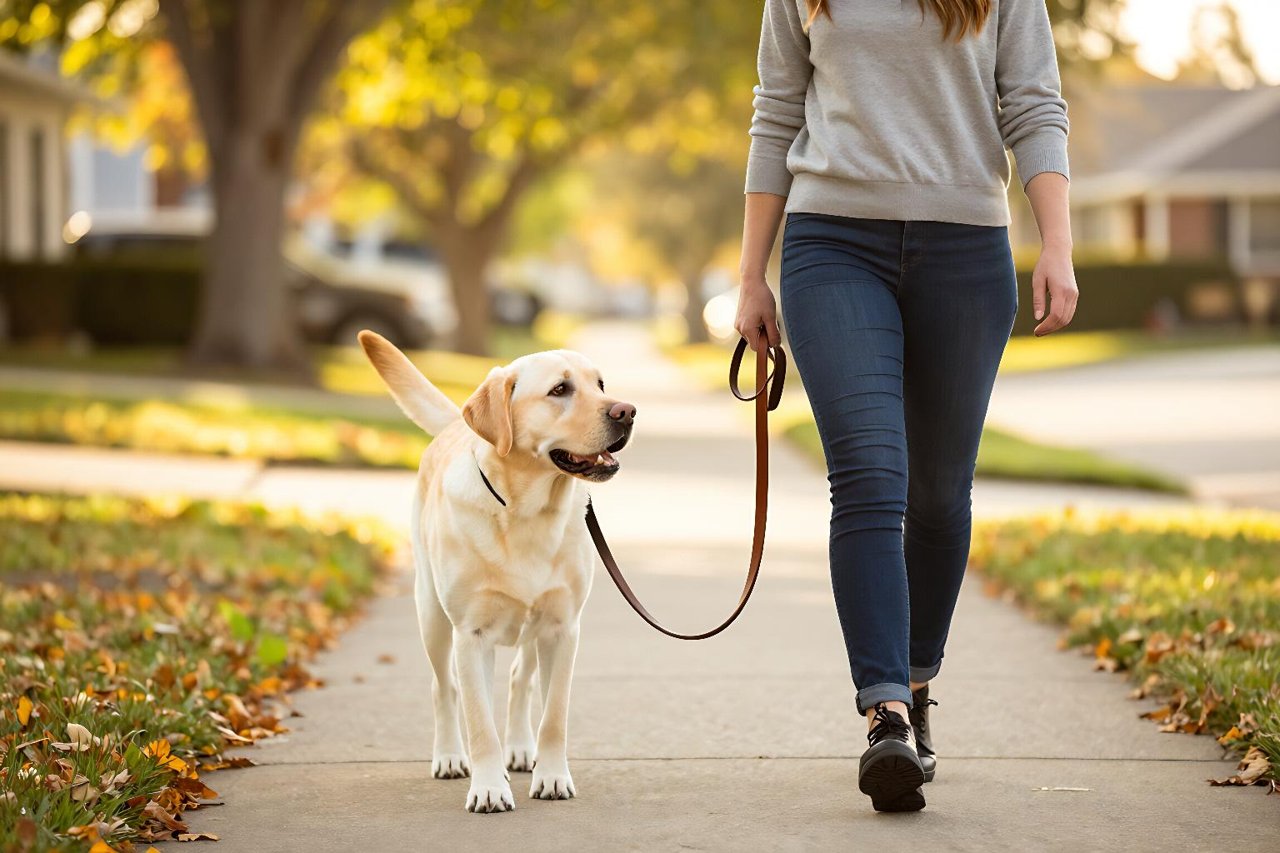
Stopping is half the job. The other half is giving your dog something to do instead, which for most dogs means walking at your left leg with the leash hanging in a J shape.
Build it in the driveway
Hold a treat at your left hip, take two steps, feed. Two more steps, feed. Ten reps, twice a day. When your dog offers the position without the lure, add a quiet cue like “with me” and stretch the gap: reward every three steps, then every five, then every ten. Once he knows the game, unpredictable payouts work better than predictable ones.
Start at the front door
Don’t let the first 10 feet of the walk be a sprint. Open the door only when your dog is standing behind the threshold, and close it the second he surges. It’s the same rule as the sidewalk, just easier to practice. If your dog also mobs visitors at the door, the calm-greeting work overlaps, and these tips on helping your dog behave with guests are a useful companion to leash training.
Turn Around More Than Feels Reasonable
When your dog locks onto something 30 feet ahead, a U-turn beats a leash correction and it avoids a tug-of-war. Say “this way” in a cheerful voice, turn, and walk off. Reward the moment he catches up.
Expect 10 to 15 of these in a single 20-minute walk during the first weeks. That’s not failure. Every turn is a rep that teaches your dog to watch where you’re going.
Build a Distraction Ladder
Dogs don’t generalize well. A dog who walks beautifully in your driveway will not automatically walk beautifully past a terrier on a busy street. Add difficulty in steps using the three Ds: distance, distraction, duration.
Start with distance. Practice 40 feet from a barking dog, not 4, and close that gap over days rather than minutes. A Tuesday morning supermarket car park makes a great intermediate step: motion, noise, and nobody who wants to chat.
Treat value matters more than most people expect. Kibble is fine in your kitchen. Outside, bring boiled chicken, cheese, or freeze-dried liver, and pay well when the environment is hard. If your dog won’t take food on a walk, he’s over threshold and you’re too close to something.
Split Your Walks Into Two Jobs
Trying to combine exercise, training, and sniffing into one outing is where progress stalls. Training walks are short, 10 to 15 minutes, and they’re entirely about the loose leash. Decompression walks are for sniffing, and for those you want a long line in a field or a quiet park where your dog can root around without dragging you. Twenty feet of line gives him freedom and still keeps him under control, and if you like the idea of keeping tabs on distance and location in bigger spaces, this guide to using a GPS dog leash shows how that works in practice.
When the Leash Goes Tight Because of Another Dog
Some pulling isn’t enthusiasm, it’s worry. If the leash goes tight and your dog also barks, lunges, freezes, or refuses food, the problem underneath isn’t leash manners. Running loose-leash drills in that state just rehearses the meltdown. There’s a solid starting point on reactive and fearful dogs, and a positive-reinforcement trainer is worth the money if the reactions are intense.
The practical version: work at a distance where your dog can still eat a treat and turn his head. That might be 100 feet from another dog at first. Reward every glance at the other dog followed by a glance back at you, and don’t close the distance until he’s relaxed where you are.
Catch the Pull Before the Leash Goes Tight
By the time the line is taut, the decision has already been made. The skill to build is reading your dog’s body: the ear flick, the head lift, the way his weight shifts forward half a second before he launches. That half second is your window.
Use it to ask for something incompatible with pulling, like a hand target or a sit. The cue that does the most work here is a reliable “leave it,” which you can teach in about a week with this method and which covers dropped food, dead squirrels, and the neighbor’s cat with one word.
Your First Week, Day by Day
Progress on leash pulling is boringly cumulative. Five to ten focused minutes a day beats a heroic 90-minute session on Sunday. Here’s a realistic week:
- Day 1: Swap the lead, fit the harness, cut the training walk to 10 minutes. Reward every slack moment, including the accidental ones.
- Days 2 and 3: Work the default position in the driveway, ten reps twice a day.
- Day 4: Add U-turns on a quiet street. It will feel like you’re going nowhere, because you are.
- Day 5: Take one long-line sniff walk so your dog gets real exercise and you both remember why you like this.
- Day 6: Move the position work somewhere mildly distracting, like 40 feet from a park gate.
- Day 7: Skip the drills and just walk.
Most dogs show a visible difference in four to six weeks if the daily reps actually happen. Adolescents in the 8-to-14-month window take longer, because the world is suddenly fascinating and your voice is only mildly interesting. Keep the criteria small, pay generously, and aim for something realistic: not a dog who never notices a squirrel, but a dog who notices the squirrel and still checks in with you before towing you into the road.


