
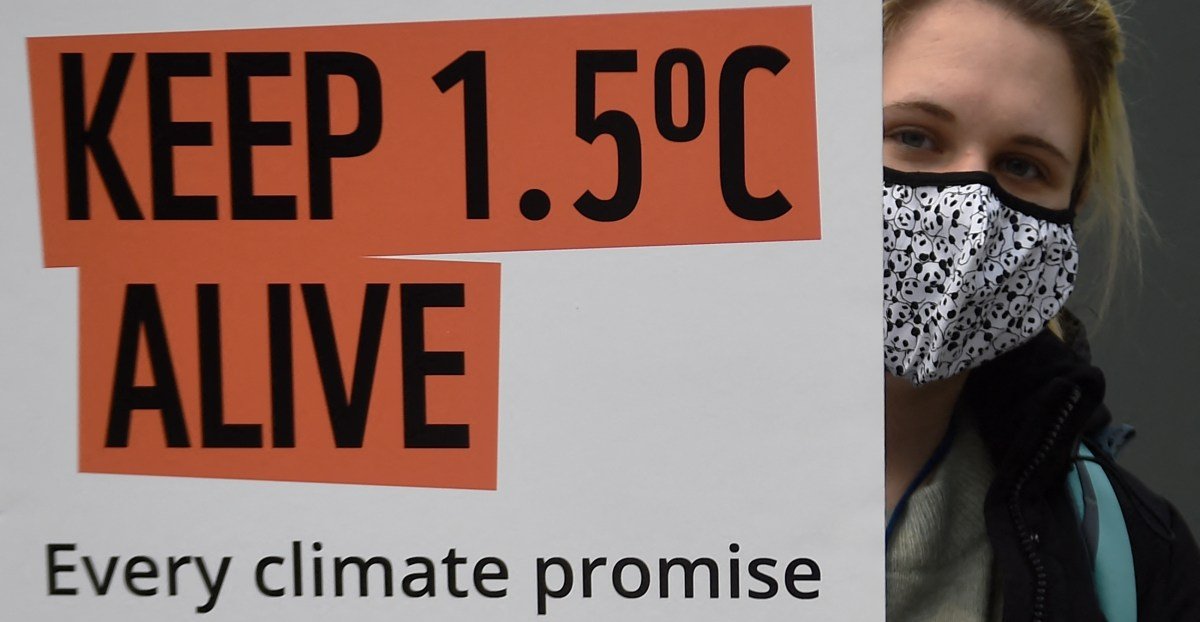
For the last decade, global climate politics have revolved around a single number: 1.5 degrees Celsius.
The idea was that keeping the planet below this warming threshold would hold many of the worst impacts of climate change in a manageable range. Cross it, and the risks rise sharply into uncharted territory.
This year, it became clearer than ever that we will cross it.
- The window of opportunity has closed on the 1.5°C climate target. Though the growth rate of greenhouse gases has started to level off, they would need to decline at an impossibly fast pace to keep the planet from warming more than 1.5°C.
- Overshooting this goal means more severe consequences from warming. Rising global average temperatures mean more extreme heat waves, rising sea levels, severe droughts, and floods. There may also be irreversible “tipping points” in natural systems, such as the loss of ice shelves and forests.
- Adaptation is more important than ever. Humanity will need to learn to live in a warmer world, but there isn’t much research into what exceeding 1.5°C of warming will mean for economics, politics, and society.
- Decarbonization is still underway. Wind, solar, and battery storage are growing rapidly and becoming cheaper than fossil fuels, offering an economic argument for curbing emissions beyond climate change.
- Every bit still matters. Missing the 1.5°C goal doesn’t mean giving up on limiting climate change. Every fraction of a degree of warming that we avoid will save lives, money, and ecosystems.
Climate scientists have been warning for years that we’ve already backed ourselves into a corner where even the most optimistic forecasts of humanity’s efforts to address climate change will breach this threshold. Now this year, even some of the loudest voices calling for global action to curb emissions have begun to drop the pretense.
“Scientists tell us that a temporary overshoot above 1.5 degrees [Celsius] is now inevitable,” UN Secretary-General António Guterres said in November. “And the path to a livable future gets steeper by the day.”
Under the 2015 Paris climate agreement, countries agreed to limit the increase in global average temperatures this century to “well below” 3.6 degrees Fahrenheit (2 degrees Celsius) compared to the start of the industrial revolution. The goalpost for national commitments to cutting emissions of heat-trapping gases was 1.5 degrees C — or 2.7 degrees Fahrenheit.
In 2018, the Intergovernmental Panel on Climate Change, a team of climate change researchers convened by the United Nations, examined the differences between the two benchmarks and concluded that every bit of warming is consequential, and that in general, the hotter it gets, the worse it gets for humanity. Higher average temperatures will lead to more extreme heat waves, higher sea levels, worse droughts in some areas, and more severe floods in others.
However, last month, the UN Environment Programme estimated that the world will overshoot 2.7 degrees Fahrenheit of warming in the next decade based on current trends. To get back on track, global greenhouse gas emissions would have to fall by more than half from current levels in that timeframe, an exceedingly unlikely prospect. The United States, the world’s largest historical emitter of greenhouse gases, is backing away from its climate commitments and actively increasing its extraction of fossil fuels.
With the window closed on staying below 1.5°C, what happens now?
We’re not thinking enough about the world we’re creating
Last year, 2024, was the warmest year humans have ever measured, and 2025 is on track to take second place. These years saw excruciating disasters that killed thousands and drained billions of dollars from the global economy. Years like 2024 will become more common.
The waste from our relentless consumption of coal, oil, and natural gas has already warmed the planet by more than 2 degrees Fahrenheit compared to the 1800s.
This is a world that has already seen sea levels rise by 9 inches on average, contributing to more frequent coastal flooding and more severe storm surges. Coastal communities, home to about 40 percent of the world’s population, would still have to contend with the sea level rise that occurs at high temperatures, even after the planet cools down. Glaciers are disappearing. Heat waves are longer, more frequent, and more intense now than they were decades ago. Extreme precipitation events are pouring out more water. The conditions for major wildfires are combining more often.
As the planet heats up further, these events will get worse.
While 1.5 degrees may not seem like a big increase, it’s important to remember that this is an increase in the average temperature for the whole planet, from the scorching deserts to the icy poles. And an increase in the average means a larger increase in the extremes.
There may also be tipping points in natural systems, where losses to ice shelves and forests reach a point where they perpetuate themselves, accelerating shifts faster than what warming alone would portend.

That has huge implications for where we live, how we get our food, and our quality of life, yet despite these potentially cataclysmic shifts, there has been alarmingly little work done that actually games out the human implications of this world, according to Andrew Kruczkiewicz, a senior researcher at the Columbia University climate school.
“It is becoming increasingly irresponsible to focus only on the physical modeling elements of overshooting [2.7°F/1.5°Cof warming],” Kruczkiewicz said. “We need to start thinking about what the [human] scenarios look like for a post 1.5°C world.”
In a paper published in November, Kruczkiewicz and his collaborators highlighted the factors that would shape the political, economic, and humanitarian consequences of warming. For instance, while it may be possible to get back below 2.7 degrees Fahrenheit of warming after exceeding it — which some of the IPCC scenarios show that it is — we don’t know whether the political will and resources even exist to make that a reality. It would take extreme measures like pulling carbon dioxide straight from the air or massive restorations of carbon-withdrawing ecosystems — an expensive proposition, especially when governments will be paying for more disasters stemming from an even warmer world.
“If you are to look at the trajectory going forward,” said Sanya Carley, a climate policy researcher at the Kleinman Center for Energy Policy at the University of Pennsylvania, “we clearly will be nowhere close to 1.5°C.”
With the window slamming shut on the most ambitious international climate target, some players are starting to rethink their priorities.
Bill Gates, one of the biggest donors to international climate change efforts and a major clean energy investor, said in October that while climate change is an important problem to solve, his focus is shifting toward learning to live better as temperatures rise rather than doing everything possible to stop the planet from heating up. He also said that solving climate change is not necessarily the best way to improve the lives of the world’s poorest.
“Unfortunately, the doomsday outlook is causing much of the climate community to focus too much on near-term emissions goals, and it’s diverting resources from the most effective things we should be doing to improve life in a warming world,” Gates wrote on his website.
Other donors remain intent on curbing emissions. Michael Bloomberg, the UN special climate envoy, last month announced a $100 million investment in efforts to detect and reduce emissions of methane, a greenhouse gas that’s about 30 times more potent than carbon dioxide.
Developing countries that contributed the least to climate change are already suffering its worst consequences, and will face even more destruction as the global temperatures climb upward.
And while wealthier countries have pledged billions of dollars to help poorer nations adapt, it’s a fraction of what the most vulnerable people need to cope with more severe heat waves and deadly floods. Plus, donor countries have a track record of missing funding deadlines. That’s why some developing countries have begun to argue for more financing to develop their own fossil fuel resources.
At the same time, political will to address climate change simply as a matter of protecting the environment is fading in many countries. Major companies are downplaying or backing away from their environmental ambitions as well.
But there is some good news: Wind, solar, and battery storage systems are cropping up at a record pace around the world and are beginning to outcompete fossil fuels in many markets. The prospect of more abundant and cheaper energy to improve standards of living may be the more effective argument for curbing greenhouse gases than keeping a lid on temperatures.
Humanity’s ongoing efforts have already begun to bend the curve, built up unstoppable momentum, and have broken the connection between emissions and economic growth. Thankfully, some of the more extreme warming scenarios are less likely now. However, the transition to cleaner energy will still require a lot of countries and politicians working together, and that will remain a tough task — especially at the moment when countries like the US are erecting trade barriers, while others are in open war.
How much further the planet will warm is a function of how many more greenhouse gases we emit, and that remains the biggest uncertainty in any climate forecast. Though we have missed a major climate goal, every fraction of a degree matters.
Anything we can do to stabilize the climate will benefit the economy and the environment. Missing the 1.5°C target is not an excuse for giving up — it only adds to the urgency of preparing for a world we have not experienced before and preventing the situation from getting even worse.