
Table of Contents
A friend of mine spent six months in a Taekwondo dojang before switching to a Shotokan karate club. His report after week one was blunt: same white uniform, completely different animal. He had a decent spinning hook kick and hips loose enough for a side split, but he could not hold a front stance for ninety seconds without his thighs shaking, and nobody had ever taught him to snap a reverse punch from the hip.
That mismatch tells you more about the karate vs. Taekwondo question than any comparison chart. Both arts come from the same corner of East Asia, both wear coloured belts, both punch and kick. Past that point, the rule sets, the training culture and the physical demands pull in genuinely different directions.
Two arts, two very different birthplaces
Karate grew up in Okinawa, the island chain south of mainland Japan, where an indigenous grappling style called tegumi blended with Chinese boxing brought over by traders. Gichin Funakoshi demonstrated it in Tokyo in 1922, and the mainland version spread through Japanese universities. The name itself means “empty hand.” The main styles you will run into are Shotokan, Goju-Ryu, Shito-Ryu and Wado-Ryu, and they differ enough that a Goju class and a Shotokan class feel like distant cousins.
Taekwondo is much younger. It was formalised in Korea through the 1950s, named in 1955, and shaped heavily by General Choi Hong Hi, who had trained in Japan and earned a Shotokan black belt. The Kukkiwon became the style’s headquarters in 1972, and the sport side grew fast: a demonstration event at Seoul 1988, a full medal sport by Sydney 2000. Karate got exactly one Olympics, Tokyo 2020, then was dropped for Paris 2024. That single fact explains a lot about how the two arts train today.

Kicks: Taekwondo’s home turf
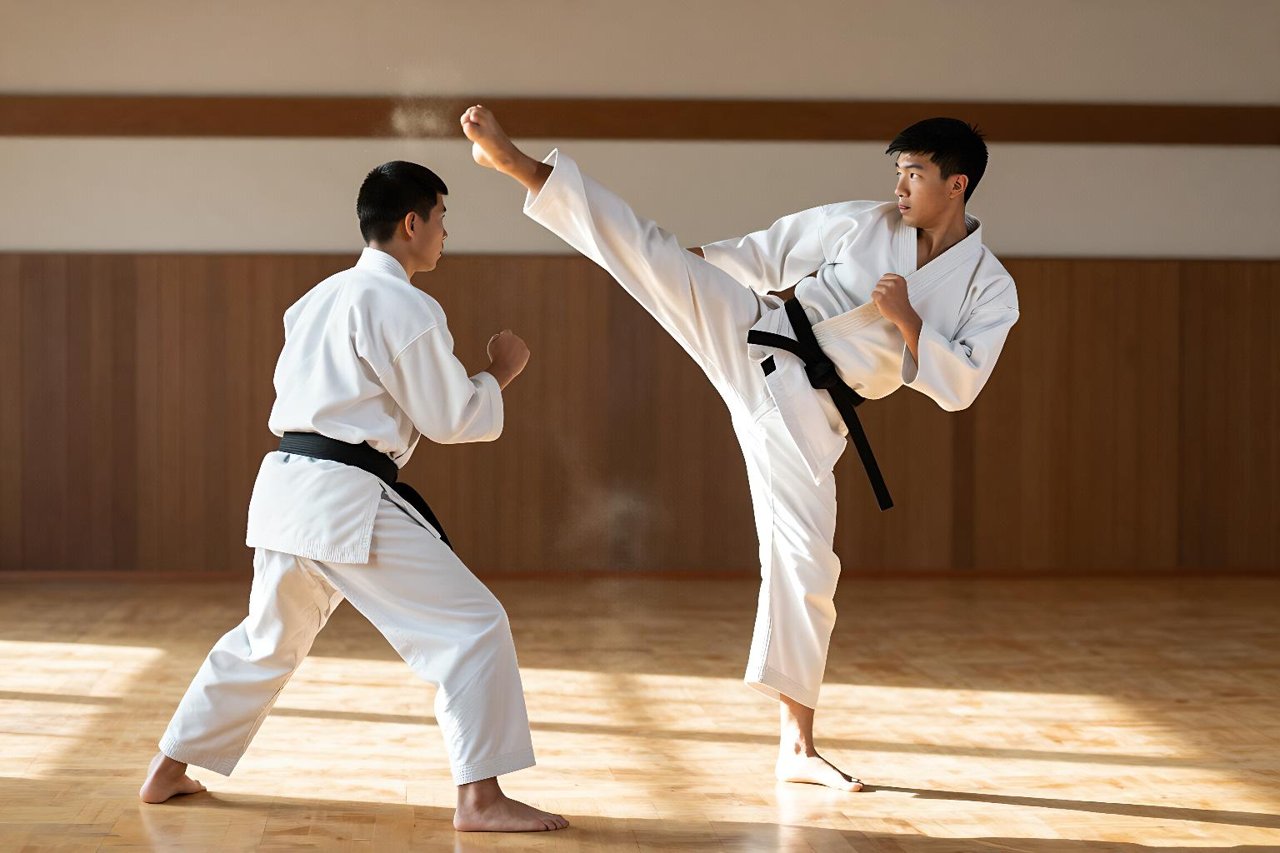
If you want to know which art owns the air, watch a World Taekwondo match. Kicking accounts for the overwhelming majority of scoring techniques, and the points scale pushes athletes toward the spectacular. A basic kick to the body scores two, a head kick three, and a spinning technique can be worth four or five. Punches to the torso earn a single point and land rarely at elite level. Head punches are simply not allowed.
Karate kumite runs on a different rhythm. Under World Karate Federation rules the referee stops and restarts after each score: three points for an ippon, two for a waza-ari, one for a yuko. Bouts are short and explosive, decided by distance, timing and a single clean technique. Karate rewards the first accurate strike, not the fifth.
Style matters here. Kyokushin and its offshoots fight bare-knuckle, full contact, no punches to the head but plenty of leg kicks that leave bruises for a fortnight. A Shotokan club may do almost no contact sparring at all. Taekwondo also splits: WT sport sparring looks nothing like the self-defence drills taught in the same building.
Hands, throws and the messy reality of self-defence
Karate carries more handwork in its curriculum. Reverse punches, knife-hand strikes, forearm blocks, elbow entries and, in Wado-Ryu and Goju-Ryu especially, throws, sweeps and joint locks hidden inside the kata. Whether you ever learn to use them depends on how the club interprets its syllabus. A competition-focused dojo may drill kumite tactics four nights a week while treating bunkai as a box-ticking exercise. That tension between preserving a combat system and winning medals is exactly what the traditional versus modern martial arts debate keeps circling.
Taekwondo’s self-defence component, called hosinsul, is often bolted on near the end of a grading cycle and frequently borrows from Hapkido: wrist releases, lapel grabs, a few takedowns. Useful, but rarely trained against resistance.
Neither art, straight out of the box, is a complete self-defence system. Sport Taekwondo ignores head punches and clinching. Sport karate ignores sustained pressure and ground work. Both give you something valuable anyway: the ability to move, judge distance and stay calm while someone tries to hit you.
Belts, forms and what a normal week looks like
Both use coloured belt systems, both count grades downward toward black, and both use forms as a grading requirement. Karate has kata: the Pinan or Heian series first, then Bassai Dai, Tekki, and higher-level forms. Taekwondo has poomsae: Taegeuk 1 through 8, then the black belt forms Koryo, Keumgang, Taebaek and beyond. Nobody outside the arts can tell them apart in a video, but the body mechanics differ, with karate forms favouring low, grounded stances and Taekwondo forms favouring speed and upright posture.
A typical week splits roughly like this:
- Karate class: fifteen minutes of warm-up and body-weight conditioning, twenty minutes of line drills (blocks, punches, stances), then kata or kumite depending on the night. Expect push-ups, deep stances and a lot of repetition.
- Taekwondo class: skipping and dynamic stretching, footwork drills across the floor, kicking combinations on pads or paddles, poomsae, then sparring. Expect more sweat and more hip work.
- Grading frequency: Taekwondo clubs often grade every two to three months; karate clubs are usually slower, sometimes twice a year.
- Time to first dan: realistically three to five years in either art, and longer if you train twice a week.
Body type, fitness and who gets hurt
Taekwondo is an aerobic, flexibility-hungry art. The best practitioners have mobile hips, long levers and fast twitch fibres, and the training builds exactly that. It is also where the injury data gets uncomfortable: kicking to the head means head contact, and head contact means concussions, even with the padded hogu and helmet.
Karate spreads the load. Holding zenkutsu-dachi for a two-minute drill builds leg endurance the way squats do, kata raises your heart rate without anyone kicking you in the temple, and kumite is short, sharp interval work. Deep stances and heavy hip rotation can aggravate existing knee problems, so mention any old injuries before your first class.
If you are stiff, forty and have never touched your toes, karate will ask less of you early on. If you are a former dancer or footballer with loose hips, Taekwondo will feel like coming home.
For kids, both work, but for different reasons
Taekwondo tends to hold younger children’s attention. Constant movement, kicking drills, pad work and a clear competition ladder keep the energy up, and most WT-registered clubs run proper junior divisions. Karate leans harder on etiquette, bowing, standing still and correcting a stance for the tenth time. Some kids find that boring. Others need it.
Check the sparring rules for your child’s age group before you sign anything. Plenty of karate schools run no-contact or light-contact sparring under twelve, while Taekwondo competition for juniors still involves kicks to the head.
Pick the instructor before you pick the art
Here is the part that gets buried under style arguments: a brilliant Shotokan instructor will beat a mediocre Taekwondo one every time, and the reverse is just as true. The gap between two clubs teaching the same art is usually wider than the gap between the arts themselves.
So watch a class before you commit. Look at the senior students, not the instructor. Are they sharp, controlled and respectful to each other? Does the teacher actually correct people, or does he spend the hour showing off? Ask what the sparring rules are for your age and grade, how many black belts the club has produced, and whether the syllabus leans competitive or traditional. Ask about insurance and instructor certification. Any club that dodges those questions is telling you something.
Try a trial class in each. One hour of Taekwondo footwork and one hour of karate line drills will settle the karate vs. Taekwondo question faster than a hundred forum threads. Most people know within twenty minutes which one they want to come back to, and that instinct is worth trusting more than any list of pros and cons.


