
Table of Contents
Put a boxer and a Muay Thai fighter in the same ring and the mismatch shows up in the first thirty seconds. One is hunting a jab and a new angle. The other is quietly wondering why nobody has kicked the boxer’s lead leg yet. Muay Thai vs. boxing gets framed as a fight between two styles, but the honest difference is simpler: the rulebook decides what is allowed, and everything else, from your stance to your cardio, follows from that.
Both are stripped-down striking arts with weight classes, rounds and referees. Both will get you fitter than most gym routines ever will. Pick the wrong one for your temperament and you’ll spend six months learning a game you don’t enjoy playing.
Rules first, because they explain everything else
Boxing is hands only, above the belt, to the front and sides of the head and torso. No kicks, knees, elbows, throws or hitting someone on the canvas. Clinching is tolerated for a beat before the referee steps in and restarts you at distance.
Muay Thai allows punches, kicks, knees, elbows and sweeps, plus a standing clinch where you can land knees and dump your opponent. In Thailand, fights run five rounds of three minutes with two-minute breaks. Most amateur and Western promotions use three rounds of three. Either way, you have to manage eight weapons and one entire phase of the fight, the clinch, that boxers never train.

That single rule change tilts the whole sport. Because kicks are legal, the Muay Thai stance is squarer and more upright. Because elbows are legal, the guard sits tighter and higher. Because the clinch is legal, conditioning work means wrestling a sweaty human for five minutes, not just running hills.
Lineage, very briefly
Modern boxing grew out of bare-knuckle prizefighting in 18th-century England and turned into a rules-bound sport with gloves, gloves-wearing weight classes and a written code. Muay Thai comes out of Thai military and village fighting, codified in the 20th century and nicknamed the art of eight limbs. Both still carry ritual. Boxing has ring walks and weigh-in theatre; Muay Thai has the wai kru dance and the mongkol headband. If you want to know how much of that older tradition survives as useful training, there’s a solid breakdown of traditional martial arts vs. modern martial arts that covers the divide properly.
Hands versus eight limbs
Boxing owns the deeper hand game, and it isn’t close. Watch a decent amateur for one round and you’ll see levels, feints, half-step pivots and a jab that changes speed three times in ten seconds. If punching technique is what you want to master, a boxing gym will teach it better. Full stop.
Muay Thai punches tend to be shorter and straighter, mostly used to set up kicks or to score while the other person covers. The payoff is variety. A Thai fighter can attack head, ribs, thighs and calves. Six hard low kicks to the outside of the lead leg don’t just hurt, they change how the opponent stands, and once their base is compromised the offence slows down on its own.
The teep is the quiet game-changer
A straight push kick to the hip or stomach, the teep breaks rhythm, keeps pressure off and scores with judges. It’s the closest thing Muay Thai has to a jab in terms of function, and it’s the first thing most boxers get hit by when they cross over.
Gloves change the math too
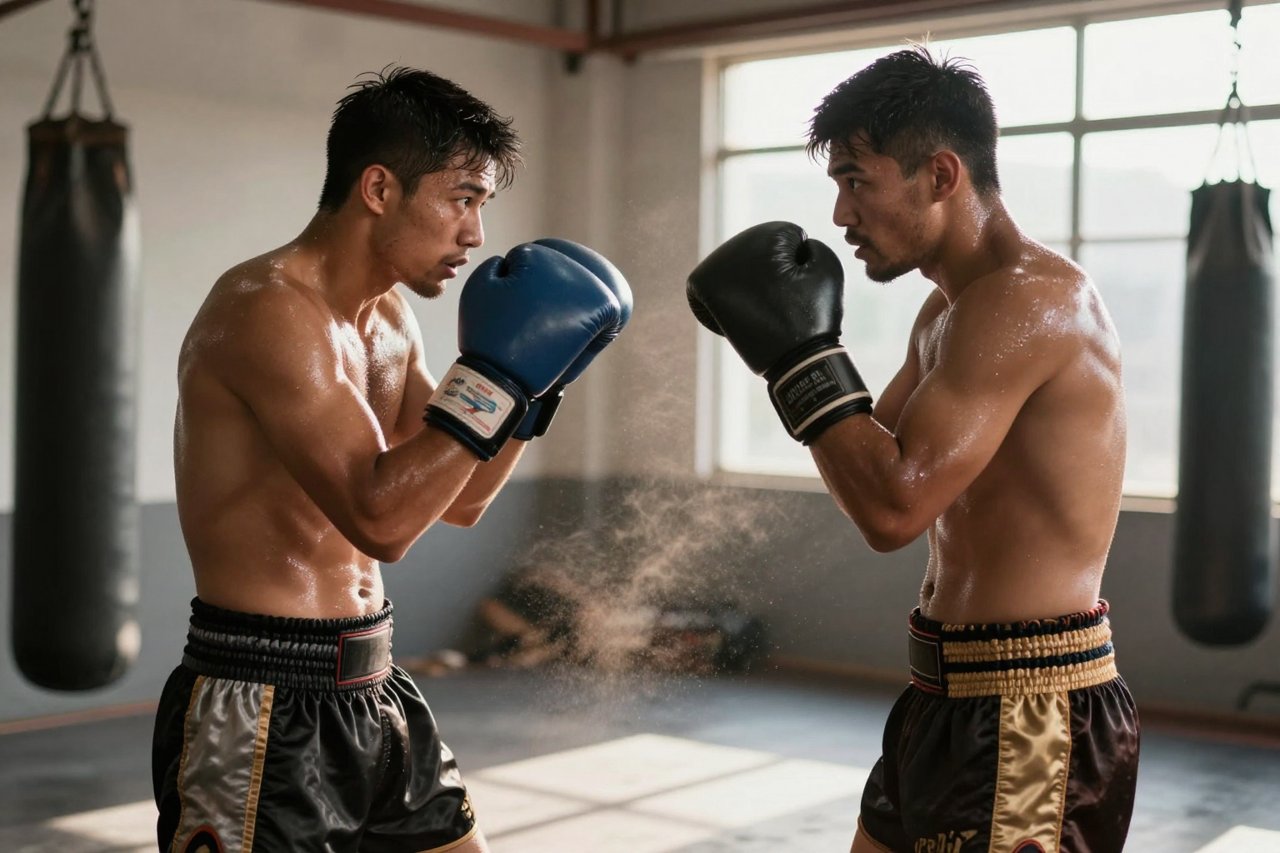
Boxers wear 8oz to 10oz gloves, which protect hands and cut down on facial damage. Muay Thai uses 4oz gloves in competition, so the knuckles are exposed, the guard has to be tighter and punches arrive faster. A grazing shot that would be harmless in boxing gloves actually hurts.
Footwork: chess versus pressure
Boxing footwork is built on lateral movement and in-and-out entries. Boxers circle, pivot off the lead foot and slip out of range. Muay Thai fighters walk forward more, and their feet stay closer together and squarer so they can kick with either leg without telegraphing it.
This is where crossovers get exposed. A boxer walking into a Thai class usually has clean hands and decent head movement, then gets chopped apart by low kicks because they’re standing side-on. A Thai fighter in a boxing gym tends to be flat-footed and easy to hit with a jab, though their balance and clinch strength surprise people. If you’re torn between hands and kicks but the clinch doesn’t appeal, this boxing vs. kickboxing comparison covers the middle ground well.
What a training week actually feels like
- Boxing: roadwork or skipping, shadowboxing, heavy bag, pad rounds, then sparring. Plenty of the skill work is drilling hands at mid and close range until the combinations are automatic.
- Muay Thai: running (Thai camps often do 5 to 10 km before breakfast), skipping, long pad rounds, bag work, clinch and low-intensity sparring. Pad sessions are longer and more choreographed than boxing pads.
- Both: roughly the same volume of sweat, though Muay Thai builds more hip and leg conditioning because of the kicking load.
Damage lands differently as well. Boxing sparring is the usual suspect for head trauma, and that risk is cumulative and real. Muay Thai spreads impact across shins, forearms, ribs and hips, which often means fewer concussions but more chronic bruising, sore shins and rib shots that make breathing interesting for a day or two. Neither sport is gentle, and neither is dramatically safer.
Which one fits you?
Answer a few blunt questions before you sign anything.
- Do you actually enjoy watching the sport? Beginners stick with what they already understand.
- Is punching range comfortable for you, or do you panic in the pocket? Boxing demands more time there.
- Do you want to fight for real? Count how many Muay Thai shows and boxing shows are within driving distance of your house.
- Do bad knees or shins run in your history? The kicking volume is not optional in Muay Thai.
- Who coaches the beginners at the gyms near you? That matters more than the style on the sign.
Doing both is more common than you’d think
Plenty of fighters train crossovers. A boxer adding one Muay Thai session a week picks up a teep and better balance in close, and their defence improves because they finally have to worry about something below the waist. A Thai fighter who spends eight weeks in a boxing gym often comes back with a sharper jab and cleaner entries. You see the hybrid constantly in promotions like ONE Championship, where fighters switch between four-ounce and standard gloves without blinking.
Just don’t start both at once. Learning two guards, two stances and two sets of footwork simultaneously is how beginners build bad habits in each discipline and get good at neither. Give one art six months of consistent work, get a base you can trust, then go borrow the best parts of the other. The people who look sharpest in either ring are almost always the ones who spent a long, unglamorous stretch getting decent at one thing first.


