
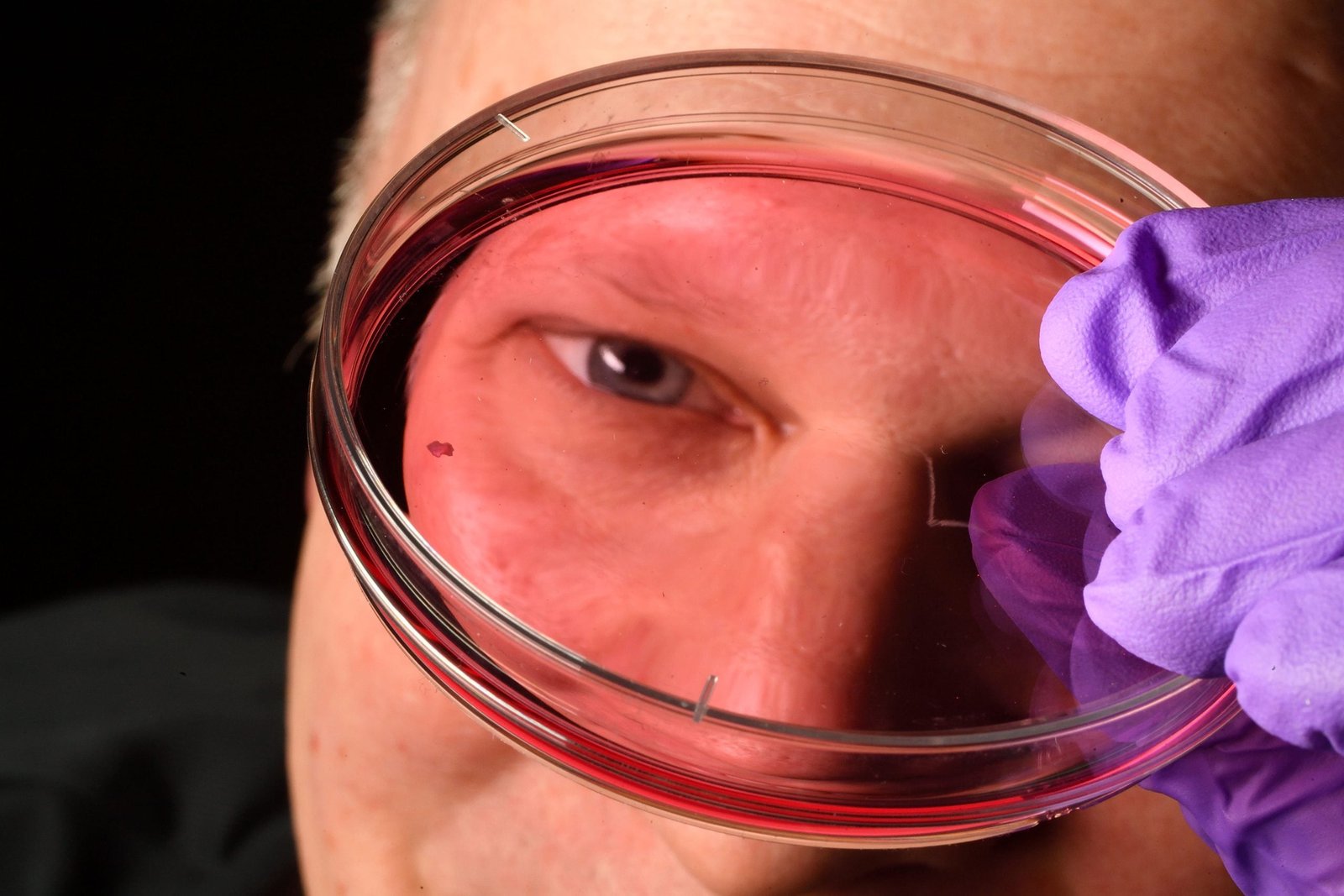
A new study reveals an unexpected mechanism behind how humans develop sharp, color-rich vision before birth, pointing to a coordinated role between key biochemical signals in the retina.
Humans begin developing sharp vision before birth through a coordinated interaction between a vitamin A–derived molecule and thyroid hormones in the retina, according to scientists at Johns Hopkins University.
The discovery challenges long-standing ideas about how the eye forms its light-detecting cells and may guide future research into treatments for conditions such as macular degeneration, glaucoma, and other age-related vision disorders.
The study, based on lab-grown retinal tissue, was published in Proceedings of the National Academy of Sciences.
“This is a key step toward understanding the inner workings of the center of the retina, a critical part of the eye and the first to fail in people with macular degeneration,” said Robert J. Johnston Jr., an associate professor of biology at Johns Hopkins who led the research. “By better understanding this region and developing organoids that mimic its function, we hope to one day grow and transplant these tissues to restore vision.”
In recent years, the team developed a new approach to studying eye development using organoids, which are small clusters of tissue grown from fetal cells. By tracking these lab-grown retinas over several months, the researchers identified the cellular processes that shape the foveola, a central region of the retina responsible for high-acuity vision.
How Cone Cells Shape Human Vision
The study focused on photoreceptors that support vision in daylight. These cells mature into blue, green, or red cone cells, each tuned to different wavelengths of light.
Although the foveola makes up only a tiny portion of the retina, it is responsible for about 50% of visual perception. This region contains red and green cones but lacks blue cones, which are spread more widely across the rest of the retina.
Humans are unusual in having three types of cones, enabling a broad range of color perception that is uncommon in many other species. Scientists have long struggled to understand how this precise arrangement forms. Common research animals such as mice and fish do not share this pattern, making it difficult to study, Johnston said.
The researchers found that cone distribution in the foveola is shaped by a coordinated sequence of events during early development.
At first, small numbers of blue cones appear in this region between weeks 10 and 12. By week 14, however, these cells are converted into red and green cones. The study identifies two key mechanisms behind this shift. A vitamin A–derived molecule called retinoic acid is broken down, limiting the formation of blue cones. At the same time, thyroid hormones drive the conversion of existing blue cones into red and green ones.
“First, retinoic acid helps set the pattern. Then, thyroid hormone plays a role in converting the leftover cells,” Johnston said. “That’s very important because if you have those blue cones in there, you don’t see as well.”
Challenging Longstanding Assumptions
These results challenge a widely accepted idea that blue cones simply move away from the foveola during development. Instead, the findings suggest the cells change identity to achieve the correct balance of cone types.
“The main model in the field from about 30 years ago was that somehow the few blue cones you get in that region just move out of the way, that these cells decide what they’re going to be, and they remain this type of cell forever,” Johnston said. “We can’t really rule that out yet, but our data supports a different model. These cells actually convert over time, which is really surprising.”
The findings could help guide new strategies for treating vision loss. Johnston’s team is continuing to improve its organoid models so they more closely mimic how the human retina functions.
This progress could support the development of better photoreceptors and eventually lead to cell-based therapies for diseases such as macular degeneration, which currently have no cure, said study author Katarzyna Hussey, a former doctoral student from Johnston’s lab.
“The goal with using this organoid tech is to eventually make an almost made-to-order population of photoreceptors. A big avenue of potential is cell replacement therapy to introduce healthy cells that can reintegrate into the eye and potentially restore that lost vision,” said Hussey, who is now a molecular and cell biologist at cell therapy company CiRC Biosciences in Chicago. “These are very long-term experiments, and of course we’d need to do optimizations for safety and efficacy studies prior to moving into the clinic. But it’s a viable journey.”
Reference: “A cell fate specification and transition mechanism for human foveolar cone subtype patterning” by Katarzyna A. Hussey, Kiara C. Eldred, Brian Guy, Clayton P. Santiago, Jingliang Simon Zhang, Ian Glass, Thomas A. Reh, Seth Blackshaw, Loyal A. Goff and Robert J. Johnston, 13 February 2026, Proceedings of the National Academy of Sciences.
DOI: 10.1073/pnas.2510799123
Funding: Damon Runyon Cancer Research Foundation, Howard Hughes Medical Institute, NIH/National Institutes of Health, Foundation Fighting Blindness, BrightFocus Foundation, Maryland Technology Development Corporation
Never miss a breakthrough: Join the SciTechDaily newsletter.
Follow us on Google and Google News.