
Table of Contents
Most omega-3 advice boils down to “eat more oily fish.” That is a slogan, not a plan. If you already know the omega-3 benefits are real, the missing piece is usually logistics.
This five-step routine is built for a cluttered normal week, not a Sunday meal-prep photo shoot. It gives you exact places to put fish, seeds, capsules, and a reminder to reassess before you buy another bottle.
Step 1: Set a weekly fish target and schedule it
For general health, 250 to 500 mg of combined EPA and DHA per day is a reasonable target. That works out to about two servings of oily fish per week, with each serving roughly 120 to 150 g cooked or one small tin of sardines.
Menus beat milligrams, so put these into a typical week:

- Monday lunch: one tin of sardines mashed with Dijon mustard over a bowl of arugula and sliced cucumber.
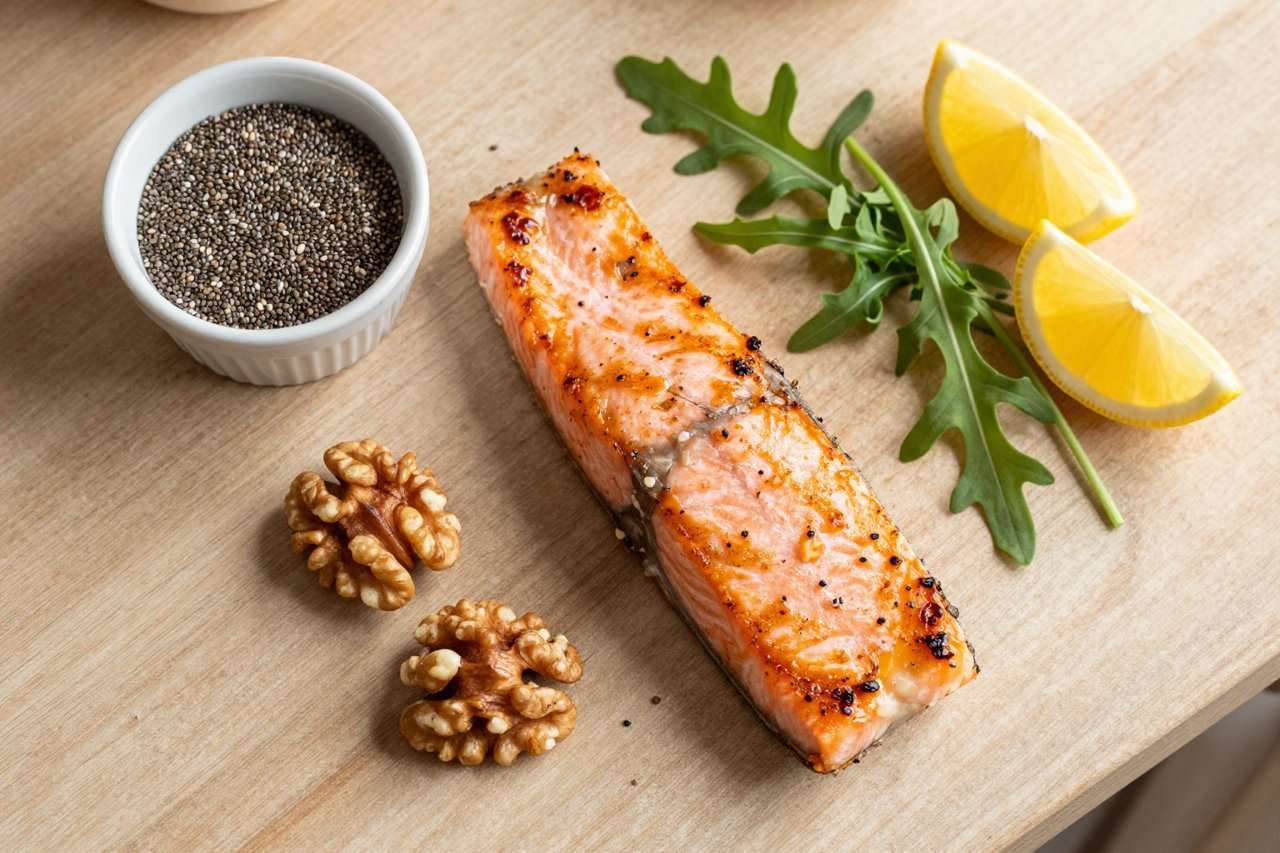
- Thursday dinner: a 150 g salmon fillet brushed with olive oil, lemon juice, and garlic, then baked until just opaque.
- Friday or Sunday: smoked mackerel flaked into scrambled eggs.
If you are still not sure whether this is worth the shopping list, read what the science really shows about omega-3 benefits. Once you are comfortable, step 1 is already the whole plan.
Step 2: Add plant omega-3s as the backup layer
Fish-based EPA and DHA are not the only omega-3s. Plant foods such as flaxseed, chia seeds, walnuts, and hemp seeds contain alpha-linolenic acid (ALA). Your body can convert a small amount of ALA into EPA and DHA, so these foods are best used as a bridge between fish meals, not as a complete replacement.
Try these practical swaps:
- Add 2 tablespoons of ground flaxseed to porridge, yogurt, or a smoothie. Whole flaxseed tends to pass through undigested.
- Make overnight chia pudding with 2 tablespoons of chia seeds and 200 ml of milk, then top it with berries before eating.
- Keep a 30 g sachet of walnuts in your bag for a snack.
Those portions add 4 to 6 g of ALA across a day, but only a small fraction becomes EPA and DHA. They help, and they bring fibre and minerals, but if your goal is a measurable omega-3 status, fish or algae oil is the safer route.
Step 3: When you buy supplements, read the back of the label
Front labels say “triple strength” and “ultra pure” with almost no useful information. The back label does the talking. Look for the two numbers next to EPA and DHA.
Example: one softgel claims 1,000 mg fish oil. Just below, the label says EPA 180 mg and DHA 120 mg. That product gives you only 300 mg of the long-chain fats per pill. If your average intake from food is low and your daily goal is 500 mg, one pill is not enough.
What I check before buying:
- A clear amount of EPA plus DHA, not just “total fish oil”.
- Third-party testing for oxidation and contaminants.
- A code date or freshness guarantee on the package.
If you are vegan, look for the same EPA and DHA numbers in an oil made from algae, not flaxseed oil. Flax oil remains mostly ALA and hits the same conversion limit.
Step 4: Take omega-3 with a meal that contains fat
EPA and DHA are absorbed better when they travel with dietary fat. In a practical test, taking a fish oil capsule with a higher-fat breakfast produced higher blood levels than taking it with a low-fat breakfast. It also reduces the “fishy burp” problem.
Build a trigger: put your capsule bottle next to the olive oil or the eggs, not next to the coffee machine. If you take a supplement capsule at breakfast, eat some eggs, yogurt, or avocado with it. At lunch, a salad with olive-oil dressing does the same job.
Many fat-soluble nutrients follow that same rule. If you are already wondering whether a daily multivitamin is pulling its weight, this honest look at multivitamin benefits explains the timing issue in more detail.
Step 5: Give it 12 weeks, then reassess or stop
Most omega-3 research measures change over months, not days. Put a note on your calendar for 12 weeks after starting. Write down the specific problem you are trying to address: stiff knees, dry skin, high triglycerides, or something else. At week 12, check whether the symptom or blood marker moved. If nothing changed, talk to a doctor or dietitian before increasing the dose. The answer may be a different dose, a different form, or no supplement at all.
More is not always safer. In one research analysis on this site, high circulating levels of omega-3s were linked to increased markers of inflammation rather than the expected decrease. That finding does not mean you should avoid fish. It means a mega-dose from capsules is genuinely different from eating two well-chosen fish meals.
Pay close attention if you take blood thinners or have a health condition that affects bleeding. High doses of EPA and DHA can slow clot formation, so changes should be reviewed by a clinician.
Signs that your dose needs a second look
- Persistent acid reflux or fishy burps that survive a switch in formulation.
- Unexplained bruising or nosebleeds, especially if you are taking anticoagulants.
- No measurable change in your original goal after a full 12-week trial.
Build the habit first with good food, use a high-quality supplement only to plug the gap, and let your bloodwork or symptoms tell you whether it is working. That is how the research on omega-3 benefits becomes something you can feel instead of another thing you worry about.


