
Table of Contents
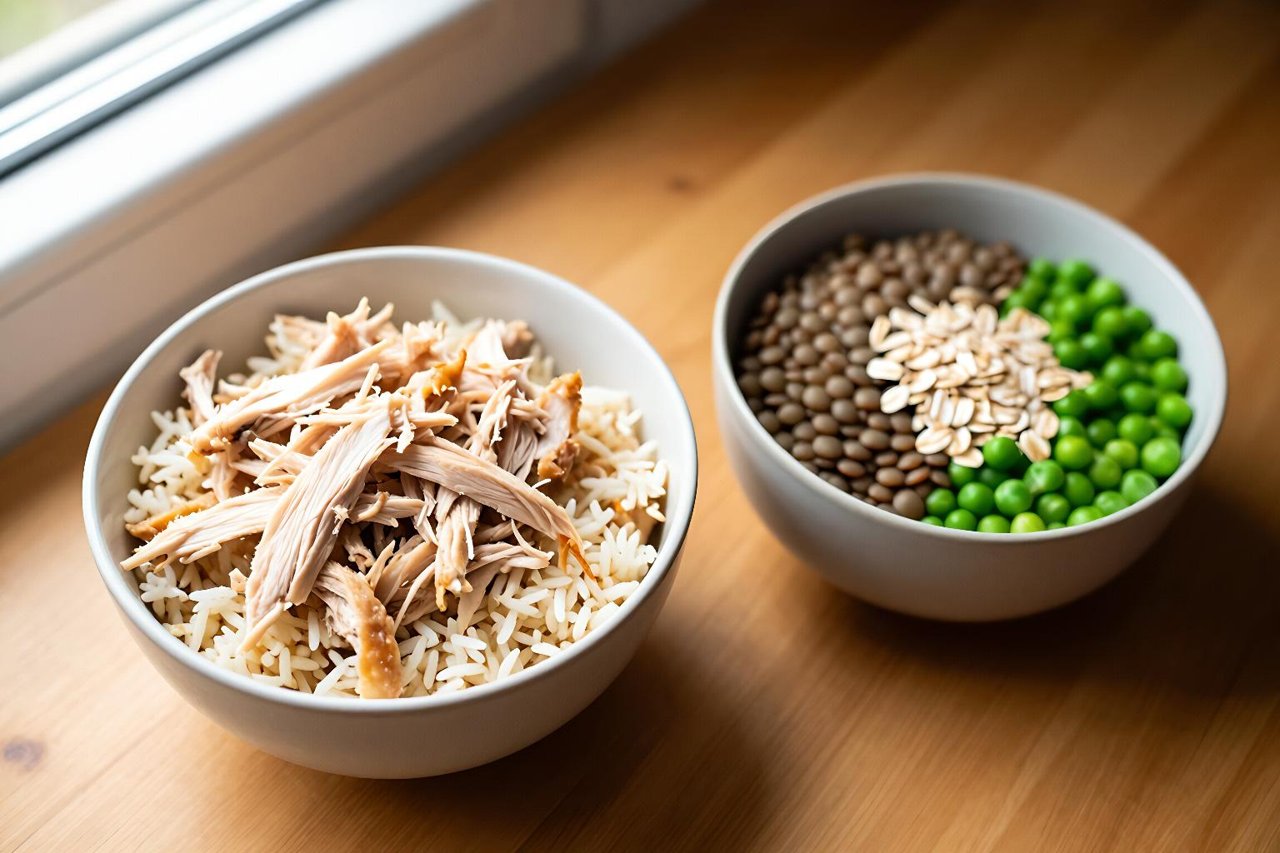
Two bowls on the kitchen floor tell the story faster than any marketing copy. The first holds shredded chicken, brown rice and a spoonful of salmon oil. The second holds lentils, oats, pea protein isolate and sunflower oil. Both can be complete and balanced. Only one of them gets there without much effort.
That gap between “possible” and “straightforward” is where most of the plant-based foods vs. animal-based foods conversation actually lives. Strip away the slogans and you’re left with amino acids, digestibility, land use, price, and what happens to the animals on either side of the equation.
Nutrient density puts animals ahead at the starting line
Per 100 grams, raw chicken breast carries roughly 23 g of protein and almost no carbohydrate. Cooked lentils bring about 9 g of protein next to 20 g of carbohydrate and 8 g of fibre. To match the protein in a palm-sized piece of chicken, you’re eating a bowl of legumes close to three times the weight.
None of that makes lentils a bad ingredient. It just means plant ingredients arrive dilute, which is why commercial plant-based pet foods lean hard on concentrates. Pea protein isolate sits near 80% protein, potato protein around 78%, soy protein concentrate at 65%. A whole-food vegan diet for a dog or cat is technically possible, but it takes far more formulation work than a chicken-and-rice recipe that a manufacturer can almost build in their sleep.

Protein quality is really an amino acid conversation
The crude protein percentage on a bag tells you how much nitrogen is in the food. It says nothing about whether your animal can use it. Nutritionists talk about amino acid profiles and digestibility instead, and that’s where the two categories genuinely diverge.
Animal proteins tend to score higher on standardised digestibility tests, with egg, milk and meat isolates landing in the 90 to 100 range on the DIAAS scale. Soy sits close behind at about 90. Pea protein comes in near 70, wheat gluten closer to 45. Plant proteins are also usually low in methionine and lysine, the two limiting amino acids for most cereal-and-legume blends.
Formulators solve this by pairing sources, rice with peas, corn with soy, or by adding free amino acids directly. Both methods work. Both add cost, complexity, and one more thing that can go wrong in a factory.
Nutrients that hide inside animal tissue
- Taurine, an amino acid found almost exclusively in animal tissue
- Preformed vitamin A, which plants supply only as beta-carotene
- Arachidonic acid, an omega-6 fat that cats cannot build from plant precursors
- Vitamin B12, effectively absent from unfortified plant ingredients
- Heme iron, absorbed two to three times more efficiently than the non-heme iron in plants
Cats and dogs don’t play by the same rules
Cats are obligate carnivores and the physiology is specific. They have limited enzyme activity for converting beta-carotene into retinol, no delta-6-desaturase for making arachidonic acid, and a taurine requirement somewhere around 1 to 2 g per kg of dry matter. Get taurine wrong and you’re looking at dilated cardiomyopathy and retinal degeneration, not a slightly dull coat.
Which is why any plant-forward formula for cats deserves scrutiny of its protein content and amino acid supplementation before it earns a place in the bowl.
Dogs are far more adaptable. They synthesise their own taurine, convert beta-carotene, and spent roughly 15,000 years eating alongside humans, picking up extra copies of the amylase gene along the way. A plant-based dog food with methionine, lysine, taurine and B12 added can meet AAFCO nutrient profiles, and several have done so in feeding trials.
The caveat is real, though. Between 2014 and 2019 the FDA investigated a cluster of dilated cardiomyopathy cases in dogs eating grain-free diets heavy in peas, lentils and potatoes. Nobody pinned down the exact cause, but the pattern was strong enough that veterinary cardiologists still flag legume-heavy formulas, particularly for golden retrievers and cocker spaniels with known taurine sensitivity.
Land, water and the welfare ledger
Feed conversion is where animal-based foods take their biggest hit. Beef cattle need roughly 6 to 10 kg of feed to produce 1 kg of edible protein. Chickens manage about 2 to 1. Soybeans and pulses come in near 1 to 1, simply because you’re eating the crop directly rather than cycling it through an animal first. Livestock grazes across roughly 77% of global agricultural land while delivering under a fifth of the world’s calories.
The animal side of the ledger is harder to quantify but no less real. Retailer and restaurant welfare commitments have moved supply chains at genuine scale, though audits of those promises show uneven follow-through. If that subject pulls you in, the evidence behind veg*n welfare pledges and how they hold up makes for sobering reading.
Labels are doing more work than most shoppers realise
“Plant-based” has no legal definition in most markets. Neither does “natural” or “human-grade.” What does carry weight is a nutritional adequacy statement, AAFCO in the United States or FEDIAF in Europe, plus a named manufacturer and evidence of a feeding trial rather than a formulation-only claim. Our breakdown of how product labeling and certification gets verified covers what those claims actually prove.
If you want the practical version, what to look for in high quality cat food walks through ingredient splitting, guaranteed analysis, and the difference between a named meat source and “animal digest.”
Blending the two without guessing
Most households land somewhere in the middle rather than picking a side. A few rules make that easier:
- Treat plant-based food as a portion, not a whole diet, unless the packaging carries a complete-and-balanced statement for your animal’s life stage.
- Rotate protein sources across the week: chicken one day, insect or pea-based the next. Variety covers gaps that a single formula might miss.
- Watch stool quality for two weeks after any switch. Firmness and volume are the fastest read on digestibility you’ll get.
- Ask for bloodwork at the next annual visit, including taurine for any cat on a legume-heavy diet.
- Count treats in the total. Ten percent of daily calories is the usual ceiling, and it’s the easiest place for a balanced diet to quietly fall apart.
What the bowl looks like six months in
Labels win arguments; the animal settles them. A food that works shows up as steady weight, a coat that doesn’t feel like straw, small firm stools, and an empty bowl at every meal. A food that doesn’t work usually announces itself within a fortnight, either at the litter box or on the scale.
Cost deserves an honest look too, and the right number is cost per day rather than cost per bag. A 2 kg plant-based formula at £28 that feeds a cat for three weeks can beat a 10 kg chicken-based bag that goes stale in the cupboard. Run the maths on your own animal, buy the smallest size first, and let six weeks of observation decide what stays on the shelf.


