
Table of Contents
In September 1940, four teenagers and a dog named Robot were exploring a wooded hill above Montignac in southwest France when they found a hole in the ground. They widened it, dropped through, and lit whatever they had brought. The walls around them were covered in bulls, horses and stags, painted in red and black, some of them five metres long. They had walked into Lascaux, an art gallery that had been sealed for roughly 17,000 years.
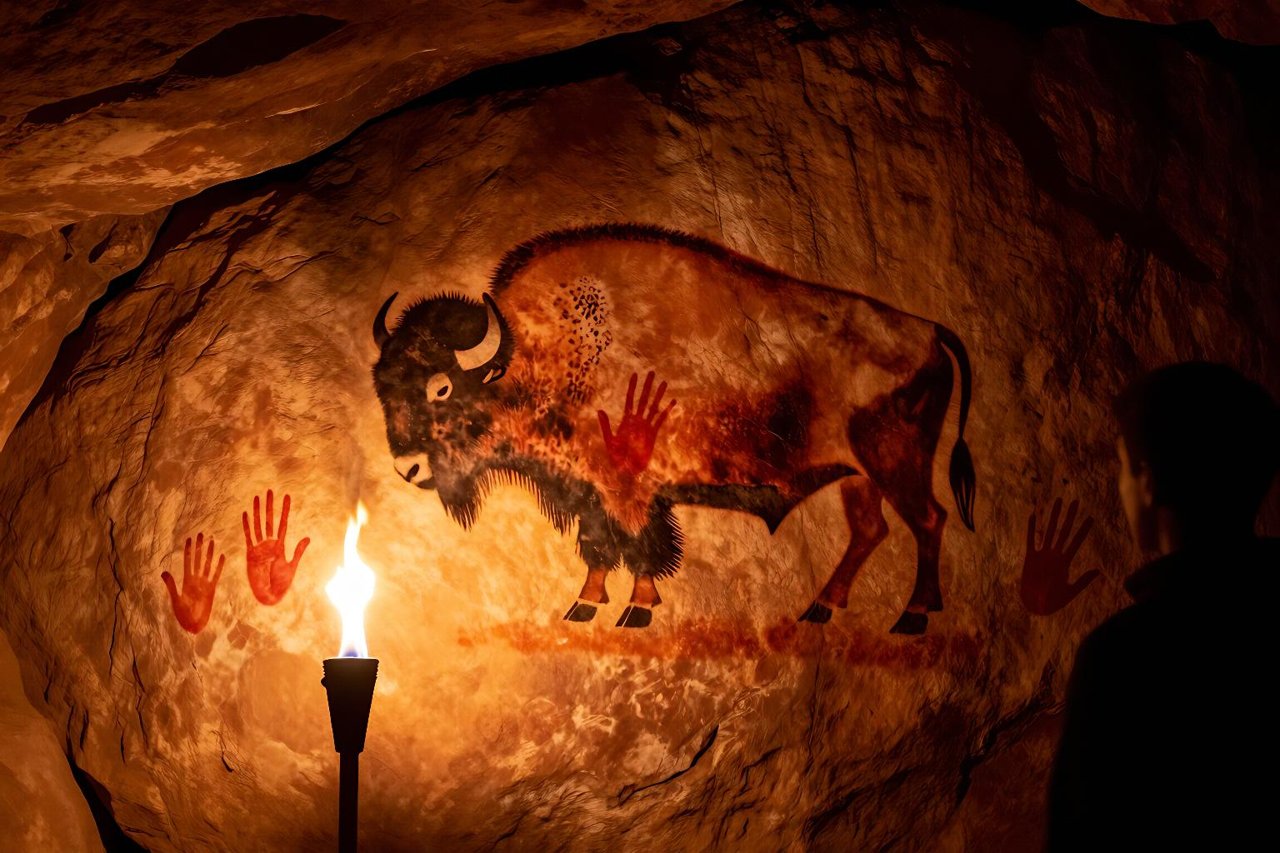
Most people meet prehistoric cave paintings as a single image: a bison, maybe a handprint, reproduced on a museum wall or a fridge magnet. The reality is stranger and much more interesting. These are not crude doodles by primitive people. They are deliberate, technically skilled works made by people with the same brains as ours, working in near-total darkness with light from burning animal fat.
What Counts as a Cave Painting?
Archaeologists call it parietal art, from the Latin paries, meaning wall. The category covers far more than animal portraits. It includes hand stencils made by spitting pigment around a palm, rows of dots, grids, zigzags and abstract signs whose meaning has not survived. Roughly 400 caves with painted or engraved walls have been recorded in the Franco-Cantabrian region alone, and new ones turn up most years.
The oldest known figurative painting sits in a limestone cave on the Indonesian island of Sulawesi, where a study published in 2024 dated a scene of a pig and three human-like figures to at least 51,200 years ago. That is older than anything in Europe by a wide margin, which tells us something important: image-making was likely part of human behaviour long before anyone reached the caves of France and Spain.

Five Sites That Changed the Timeline
Lascaux, France
Around 600 painted animals crowd the walls of Lascaux, including aurochs, ibex and a horse that appears to be galloping across a frieze nearly 20 metres long. The cave opened to visitors in 1948 and closed again in 1963, when exhaled carbon dioxide, body heat and airborne spores triggered the growth of green algae across the paintings. A replica, Lascaux IV, opened in 2016 and is now the main way to see the work.
Chauvet-Pont-d’Arc, France
Discovered on Christmas Eve 1994 by three cavers following a draft of warm air, Chauvet holds images dated to around 36,000 years ago, making it roughly twice as old as Lascaux. The artwork is also unexpectedly sophisticated: lions moving in a hunting pack, rhinoceroses drawn with shading, and a panel where overlapping figures of horses and bison appear to show motion under flickering light. The cave itself has been off-limits since soon after its discovery, but a large-scale replica called Chauvet 2 opened nearby in 2015.
Altamira, Spain
The painted bison ceiling at Altamira was noticed in 1879 by a young girl, María Sanz de Sautuola, who looked up while her father worked on the floor below. He published his findings and was accused of forgery by the scholarly establishment, which refused to accept that early humans could paint that well. He died in 1888, fourteen years before the claims were vindicated.
Sulawesi, Indonesia
Leang Tedongnge holds a warty pig painted in dark red ochre, dated to at least 45,500 years ago, and nearby Leang Karampuang has the 51,200-year-old hunting scene. These caves sit in karst hills behind a rice-farming valley, and they carry a useful reminder that early art was never a European speciality.
El Castillo and Cueva de las Manos
A single red dot in Spain’s El Castillo cave has been dated to about 40,800 years ago, possibly the work of Neanderthals. At Cueva de las Manos in Argentine Patagonia, dozens of hand stencils in red, white and black cover a rock overhang, some placed beside images of guanaco hunts.
Pigments, Brushes and Blown Handprints
There was no art shop. Everything came from the ground, and the recipes were consistent enough across continents that we can reconstruct them with reasonable confidence.
- Red and yellow ochre, ground from iron-rich soil and heated to deepen the colour, provided most of the warm tones.
- Black came from charcoal, or from manganese minerals dug out of the cave floor.
- White was usually kaolin clay, chalk or gypsum.
- Binders such as animal fat, blood or plant juices helped pigment stick to damp rock.
- Application involved fingers, moss pads, chewed twigs used as brushes, and hollow bird bones or reed tubes for blowing pigment onto a hand pressed against the wall.
The logistics were just as impressive. Deep in the Chauvet cave, footprints of a child have been preserved in clay alongside marks on the floor. Lascaux required wooden scaffolding, and the only light inside was provided by sandstone lamps burning rendered fat, or by torches of juniper and pine. Whoever painted the deepest panels was working from memory, or from a limited set of sketches in charcoal on the floor.
How Do You Date a Painting?
You cannot put a pigment sample in a radiocarbon machine if it was made from mineral ochre, because carbon dating only works on organic material. Charcoal drawings are the exception, which is why so much of our timeline depends on black figures. For everything else, scientists use uranium-thorium dating on the thin sheets of calcite that grow over artwork, giving a minimum age. A calcite crust takes thousands of years to form, so a painting underneath it must be older, potentially much older.
This is why dates keep shifting. A figure that was labelled 30,000 years old twenty years ago may now be described as more than 40,000, not because anything changed on the wall but because the measurements got better.
Why Paint in Total Darkness?
Nobody lived deep in these caves. The usable entrances were cold, damp and prone to flooding. The paintings sit in chambers hundreds of metres from daylight, in places where you would have to crawl through a shaft on your stomach to get there.
The most compelling explanations cluster around ritual and initiation. Painted panels tend to sit in acoustically resonant chambers, where a voice or drum echoes back, suggesting ceremonies involving sound. Hand stencils often belong to children and adolescents, which fits the idea of coming-of-age ceremonies. Researchers have also followed the Lascaux friezes through a flickering flame and found that the overlapping legs and repeated heads create an effect close to animation. That may have been intentional, a form of storytelling in the dark.
Seeing Prehistoric Cave Paintings for Yourself
The original Lascaux and Chauvet caves are effectively closed, but the region around them is wide open. The Vézère valley alone holds more than a dozen sites, including Font-de-Gaume, Les Combarelles and Rouffignac, where visitors ride a small electric train into a cave ceiling crowded with mammoths. Niaux, in the Ariège, still admits small guided groups into a cave with genuine black charcoal paintings.
To get your bearings, it helps to understand the geography of the area and how the towns connect. This guide to visiting the Dordogne region covers the practical side: where to base yourself, how far apart the main sites are, and when to book ahead. Reservations matter. Font-de-Gaume admits around 70 people a day in summer, and spots disappear weeks in advance.
The Discoveries Aren’t Finished
Rock art keeps turning up in places nobody expected. In the Sierra de San Francisco, deep in the mountains of Baja California Sur, enormous murals of deer, pumas and human figures cover rock shelters in red, black and white, some painted several metres up a wall by artists working from ledges. Reaching them takes a drive and a hike, but they are among the largest and best-preserved prehistoric paintings in the Americas, and they sit within reach of the peninsula’s quieter travel routes, including a Baja escape around Loreto.
In the Amazon, laser surveys have revealed kilometres of ice-age rock art depicting mastodons along cliff faces in what is now Colombia. In Australia, some Aboriginal rock art may have been made tens of thousands of years ago and continues to be maintained and repainted today, part of a living tradition rather than a frozen record.
If you want to see the work without buying a plane ticket, documentaries are a surprisingly good substitute. Werner Herzog’s Cave of Forgotten Dreams, filmed inside Chauvet with special permission, is the best of them, and there are plenty of others worth the evening. Our list of the best documentaries you can watch right now is a good starting point.
What remains unresolved is the biggest question of all. We can date the pigment, identify the species, and reconstruct the brushes. We still cannot read the signs: the dots, the tectiforms, the grids and the strange geometric marks that appear across Europe for 20,000 years and vanish. They are language of some kind. Nobody has yet found the key.


