
Table of Contents
Nearly 4,600 years ago, a team of workers muscled one of the last granite blocks into place on the summit of the Great Pyramid of Giza. That capstone may have been gilded, flashing in the afternoon sun. The structure below it was the last surviving wonder of the ancient world. Today, the Egyptian pyramids still provoke the same mixture of awe, confusion, and argument. They are not just tombs. They are the most precise and massive monuments humans would create until the industrial age.
A River Valley Made It Possible
The pyramids didn’t appear out of nowhere. They came out of a civilization that spent a thousand years mastering agriculture, bureaucracy, and stone-working along one unpredictable river. The Nile’s annual floods didn’t just water crops. They also organized labor on a huge scale. As a detailed look at Ancient Egypt’s rise explains, the river valley gave early pharaohs the resources and the workforce to experiment with monumental architecture. Without that river, the Great Pyramid would be no more than a sand dune.
Early attempts were clumsy. King Djoser’s step pyramid at Saqqara is not a true pyramid in the geometric sense; it is a stepped mastaba, a staircase to heaven. His successor Sneferu had the ambition to build a smooth pyramid, but his first attempt at Dahshur bent halfway up, a clear design failure. Only then, with Khufu, did everything come together.
The Giza Trio
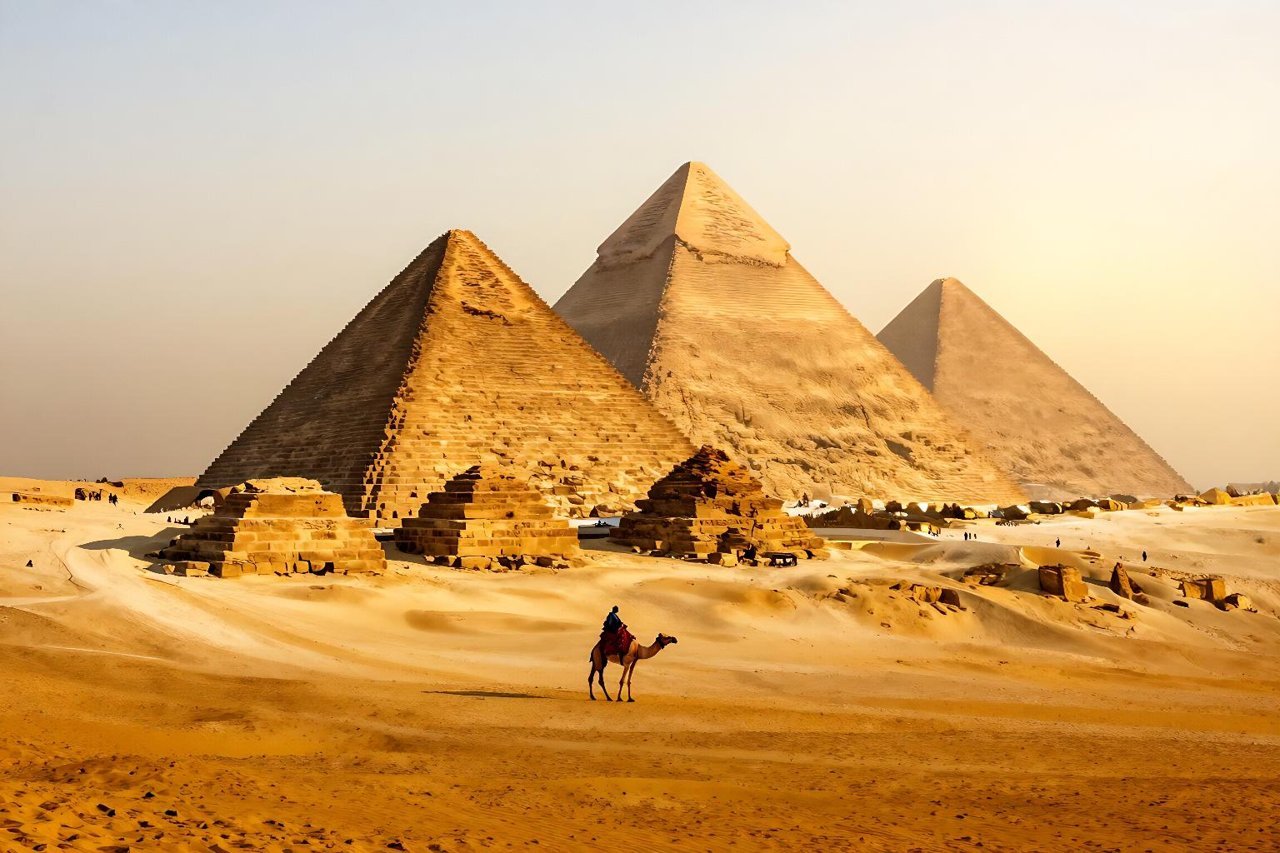
The Great Pyramid is the official tomb of Khufu, the second king of the 4th Dynasty. Next to it stand the slightly smaller pyramids of Khafre and Menkaure, plus several smaller queen pyramids and the Great Sphinx. Egypt has over 90 other pyramids, but Giza gets the attention for good reason. The Great Pyramid’s base covers over 13 acres, and its original casing stones were so polished that the whole thing reflected the sun.

How Did The Egyptians Cut And Move Millions Of Stones?
We still don’t have a definitive answer, but we have a lot of evidence. The Great Pyramid contains roughly 2.3 million blocks. Most weigh about 2.5 tonnes, and some granite beams in the king’s chamber weigh 80 tonnes. The builders had no iron tools, no pulleys, and no wheels. That has generated more theories than any ancient mystery since the Trojan War.
Recent experiments show that wet sand can halve the friction when dragging sledges. A team from the University of Amsterdam proved that adding just the right amount of water to sand reduces the pulling force needed. They even spotted a wall painting in the tomb of Djehutihotep that shows a worker pouring water in front of a sled. That is a concrete clue, not a guess.
The leading theories for lifting the blocks are:
- The long external ramp, which would have had to be over a kilometer long to keep a slope under 6%. The remains of ramps have been found at other quarries, but not at Giza.
- The internal ramp, a spiraling corridor built into the body of the pyramid that allows blocks to be pulled upward as the structure rises. Some blocks in the pyramid show spiral grooves that fit this model.
- The counterweight system, which uses a heavy falling mass on the other side of the structure to lift a block. This could work with wood, water, or sand.
The truth is probably a combination of several methods, depending on the stage of construction and the size of the block.
Every Measure Is Absurdly Precise
The Great Pyramid’s base is nearly a perfect square. The four sides vary only about 4.4 centimeters from each other. North-south alignment is even more remarkable. The eastern side is oriented to a fraction of a degree off true north, which is better than an ordinary survey using a standard compass. The original height was 146.5 meters; today, with the outer casing stripped away, it stands 138.5 meters. For over 3,800 years, it was the tallest manmade structure in the world, until the Lincoln Cathedral in England surpassed it.
What Is the 5-Inch Gap?
In the grand gallery, a narrow slot called the ‘Great Step’ has a 5-inch-wide crack running from the floor to the ceiling. Nobody documented creating it, and it does not look like a structural failure. Some engineers think it might be intentional, functioning as a ventilation duct or even a resonator for sound. The crack is poorly understood, and only recently have engineers run numerical models on it. It is a small detail, but it shows how little we know about the inside of the pyramid.
What We Have Found Inside
The burial chamber is a granite-lined room in the heart of the pyramid, not on the base floor. It contains a broken sarcophagus made of black granite, but no mummy. The king’s body was likely stolen in antiquity. Above the chamber are five relieving chambers designed to absorb the weight of the pyramid, separated by massive granite slabs. When the first modern explorers broke in, they found graffiti in Greek and Coptic, a dead pigeon, and a half-eaten loaf of bread.
The Air Shafts
Four narrow shafts run from the king’s chamber and the queen’s chamber to the outside, at steep angles. These are heavily debated. They may have been air vents, but their precise angles suggest a religious purpose. The southern shaft from the king’s chamber points straight at Orion’s belt; the northern one points at the subpolar stars. This alignment is not accidental, given how much care the Egyptians put into star mapping.
Why Did Pyramid Building Stop?
After the 4th Dynasty, pyramid building went downhill in both scale and quality. Middle Kingdom temples used mud-brick cores and cheap fill, and many collapsed. By the time Thutmose I came to power in the 18th Dynasty, royal burials moved to the Valley of the Kings, deep in the hills near Luxor. The transition took centuries, but the message was clear: the old way of raising megaliths was too expensive and too vulnerable to looters. To understand how this fits into the broader sweep of human history, a look at 5,000 years of world history puts the pyramid age in context.
Modern Science Is Still Uncovering Hidden Chambers
In 2017, the ScanPyramids project detected a large void above the grand gallery using muon tomography. The void is over 30 meters long, the size of a corridor or room, and completely untouched. Since then, researchers have mapped more anomalies. In 2023, specialists used cosmic-ray muons again and found subtle density fluctuations that could be further empty spaces. The same human drive that pushes scientists to explore the Mariana Trench also pushes them to scan these stone giants. Just as oceanographers are still revealing mysteries in the deep sea, pyramid researchers are uncovering new details from the plateau.
Myths, Aliens, and the Real Human Triumph
The belief that aliens built the pyramids is ancient. It gained traction because heavy stones and tight tolerances are hard to imagine without advanced machines. But the human evidence is overwhelming. Archaeological digs at the workers’ town of Heit el-Ghurab show barracks, bakeries, breweries, and a state-run supply chain. The bones found there have healed fractures consistent with climbing and carrying. Painted graffiti on blocks shows crew names like “Friends of Khufu” and “Boat Gang.” We even know they had a dedicated priesthood and a pyramid town that supported hundreds of workers.
The wonder is not that it was impossible; it is that ordinary people could do it after all. That insight is more awe-inspiring than any ancient astronaut theory. If you like that kind of trivia, this roundup of 65 amazing facts includes some pyramid details that are genuinely strange.
Stand on the Giza plateau at sunset and look at the three pyramids against the southern sky. They have outlived every empire that has tried to claim them. Bakers and dockworkers hauled them into place, and the result still tilts your head upward. That is the real pyramid mystery: the sheer audacity of a culture that believed its king could go to the stars, and then organized its entire economy around helping him.


