
Table of Contents
If you’ve ever opened a bottle of probiotics, swallowed a capsule every morning for two weeks, and felt absolutely nothing, you’re not alone. A few years ago I gave up on probiotics entirely because I expected them to work like a light switch. They don’t. The real problem was that I had no experiment, no timing plan and no way to track whether anything shifted.
That’s why I now treat probiotics like a science project. This step-by-step guide walks through exactly how to choose, take, and measure probiotics benefits so you don’t waste another $30 on a bottle that ends up in the back of your cupboard.
Step 1: Write Down Your Gut Health Goal Before Buying Anything
Probiotics are not interchangeable. The strain that works for constipation is often different from the one that helps after antibiotics. If you don’t define your goal, you’re gambling on an arbitrary strain and a random dosage.
Here are three concrete examples:

- If bloating gets bad after large meals, a product containing Bifidobacterium lactis HN019 or Lactobacillus acidophilus NCFM has decent clinical evidence.
- If you are about to take a course of antibiotics, look for Saccharomyces boulardii or Lactobacillus rhamnosus GG. They have the best data for reducing antibiotic-associated diarrhea.
- If your goal is immune defense during winter, Lactobacillus casei DN-114001 has been studied extensively in elderly populations.
Before you buy anything, check what the science really says about probiotics for your specific condition. That will keep you from chasing trends with no human evidence.
Step 2: Decode the Label so You Don’t Waste Money
Once you have an intended strain, read the label like you’re checking a prescription. There are three parts that matter:
- The full strain code. “Lactobacillus acidophilus” is not enough. Look for an exact code like “Lactobacillus acidophilus NCFM” or “Bifidobacterium animalis subsp. lactis BB-12”.
- CFUs at expiry. Labels should say “10 billion CFU guaranteed through the best-by date”, not “manufactured with 10 billion CFU”.
- Storage instructions. Several proven strains are fine at room temperature, but a few need refrigeration. If the label asks for cold storage, respect it.
Why is this so important? A clinical trial of a strain like L. rhamnosus GG doesn’t tell you anything about a random strain of L. rhamnosus. Supplement makers who list the full FDA-style strain code are telling you they’ve actually tested that exact organism. When you see just the species name and a huge number, treat the product as suspicious.
It can also be worth checking the supplement facts against this science-backed guide to probiotic strains, CFUs and real benefits, where you can compare specific products and dosages.
Step 3: Combine Capsules with Live Fermented Foods
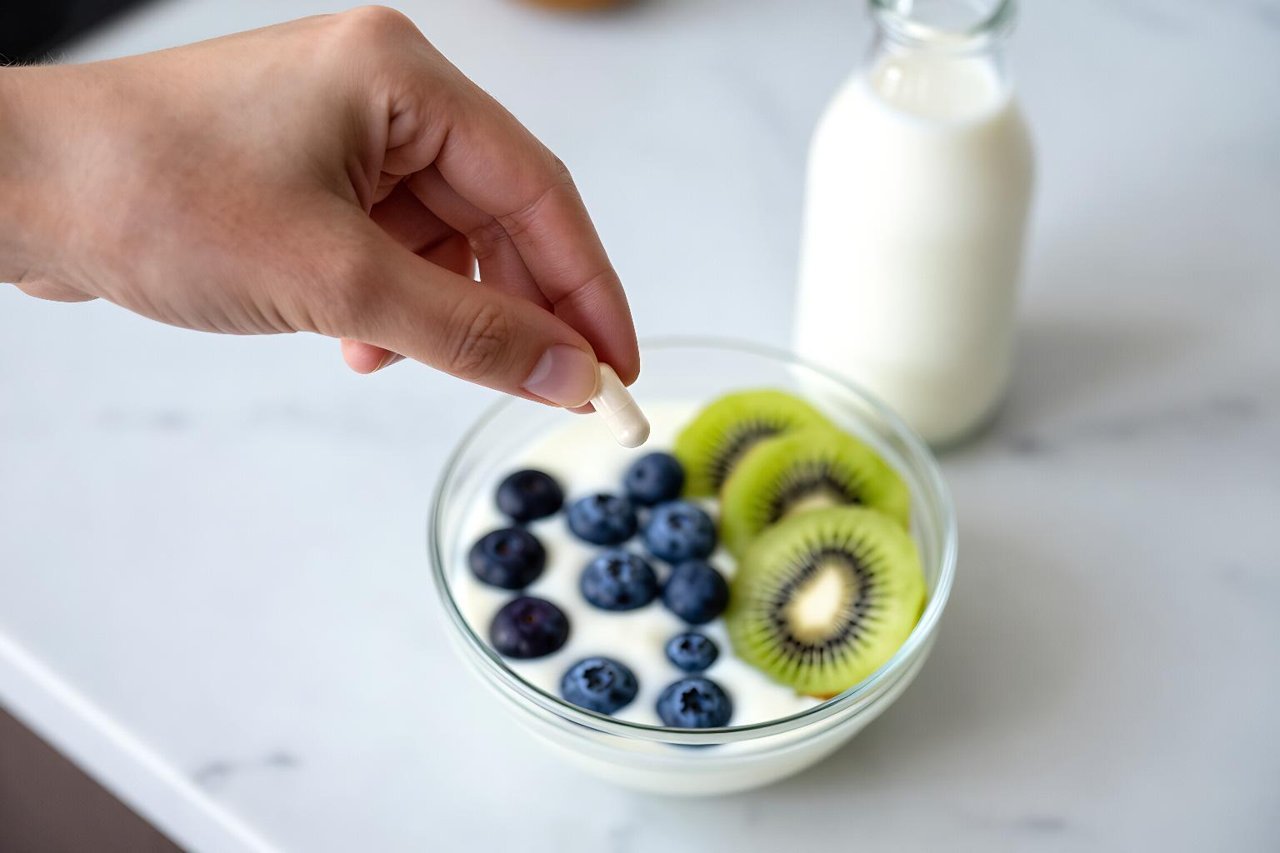
Probiotics are transient visitors. They can only deliver durable health effects if the gut environment supports them. That doesn’t require a dramatic diet overhaul. A small daily serving of live-cultured food is enough to help colony formation.
Example: try swapping your usual breakfast drink for 150 ml of plain, unsweetened kefir. One reason is that kefir is packed with active microbes. Another is that it carries bioactive peptides that support calcium absorption. This is interesting because people who consume fermented dairy regularly tend to have better bone mineral density over time. You can read more about the gut-bone connection in this overview of how probiotics in fermented dairy may help manage osteoporosis.
Other simple options:
- Refrigerated sauerkraut or kimchi – just check the label says “live cultures” and that it was not pasteurized after fermentation.
- Plain Greek yogurt with “active live cultures” listed.
- Natto or miso soup, as long as you tolerate soy.
Notice you don’t need a complicated gut-health diet. One fermented-food serving a day alongside your capsule is usually enough to create a visible difference within two weeks.
Step 4: Time the Dose Around Meals and Antibiotics
One of the most overlooked factors is when you swallow the thing. Most Lactobacillus strains survive stomach acid better on an empty stomach, so they reach the intestines faster. But if you feel nauseated taking probiotics before food, take them at the start of a meal. The difference is small; consistency matters more than that 20-minute window.
The exception is antibiotics. Taking a probiotic at the same time as your antibiotic means you’re largely wasting it. The antibiotic kills the incoming bacteria before they can settle. The accepted practice is to keep a two-hour gap between the two. This guide to timing probiotics with antibiotics explains why the gap is critical and what to do if you forget.
Step 5: Track Numbers, Not Feelings, for Two Weeks
Here’s the step that makes probiotic benefits actually visible: tracking.
Pick three markers relevant to your goal and score them each evening on a 1-5 scale. For instance, if your goal is improving digestion, track these:
- Bloating one hour after dinner (1 = severe, 5 = none)
- Stool regularity (1 = constipated or diarrhea, 5 = normal and easy)
- Sleep quality (1 = awful, 5 = excellent)
Keep your meals and sleep roughly consistent during the trial. Do not add other new supplements. At the end of fourteen days, average the scores from the first week and compare them with the second week. If bloating averages 3.2 in week one and improves to 4.4 in week two, that’s your signal to keep going. If nothing changes, try a different strain or switch to a higher CFU product for another two-week trial.
If you’re also interested in body composition and anecdotally find your weight or appetite changing, professional data is mixed but still worth tracking. The article looking at whether probiotics help you lose weight walks through the evidence and identifies which strains show the most promise.
Troubleshooting: What to Do When You’re Still Not Seeing Probiotics Benefits
Sometimes the probiotic works but, in the first few days, you feel bloating or mild wind as the bacteria adjust the pH of your gut. If that happens, drop the dose to half for a week before ramping back up.
If bloating persists for more than two weeks, the product might be too concentrated for your microbiome. In that case, look for a lower CFU product, or try a yeast-based probiotic like Saccharomyces boulardii. It behaves differently than Lactobacillus species and often triggers fewer gas-producing fermentation issues.
One more thing: if you have small intestinal bacterial overgrowth (SIBO), certain probiotics can make things worse. That counter-intuitive situation is exactly why you should treat probiotics not as a one-size-fits-all pill but as a tool you adjust based on personal data. Using a step-by-step method is what turns a twenty-dollar bottle into genuinely useful support rather than an expensive lesson in wishful thinking.


