
Table of Contents
Picture artificial intelligence and plenty of people still imagine a machine with arms, eyes and a personality. Picture a robot and they’ll describe something that thinks, plans and talks back. Both images blur the same line, and blurring it makes it harder to understand what any given product, headline or job warning is really about.
A Unimate arm installed at a General Motors plant in New Jersey in 1961 was a robot. It weighed two tonnes, stacked hot metal castings, and had roughly the decision-making range of a garage door opener. ChatGPT is artificial intelligence with no body, no motors and no idea what a table is. One is a machine that moves. The other is maths that predicts. The difference between robots and artificial intelligence isn’t academic hair-splitting; it decides what you buy, what regulators write rules about, and which jobs change first.
The words themselves point in different directions
“Robot” arrived first, from the Czech robota, the forced labour a serf owed a landlord. Josef Čapek suggested the term to his brother Karel, who used it in the 1920 play R.U.R., where manufactured workers eventually revolt. The word was always about bodies doing work, and about the discomfort of owning them.
“Artificial intelligence” showed up in 1956 on the invitation to a summer workshop at Dartmouth College. John McCarthy’s subject wasn’t machinery. It was a question: can a machine be made to simulate any feature of intelligence, including reasoning and learning? Nearly seven decades on, the phrase still describes a capability rather than a device. If the vocabulary around it gets slippery, this plain-English AI glossary sorts out machine learning, inference and agents faster than most conference talks.

A robot is a body. AI is a method for deciding things
Robotics is a hardware discipline. It borrows from mechanical engineering, control theory and power electronics, and it lives or dies on physical questions: can this thing cross a messy floor without breaking anything, for ten thousand hours, at a price a customer will pay?
AI is a software discipline. The central question is different: given an input it has never seen, can this model produce a useful output? Training data, weights, latency and error rates matter. Wheels don’t.
The vacuum cleaner test
The first Roombas, sold in 2002 for around $199, cleaned by bumping into furniture on a randomised path. No map, no camera, no learning. Pure robot: motors, bump sensors, a behaviour loop. Later models added cameras, mapping and object recognition, which is where AI climbed aboard, as a passenger rather than the vehicle.
The chatbot test
Strip a large language model of every physical component and it works exactly the same. That’s the giveaway. If a system would perform identically with its body removed, the intelligence is doing the work and the machine is incidental.
Where the two genuinely overlap
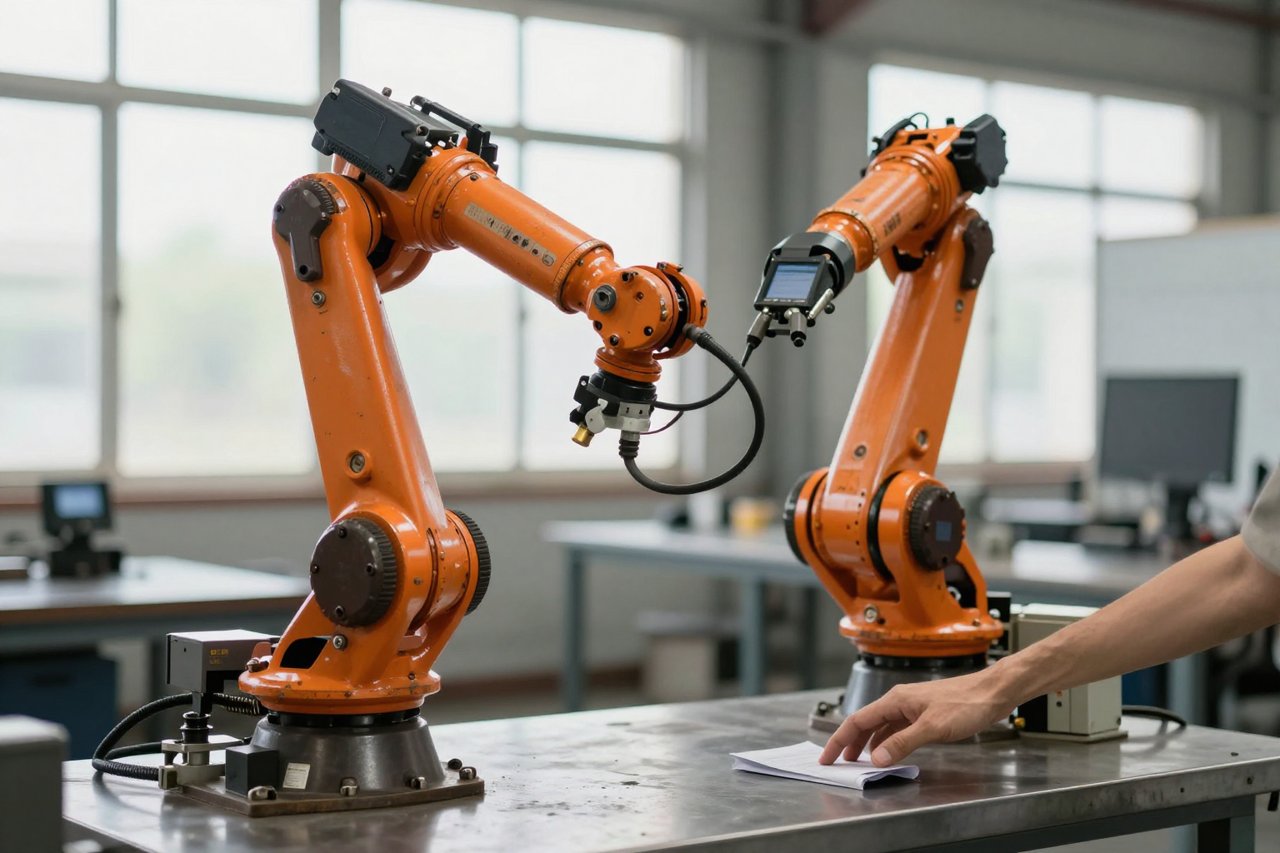
Perception is the big one. A welding arm that replays a recorded path needs no AI at all. A bin-picking arm that has to grab an arbitrary object out of a cluttered crate does: it must segment an image, estimate a grasp, and recover when the object slips. That’s a model inside a machine.
Self-driving cars are the clearest hybrid in public view: robots on wheels where almost all the difficulty sits in the software. Warehouses run the same pattern quietly, with fleets of autonomous trucks in mining pits and weeders in fields doing the same join. Robotics has also become a test bed for ideas argued over on paper for decades. Symbolic AI, which builds reasoning from explicit rules instead of learned weights, is reappearing in factory scheduling and lab automation precisely because every decision can be traced and explained.
Four combinations you actually run into
- Robot, no AI. Conveyor diverters, CNC loaders, paint booths, the Unimate. Reliable, cheap, deaf to context.
- AI, no robot. Spam filters, credit scoring, translation, AlphaGo, the model drafting your emails. No actuators anywhere.
- Both. Warehouse picking arms, autonomous haul trucks, surgical assistants. Worth noting that the da Vinci surgical system is mostly teleoperated, a surgeon’s hands at a distance rather than an AI making cuts, which is its own useful distinction.
- Neither, but called a “bot”. Chatbots, RPA scripts, scrapers. The word has stretched to cover anything running without a human clicking a button, and that stretch is a big reason the confusion survives.
Why the mix-up has consequences
Procurement is the first casualty. A logistics manager who needs to move 40,000 pallets a year sometimes ends up buying a forecasting dashboard labelled “AI-powered” because that’s the term in the budget line. The pallets stay where they are.
Law splits the same way. The EU AI Act regulates AI systems by risk level and doesn’t care whether they have wheels. Machinery safety standards such as ISO 10218 govern the arm and ignore the model. Two rulebooks, two sets of inspectors, one machine on the factory floor.
Job anxiety follows the same fault line. Physical automation hit welders, packers and machine operators first. Cognitive automation is landing on translation, first-line support and paralegal work. Different skills, different politics, different retraining budgets, and lumping them together makes both conversations worse.
Coverage rarely helps. A single week of science news can jump from a spacecraft trajectory to a battery breakthrough in three paragraphs, with a robotics demo sandwiched in the middle, and readers skim the lot as one topic.
Three questions that settle it in ten seconds
Does it have actuators, or could it? Does it sense the physical world through cameras, lidar or touch? And could the interesting part of it run on a laptop with the hardware switched off? Two yeses mean a robot. A yes to the last one means AI. Everything else is a marketing deck.
What happens as the two merge
The interesting work sits at the seam. Foundation models are being wired into robot arms so a person can say “put the red crate on the top shelf” instead of writing a motion program. Humanoid programmes from half a dozen companies are chasing the same goal with far more hardware and far less data than the software people have. The bottleneck isn’t intelligence anymore, it’s experience: robots learn to fold laundry by being teleoperated through thousands of hours of it, and that footage is expensive to collect.
Cost matters more than cleverness. When a capable arm with decent perception drops below the annual wage of a night-shift picker, deployment stops being an engineering decision and becomes a finance one. Safety standards will lag, insurers will improvise, and the useful question at every step won’t be whether something counts as a robot or as AI. It will be who is accountable when the model, the motor and the person standing nearby all get it wrong on the same afternoon.


