
Table of Contents
A 30g tin of matcha costs more than four times as much as a box of green tea bags, and most cafés charge extra to put it in a latte. There is a real reason for that, and it has nothing to do with the packaging.
Almost everything about the way matcha is made, from the shade cloth thrown over the bushes in spring to the granite wheels that grind the leaf at a trickle of a pace, exists to produce one thing: a powder fine enough to stay suspended in water. Once you can drink the leaf instead of steeping and discarding it, the flavour, the caffeine, the colour and the price all shift at once.
Shade is where matcha begins
Three weeks or so before harvest, growers cover the tea fields with cloth that blocks roughly 90% of the sunlight. The plant responds by pushing out more chlorophyll to catch what light is left, which is why the leaves end up a deep, almost blue-toned green rather than the olive of a standard green tea bush.
Something else happens under that cloth. The leaves convert less of their amino acids into catechins, so the balance tips. L-theanine, the amino acid responsible for savoury depth, stays high. The bitter, astringent compounds drop. That single change is why a good bowl of matcha tastes softly sweet and marine rather than sharp.

Only after shading is the leaf picked, steamed within hours, dried, and stripped of stems and veins. At this stage it is called tencha. It looks like dark, brittle flakes, and it tastes nothing like the drink it will become.
You drink the whole leaf, not an infusion
With a normal cup of green tea, hot water pulls out maybe a fraction of what the leaf contains, and the rest goes in the bin. Matcha skips that step entirely. The leaf is ground to a powder of around five to ten microns, finer than talc, and whisked into water. You consume all of it.
In practical terms, that means:
- Caffeine lands in a single serve. Two grams of powder, a typical bowl, carries roughly 60 to 70mg, close to a shot of espresso, but it arrives over a longer window.
- You get the leaf’s full catechin load. EGCG is the one most studied, and none of it stays locked in a spent teabag because there is no teabag.
- Fibre and chlorophyll come along too, in quantities a strained infusion simply cannot deliver.
- Nothing is wasted, which is half the reason the price per gram looks alarming next to loose leaf.
Milling is slow on purpose
A traditional granite mill turns at around 30 to 60 revolutions per minute and produces 30 to 40 grams of matcha an hour. That is not a romantic detail; it is a technical requirement. Grind faster and the friction heat scorches the powder, turning the bright green dull and the flavour flat.
Freshness matters more here than with almost any other tea. Once the leaf is powder, surface area is enormous and oxygen goes to work quickly. A matcha that smelled of fresh cream and cut grass in March can smell like dry hay by July if it has been sitting in a warm cupboard.
What it actually tastes like
People expecting a stronger version of green tea are usually surprised. Matcha is thicker, sweeter and more savoury. Good ceremonial grade has a creamy, almost broth-like quality, a whisper of spinach or nori, and a bitterness that shows up at the back of the throat and then fades. Cheap matcha is one-dimensional and chalky, with an astringency that lingers unpleasantly.
The umami you cannot get from a teabag
That savoury note is L-theanine doing its work. A steeped sencha is brighter and more citrusy because the leaf was never shaded. Matcha sits in a different part of the flavour map, closer to a light dashi than to a cup of tea.
Caffeine and L-theanine, together
Matcha’s reputation for calm alertness rests on the fact that the caffeine and L-theanine arrive in the same mouthful. L-theanine crosses into the brain and tends to soften the edge of a caffeine hit, which is why people describe the effect as steadier than coffee. A bowl contains somewhere in the region of 20 to 40mg of the amino acid, alongside the caffeine.
Worth being honest here: the human studies are small and the effect is modest. Coffee drinkers who expect a jolt may find matcha underwhelming at first. What it does well is avoid the 11am crash that follows a double espresso.
Grades, and why the labels are slippery
Terms like ceremonial, premium and latte grade are not regulated anywhere. They are marketing shorthand, and a tin can carry any of them regardless of what is inside.
What the words usually point to:
- Ceremonial grade comes from the first spring harvest, is de-stemmed carefully, and is intended for whisking into plain hot water. Expect a vivid emerald colour and a sweet, rounded finish.
- Koicha grade is the top tier, made for thick tea at roughly double the powder-to-water ratio. It should be smooth enough to drink almost syrupy, with no bite at all.
- Culinary or latte grade uses later harvests and includes more stem and vein material, so it is greener-brown and more bitter. Perfectly fine blended with milk and honey, unpleasant on its own.
Ignore the badge and look at the powder itself. Bright jade, a fine powdery feel between the fingers, and a sweet vegetal smell are better indicators than any word on the front. A harvest or production date on the tin is worth more than all of it.
Brewing takes ninety seconds
Use one to two grams, which is half to one level teaspoon. Sift it through a small strainer first, because clumps will not break up in the bowl and you will end up with dry pockets stuck to the ceramic.
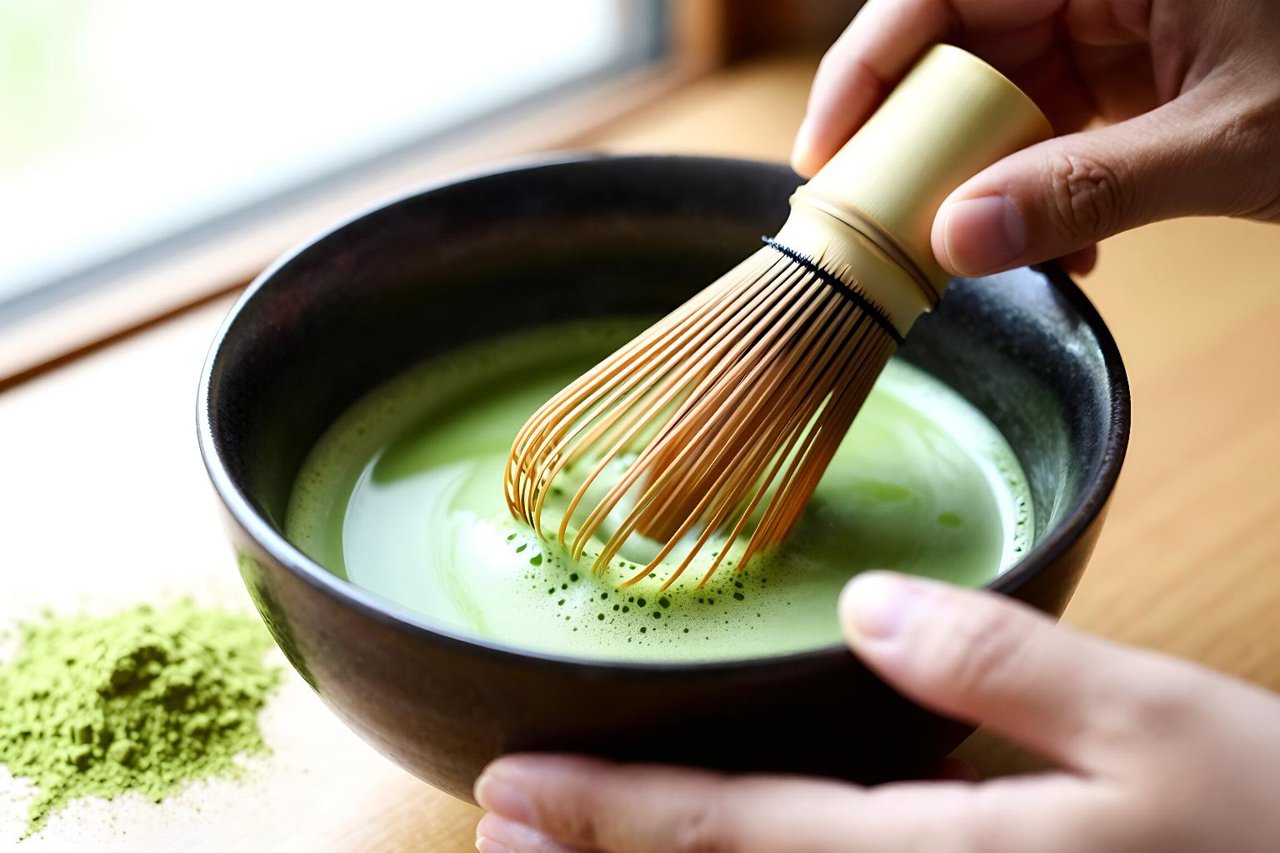
Water should be somewhere between 70°C and 80°C, not boiling. Around 60 to 80ml is enough for a bowl of usucha. Whisk in a quick W motion with a bamboo chasen for 15 to 20 seconds, keeping the tips of the whisk near the base of the bowl, until a fine foam sits on top. Drink it straight away.
For a latte, whisk a thicker paste first with a splash of water, then top with hot milk at around 65°C. Oat milk works well; the sweetness of barista oat carries the grassy notes rather than smothering them.
Keeping a tin from turning to hay
Matcha declines faster than any other tea in the cupboard, so storage is not a minor detail. Keep it airtight, away from light and heat, and out of the spice drawer where it will pick up neighbours. A sealed tin in the fridge is fine, but let it come to room temperature before opening, otherwise condensation forms inside and the powder clumps and dulls.
Once a tin is open, plan to finish it within four to six weeks. Buy 30g rather than 100g unless you drink two bowls a day. If the colour has faded to a dull army green or the smell reminds you of a lawnmower, it will still whisk up, but it will taste tired, and no amount of honey will fix that.


