
Table of Contents
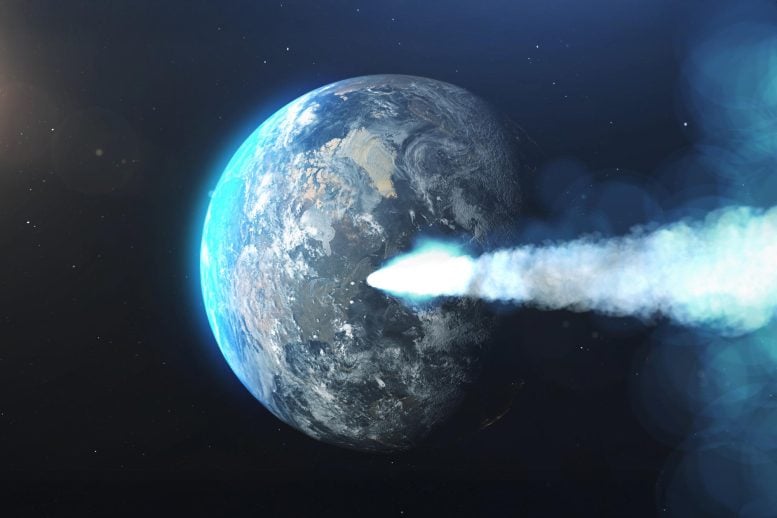
Emerging evidence suggests Earth has endured far more hidden cosmic explosions than once believed.
Touchdown airbursts, a form of cosmic impact that may occur more often than the crater-producing events known for wiping out the dinosaurs, are still not fully understood. UC Santa Barbara Earth Science Emeritus Professor James Kennett and his colleagues continue to argue that these powerful explosions deserve far more scientific attention.
“Touchdown events can cause extreme damage through very high temperatures and pressures,” Kennett said. “And yet they don’t necessarily form a crater, or they form ephemeral surface disturbances, but they’re not the classic major craters that come from direct impacts.”
Four recently released studies from Kennett and his co-authors highlight evidence for multiple airbursts from different periods in Earth’s past. In these events, an incoming object such as a comet detonates above the surface and releases intense heat and shockwaves. The researchers documented new findings from locations ranging from the deep North Atlantic to the remains of an ancient desert community. Their work points to materials that form only under extreme conditions, such as rare comet-derived elements, molten glass, and spherules produced by high-temperature melting of Earth materials, and shocked quartz that contains distinctive fracture patterns.
New evidence in the marine record
A study in the journal PLOS One describes the first discovery of impact proxies in ocean sediments linked to the Younger Dryas Impact Hypothesis (YDIH). These clues were identified in several deep-sea cores taken from Baffin Bay, just west of Greenland.
“Baffin Bay is very significant because it’s the first time we’ve found evidence for the Younger Dryas cosmic impact event in the marine record,” Kennett said.
The Younger Dryas hypothesis proposes that a fragmented comet exploded above Earth approximately 12,800 years ago. This event is thought to have triggered an abrupt cooling period known as the Younger Dryas, contributed to the disappearance of many large animals, and influenced major shifts in human cultures and populations. Because the comet broke apart, multiple explosions likely caused widespread fires that left behind a “black mat” layer rich in carbon.
The layer, which has been found mostly in the Northern Hemisphere at sites across the Americas and Europe, also contains peak abundances of platinum and iridium, as well as metallic melt spherules, shocked quartz, and minerals fused together forming meltglass.
“They’re preserved in marine sediments as deep as about 2,000 meters,” Kennett said. The presence of these proxies doesn’t say anything in particular about the actual shocks, he explained, but rather illustrate their force, reach and allude to the event’s subsequent climatological impacts. “The material was thrown up into the atmosphere, and was globally transported and deposited in a broadly distributed layer that we earlier have described.”
Potentially the first known crater of Younger Dryas Boundary (YDB) Age
Impacts with Earth by extraterrestrial material vary in magnitude from the daily bombardment of Earth by tons of fine extraterrestrial dust to the dinosaur killers that occur on a timescale of tens of millions of years. Because the more extreme events leave their marks on Earth in the form of craters, much of the “gold standard” evidence of cosmic impacts is aligned with these structures and the character of associated material.
As a result, proving the occurrence of a touchdown airburst becomes a challenge, given that there are typically no deformations in the landscape. This makes it very difficult to prove such an occurrence in the same way that the Chicxulub crater off Mexico’s Yucatán Peninsula has been linked to the massive impact that led to the extinction of dinosaurs.
“Previously, there has been no evidence for the Younger Dryas boundary (YDB) event of any crater or possible crater,” said Kennett. “So these events are more difficult to detect, especially when they are older than a few thousand years and after being buried, leave little or no superficial evidence.”
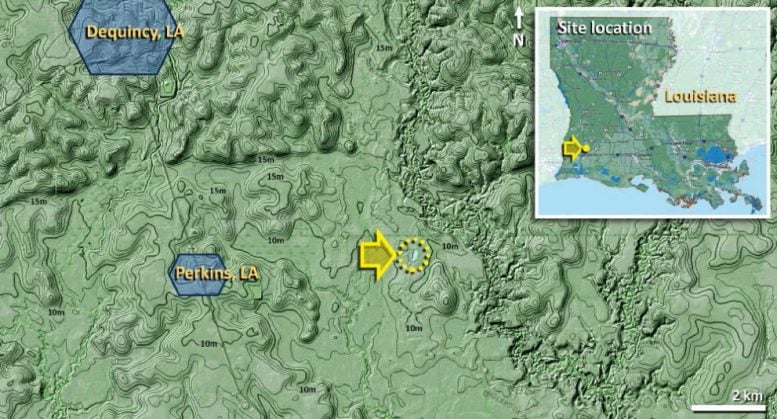
However, a shallow seasonal lake near Perkins in southeast Louisiana could be the first known such crater formed during the YDB. Reporting in the ScienceOpen journal Airbursts and Cratering Impacts, the research team followed up on a speculation first made in 1938 by the property owner that the seasonal lake could be an impact crater based on its shape and a “crater-like rim raised about 1 meter above the surrounding terrain.”
It wasn’t until 2006 that the sediments in and around the shallow depression began to be examined for impact proxies; from then until 2024, the team also examined sediment from several lake cores, finding spherules, meltglass and shocked quartz, which they determined by radiocarbon dating to support the Younger Dryas impact event. Nevertheless, the researchers said that “further research would be beneficial for testing the hypothesis that the lake/depression resulted from a cosmic impact.”
Tunguska and Tall el-Hammam revisited
Shocked quartz — grains of quartz that show fractures and cracks that could only have been produced by high temperatures and pressures — have long been considered evidence for impact. However, this line of reasoning has typically been reserved for the larger crater-forming impacts, which tend to form parallel fractures in this hard material. In a pair of papers in Airbursts and Cratering Impacts, the researchers continue to bolster their argument for a range of fracture patterns that could be indicative of airbursts. To do so, they examined sediments from the site of the Tunguska event — an airburst that occurred over Siberia in 1908, and revisited evidence from Tall el-Hammam, the site of a major ancient city in the Levant that is thought to have experienced a similar-sized event about 3,600 years ago.
“The interesting thing about Tunguska is that it is the only recorded historical touchdown event,” Kennett said, and indeed, there are documented eyewitness reports of a fireball in the sky, and photographs of flattened trees. However, for all the studies of the fallen trees and the soils at the impact site, there had up until now been little effort in search of cosmic impact proxies. This study is the first comprehensive evidence of airburst/impact proxies at Tunguska.
The researchers’ analysis of Tunguska revealed shocked quartz grains with the telltale planar deformations and fractures, some filled with meltglass. In addition, they found impact-produced spherules and melted metal and carbon. The high energies related to this impact may also have produced small ground depressions, now existing as swamps and lakes.
Meanwhile, they also expanded their evidence for a proposed Middle Bronze Age-era airburst over Tall el-Hammam in the southern Jordan Valley. In addition to previous reporting of the usual suspects of spherules, carbon, meltglass, and rare minerals, the researchers have described shocked quartz with a variety of fracture patterns similar to those in Tunguska sediments, including the classical parallel cracks, but also web-like, curved, and sub-planar fissures, indicative of a range of high pressures and directionality resulting from the blast.
Taken together, these papers point to the idea that cosmic impacts, and in particular touchdown airbursts, may occur more often than previously thought.
“They’re far more common, but also possess much more destructive potential than the more localized, classic crater-forming asteroidal impacts,” said Kennett. “The destruction from touchdown events can be much more widespread. And yet they haven’t been very well studied, so these should be of interest to humanity.”
References:
“A 12,800-year-old layer with cometary dust, microspherules, and platinum anomaly recorded in multiple cores from Baffin Bay” by Christopher R. Moore, Vladimir A. Tselmovich, Malcolm A. LeCompte, Allen West, Stephen J. Culver, David J. Mallinson, Mohammed Baalousha, James P. Kennett, William M. Napier, Michael Bizimis, Victor Adedeji, Seth R. Sutton, Gunther Kletetschka, Kurt A. Langworthy, Jesus P. Perez, Timothy Witwer, Marc D. Young, Mahbub Alam, Jordan Jeffreys, Richard C. Greenwood and James A. Malley, 6 August 2025, PLOS ONE.
DOI: 10.1371/journal.pone.0328347
“New Evidence of High-Temperature, High-Pressure Processes at the Site of the 1908 Tunguska Event: Implications for Impact and Airburst Phenomena” by Gunther Kletetschka, Marian Takac, Lucie Smrcinova, Radana Kavkova, Dallas Abbott, Malcolm A. LeCompte, Christopher R. Moore, James P. Kennett, Victor Adedeji, Timothy Witwer, Kurt Langworthy, Joshua J. Razink, Valerie Brogden, Brian van Devener, Jesus Paulo Perez, Randy Polson, Teresa M. Eaton, Matthew J. Valente, David B. Lanning Jr., Yoav Rapoport, Argyro Reyes, Ravi Holladay, Michelle Madrigal, Aleksei Kiselev and Allen West, 8 February 2025, Airbursts and Cratering Impacts.
DOI: 10.14293/ACI.2025.0001
“Evidence of a 12,800-year-old Shallow Airburst Depression in Louisiana with Large Deposits of Shocked Quartz and Melted Materials” by Robert Fitzenreiter, Kord Ernstson, Gunther Kletetschka, Malcolm A. LeCompte, Christopher R. Moore, James P. Kennett, Michael Bizimis, Florian Hofmann, Marian Takac, A. Victor Adedeji, Timothy Witwer, Julie E. Chouinard, Jesus Paulo Perez, Marc D. Young, Teresa M. Eaton, Matthew J. Valente, David B. Lanning Jr., Yoav Rapoport, Kailey Ellison, Argyro Reyes, Ravi Holladay, Michelle Madrigal, Julian Albanil, Charlie Sanchez and Allen West, 4 June 2025, Airbursts and Cratering Impacts.
DOI: 10.14293/ACI.2025.0004
Never miss a breakthrough: Join the SciTechDaily newsletter.
Follow us on Google and Google News.