
Table of Contents
Walk into any health food shop and you’ll find spirulina in at least three forms: a green powder in a tub, tablets in a brown glass bottle, and something startlingly blue that looks like food colouring. It gets sold as a superfood, blamed for tasting like a pond, and bought on habit by people who haven’t thought about it in years.
Strip back the marketing and spirulina is a simple thing: dried algae. It has an unusual nutrient profile, a long history as an actual food, and real-world uses that stretch well beyond smoothies.
What Spirulina Actually Is
Spirulina is dried cyanobacteria, and the species in almost every commercial product is Arthrospira platensis. It grows in shallow, warm, alkaline water, then gets harvested, rinsed and dried at low temperatures. The name comes from the shape: under a microscope the filaments coil into tight spirals.
That’s the whole trick. It isn’t a seaweed, a grain, or a plant. It’s a microorganism that photosynthesises like a plant and, once dried, lands at roughly 55 to 70 percent protein by weight. Cooked lentils sit near 9 percent and a chicken breast around 31 percent. Spirulina’s number is dry-weight, so the comparison isn’t quite fair, but the density is still why it gets called a protein source.

People have eaten it for a very long time. Communities around Lake Chad have dried spirulina into flat green cakes called dihé and stirred them into sauces for centuries. The Aztecs harvested a related species from Lake Texcoco.
What’s actually in it
A typical 100g of dried powder contains roughly:
- Protein: 55 to 70g, with a decent amino acid spread, though low in methionine and cysteine
- Iron: about 28mg, more than double beef liver per 100g, though plant-based iron absorbs less efficiently
- Vitamin B12: present, but mostly as pseudocobalamin, which the body can’t use. Vegans should not count spirulina as a B12 source
- Phycocyanin: the blue-green pigment, an antioxidant studied in its own right
- Gamma-linolenic acid (GLA): an omega-6 fat also found in evening primrose oil
- Beta-carotene, chlorophyll, and modest amounts of potassium and magnesium
Worth flagging: spirulina is not a meaningful source of vitamin D or calcium, whatever some labels imply.
How Spirulina Is Used
In food and drink
The most common use by far is a spoonful of powder stirred into something else. Smoothies, orange juice, yogurt, porridge, energy balls, dips. A typical serving is 3 to 5 grams, about one heaped teaspoon. Add more and the taste takes over the glass.
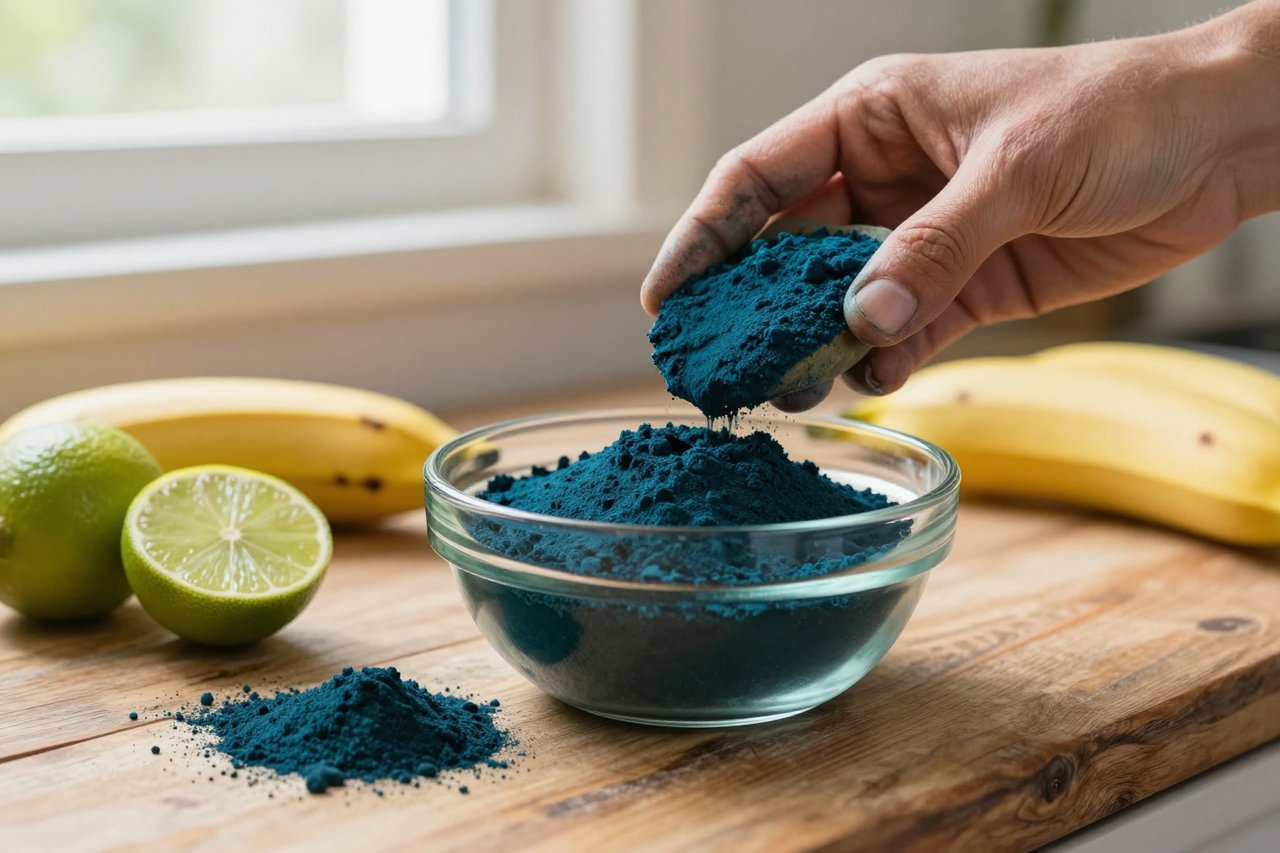
There’s also a fast-growing market for phycocyanin, sold as “blue spirulina.” It’s an extract of the pigment rather than the whole algae, so it has almost no flavour and gets used to colour ice cream, smoothie bowls and cocktails a vivid electric blue. It’s a colourant, not a protein supplement.
Smaller niches exist too: spirulina pasta in Italy and Japan, spirulina-enriched bread, and flakes sprinkled over rice.
As a supplement
Tablets and capsules usually deliver 500mg to 1g each, with labels suggesting 1 to 3g a day. Clinical studies have gone higher, using 1 to 8g daily for eight weeks or more. Capsules exist mainly to solve the taste problem.
Outside the kitchen
Spirulina’s biggest commercial use isn’t human food at all. It’s aquaculture. Fish hatcheries and shrimp farms feed it to larvae too small to eat pellets, because the particles are the right size and highly digestible. Poultry farms use it to deepen egg yolk colour. Researchers are also testing spirulina ponds as a way to capture CO2 from flue gas and to strip nitrogen and phosphorus out of wastewater.
What the Research Actually Shows
Honest answer: promising, not miraculous. Most trials are small, often 20 to 60 participants, and plenty are funded by producers.
A few findings hold up reasonably well. Several trials found modest improvements in LDL cholesterol and triglycerides, generally at 4 to 8g daily over 8 to 12 weeks. A handful of small studies on allergic rhinitis found symptom relief comparable to a mild antihistamine. There’s some evidence for lower markers of exercise-induced muscle damage. Results on weight loss are weak and inconsistent.
What it won’t do: replace a multivitamin, cure anaemia, or detox anything.
Getting Past the Taste
Fresh spirulina smells faintly of the sea. Powder that smells fishy or like a stagnant pond is usually old or oxidised.
- Start with half a teaspoon, not a tablespoon
- Pair it with something sour or sweet: lime, pineapple, mango, ginger
- Banana masks it better than berries do
- Don’t stir it into hot liquid. Heat dulls the colour and pushes the seaweed flavour forward
- Blend rather than whisk, because the powder clumps badly
If you still can’t stand it, tablets exist for good reason, and blue spirulina gives you the colour without the flavour.
Buying It Without Getting Burned
Spirulina grows in open ponds, which means it can pick up whatever else is in that water. Two contaminants matter: heavy metals such as lead and mercury, and microcystins, toxins produced by other cyanobacteria that sometimes bloom alongside it.
Buy from brands that publish third-party lab results. Look for organic certification where it’s available, and steer clear of anything described as wild-harvested from a lake, which carries the highest contamination risk. Good powder is a deep, saturated blue-green and smells clean. A 500g pouch typically runs $20 to $40. Much cheaper than that and something is off.
Who Should Be Careful
People with phenylketonuria should check with a doctor, since spirulina contains phenylalanine. Anyone on immunosuppressants or with an autoimmune condition should get advice first, because spirulina can stimulate the immune system. Pregnant and breastfeeding women are usually advised to skip it for lack of safety data. And if you take blood thinners, mention the vitamin K content to your pharmacist.
How to Start Using It
Half a teaspoon a day for the first week, then build to one or two teaspoons, always with food. Keep the tub sealed and away from light and heat, and finish it within about six months of opening. The phycocyanin degrades over time and the colour fades from deep teal to a dull olive, which is your cue that it’s past its best.
Give it eight weeks before deciding whether it earns its shelf space. If you notice nothing at all and you weren’t using it as a protein or iron top-up, that’s a perfectly legitimate answer. It’s a food, not a fix.


