
Table of Contents
Ask ten women who train martial arts why they started and you’ll get ten different answers. One wanted to stop planning routes home after dark. Another was bored of fitness classes where the instructor counted reps at her like she wasn’t in the room. A third signed up because her daughter did, and she was tired of watching from a plastic chair.
What they usually have in common shows up about eight weeks in. Training stops being a workout and becomes a skill. You know where your hands go when someone grabs your wrist, you can hold your own for three rounds, and the walk to the car at 10pm feels different.
Why martial arts beat most gym routines for women
Commercial fitness built for women leans hard on appearance. Martial arts lean on capability, and progress is easy to see without a mirror. You spar four rounds instead of two. A technique that made no sense in week one lands cleanly in week ten. Your coach stops repeating the same correction.
The strength gains are a side effect, and a decent one. Three sessions a week of Brazilian jiu-jitsu will build grip strength, hip mobility and back endurance that a machine circuit won’t get near. The real engine is technique. Leverage and timing let a 60kg woman control someone 20kg heavier. That’s mechanics, not motivational talk.

The best martial arts for women, assessed honestly
There’s no overall winner. The right pick depends on whether you want self-defence, competition, fitness or a bit of all three. Here’s how the main options play out.
Brazilian jiu-jitsu
Ground fighting, grips, chokes and joint locks, trained live against a resisting partner from the first month. BJJ is probably the strongest choice for a woman who wants a skill that works against a larger, stronger attacker at close range, because the entire art is built around removing strength from the equation. Classes run 60 to 90 minutes with 20 minutes of sparring at the end. Expect to be confused for three weeks and hooked by week six.
Muay Thai
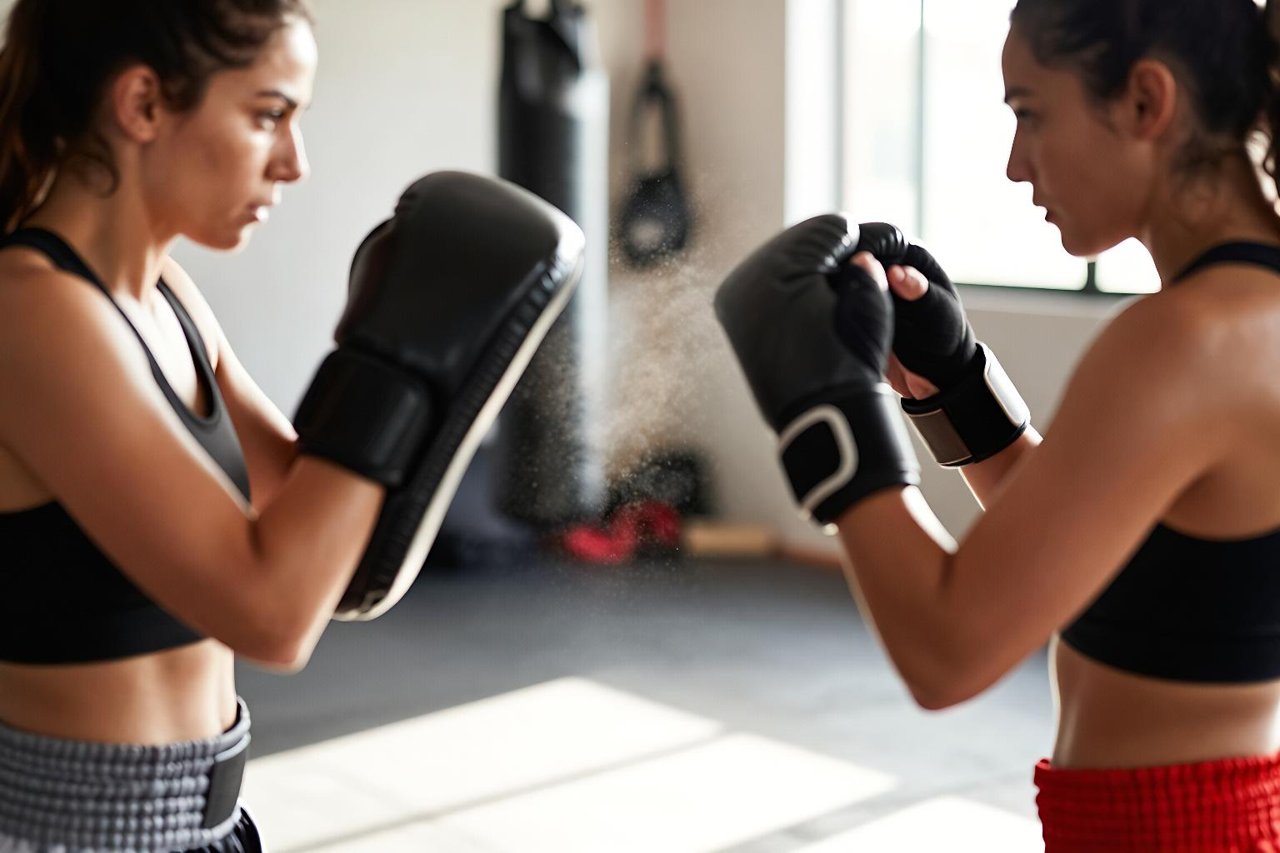
Eight points of contact: fists, elbows, knees, shins, plus clinch work in the rougher versions. It’s the best cardio on this list by a distance, and pad work gives you immediate feedback on power. Beginners spend most of the first month on stance and the basic one-two. Knees and shins bruise. You get used to it faster than you’d think.
Boxing
The cheapest entry point and the easiest to find. Footwork, head movement and a sharp jab will do more for real-world confidence than most people expect, and bag rounds double as stress relief after a bad day at work. Look for a gym that teaches defence properly and doesn’t treat sparring as a rite of passage.
Krav Maga
Self-defence first: escapes from chokes and grabs, defences against weapons, scenario work. Useful, and the basics come quickly. Quality varies wildly between schools, though, and some run it as a fitness class with shouting. Ask how much time is spent pressure testing and whether scenarios are done at realistic speed.
Judo
Throws, trips and pins, with an Olympic sport attached. Judo teaches you to fall safely, which is a life skill that pays off on ice and stairs, and the gripping battles build serious upper-body strength. It’s physically demanding, so give yourself proper recovery time between sessions.
Karate and taekwondo
Both offer structure, clear grading and excellent kicking ranges, plus class times that suit families. Traditional schools vary enormously: some spar hard and often, some barely touch contact. Visit two and watch a senior class before deciding.
Questions to ask before you sign a contract
- How far is it, door to door? Anything over 20 minutes each way will quietly kill your attendance by month three.
- What’s the split between drilling and standing in a queue? You want at least 60% of the class moving.
- Is sparring optional, coached and matched by size and experience?
- Are there other women training, and in which classes? A gym with two women in the advanced class and none in beginners tells you something.
- Is there a proper beginner intake, or will you be dropped into an open class on day one?
- Can you pay monthly? A 12-month contract before your first class is a red flag.
Do you need to get fit first?
No. Nobody arrives ready, and coaches expect complete beginners. That said, a bit of base conditioning makes the first month far less miserable, particularly if you build up your grip, hips and lower back. A single kettlebell covers a lot of ground at home: this breakdown of how to get lean, strong and flexible with kettlebells alone is a solid starting point between classes.
Gym culture will decide whether you stay
You can pick the strongest style on paper and still quit in six weeks because the room felt wrong. The signals are usually obvious on a trial class: does the instructor learn names, do senior students help beginners unasked, does anyone spar at full power with someone half their size?
Male training partners matter here. Most women’s first difficult moment involves a guy who uses strength instead of technique and calls it toughness. Good gyms shut that down immediately. The culture spreads when men do the work of showing up differently, and the wider conversation about where the sensitive men rising movement is heading touches the same nerve: strength that doesn’t need to prove itself.
What the first three months feel like
Week one is humbling. You forget the sequence, your forearms ache from gripping, and you’re sore in places you forgot existed. Weeks two to four are the grit test, and attendance is the only thing that matters. Around week six something clicks: you stop thinking about where your feet go and start noticing what your partner is about to do.
By month three you’ll have a handful of techniques you can actually land on a resisting opponent. That’s a different kind of confidence to the one you get from a personal best on a treadmill.
Recovery is part of the programme. Bruises, sore hands and a tired nervous system all need time, so build in two rest days. If you want something to fill one of those evenings that isn’t a training video, this roundup of the best shows on Max right now will do the job.
Kit worth buying, and what can wait
- A properly fitted mouthguard, custom moulded if you plan to spar. Around £40 and non-negotiable.
- 16oz boxing or Muay Thai gloves for pad work, 12oz for the bag if you’re on the lighter side.
- Two pairs of hand wraps, washed often.
- Leggings or shorts with no zips or pockets, plus a rash guard for no-gi classes.
- Flip flops for walking to and from the mat. Mat hygiene is not optional.
Skip the branded gi and the shin guards until you’ve trained a month. Most gyms lend gloves for the first few classes.
How to choose this week
Pick two arts that appeal and book a trial at one gym for each, ideally on consecutive days so you can compare while the feeling is fresh. Turn up 15 minutes early, watch the last ten minutes of the class before yours, and talk to two students who aren’t being paid to talk to you.
Then apply one rule: choose the gym you’d realistically attend on a wet Tuesday in February. A brilliant style 40 minutes away loses to a good style ten minutes away, every single time. The best martial art for women isn’t the one with the loudest reputation. It’s the one you’ll still be turning up to next year, with a mouthguard in your bag and a coach who knows your name.


