
Table of Contents
Paying cash for a car sounds like the easiest transaction on earth. Hand over the money, take the keys, drive away. Then you actually do it once and realise the hard part isn’t the money — it’s everything happening in the two hours before the handover. The lien nobody mentioned. The odometer that doesn’t match the service records. The seller who wants a $500 deposit via a payment app for a car you haven’t seen in person.
Cash buyers have genuine advantages. You just have to use them instead of letting them become the reason you get sloppy.
Why cash actually changes the negotiation
Dealerships make a meaningful chunk of profit from arranging loans — the rate markup, the origination fee, the products bundled in. A $15,000 car financed at 8% over 60 months costs the buyer roughly $3,000 in interest. Some of that is money the dealer never sees, but enough of it is that walking in as a cash buyer removes a revenue line.
That doesn’t mean the salesperson will knock $2,000 off the sticker out of gratitude. It means your offer is cleaner and closes faster, which has real value to a dealer holding a car that’s been sitting for 70 days. Private sellers care even more. Someone selling a 2014 Corolla on Facebook Marketplace for $8,200 usually wants a clean, fast, certain sale — and a cash buyer with a pre-purchase inspection already booked is exactly that.

Set your number before you open a single listing
The purchase price is not your budget. Your budget is the purchase price plus tax, title and registration, the first insurance payment, and whatever the car needs in the first month — tyres, an alignment, a battery, an oil change.
A reasonable rule: take the cash you’re willing to spend, subtract $1,200 for immediate repairs and fees, and that’s your actual ceiling on the sticker. On a $10,000 budget, you’re shopping $8,800 cars and keeping the rest liquid. This one habit prevents more bad decisions than any negotiation tactic.
Get an insurance quote using the VIN before you commit to anything. Some cars — certain trim levels, certain theft-prone models — cost noticeably more to insure than the seller’s asking price suggests.
Where cash buyers find the best cars
Private sellers
Marketplace, Craigslist, community noticeboards, the neighbour whose car has a hand-written sign in the window. Cash is the native currency here. You also get more honest history, because you’re talking to the person who actually drove the car for six years.
Auctions and fleet sales
Ex-government and fleet vehicles are usually sold with service records and no sentimental attachment to price. The catch is you often can’t test drive, and the cars are sold as-is. If you’re considering that route, read up on how to buy a government vehicle without overpaying for someone else’s old fleet car before you register to bid.
Dealerships
Negotiate the out-the-door price first, before you mention how you’re paying. If you announce cash in the first five minutes, some salespeople stop discounting the car because they’ve lost the finance profit and have nothing left to trade. Get the total in writing, then say: “I’m paying cash, and I’ll sign today at this number.”
Verify the car before any money moves
Book a pre-purchase inspection at an independent shop — usually $100 to $200 — and pay for it yourself. A mechanic on a lift will find things a 20-minute test drive won’t: leaking struts, a weeping head gasket, frame rust, mismatched paint from a repaired collision.
Check the VIN against the title and the door jamb plate. Run it through a title history service to look for salvage branding, flood damage, or an open lien. If the car has a rebuilt title, that’s not automatically a deal-breaker, but you need to understand what you’re buying — buying a salvage car without inheriting a money pit is a different process from buying a clean one, and the resale value reflects it.
Water damage is the one that hides best. Musty smells, fogged headlights, grit under the carpets, and fresh-looking wiring in a 10-year-old car are all warnings. There’s a detailed walkthrough on how to spot a flood-damaged car without buying someone else’s headache if the price seems suspiciously good.
The paperwork that protects you
Get a written bill of sale, even from a friend. It should show the date, the sale price, the VIN, the odometer reading, both names, both signatures, and the words “sold as-is.” Print two copies.
Confirm the seller’s name matches the name on the title exactly. A car sold by “my brother, he’s out of town” is a title problem waiting to happen. If you’re buying across a state line, the registration rules change and the clock starts ticking faster than you’d expect — this guide to buying a car from another state without getting stranded at the DMV covers the forms and timing.
How to hand over the money safely
Meet at the seller’s bank or yours, or in a police station car park during daylight. Never hand a stranger five figures in an alley behind a supermarket.
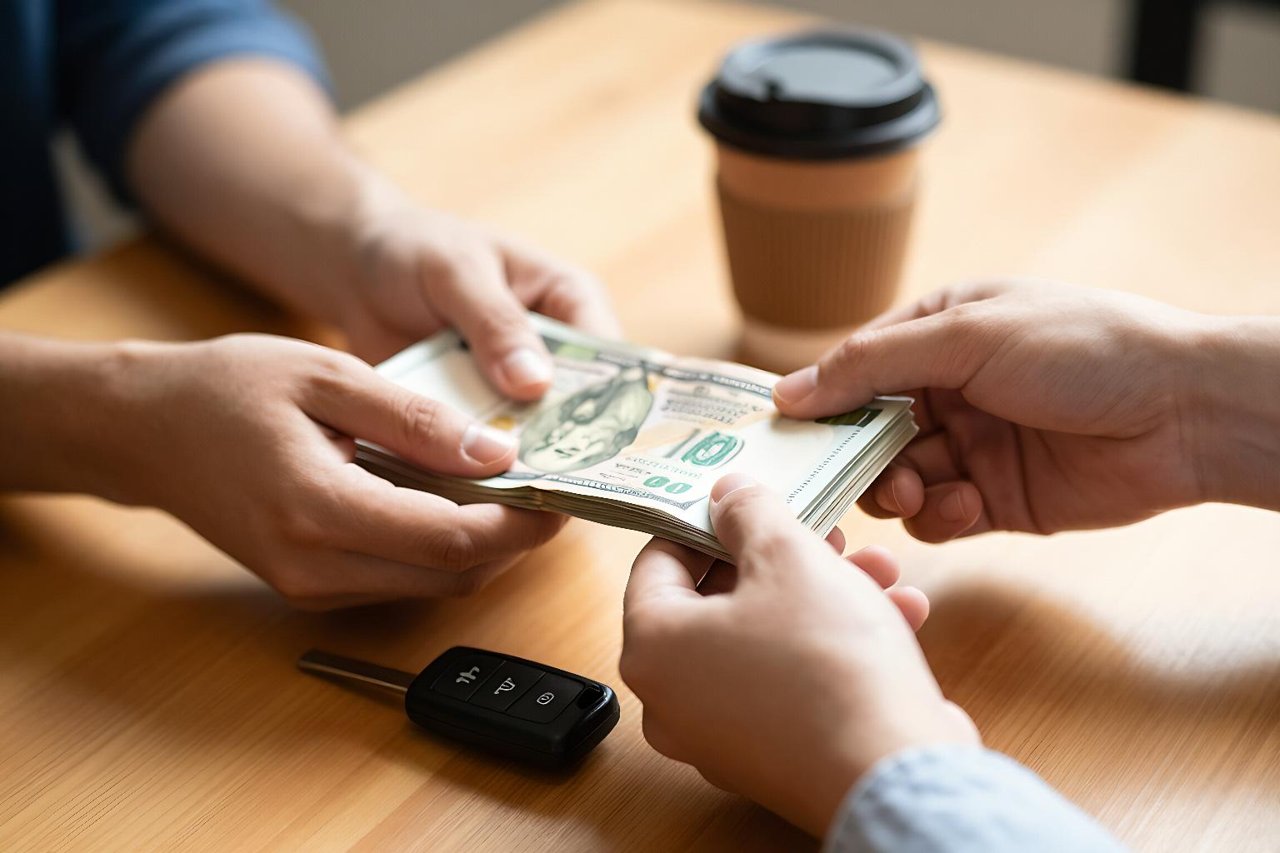
For anything above a few thousand dollars, a cashier’s cheque in the seller’s name is safer than a brick of notes — it can’t be stolen and spent. If the seller insists on cash, withdraw it inside the bank, walk out with the seller, and count it together in the lobby. Banks have cameras and staff who have seen every scam there is.
- Sign the bill of sale and both copies of the title before the keys change hands.
- Get a written receipt for the exact amount, dated and signed.
- Confirm the seller removes their insurance and you add the car to yours before you drive off — most policies won’t cover a car you don’t yet own on paper.
- Never send a holding deposit through a payment app to someone you haven’t met and whose car you haven’t inspected.
- Take the keys, the title, and any spare fobs there and then. Chasing them later is a nightmare.
Using cash as a negotiation tool (without being a pain about it)
Ask for the out-the-door price rather than the sticker. Let the seller give you a number first. When an inspection turns up worn brakes or a leaking seal, quote the repair estimate and ask for that amount off — that’s arithmetic, not haggling, and most sellers accept it.
Keep two or three cars in play. The single biggest source of overpaying is falling in love with one vehicle before you’ve seen the second one. Silence after an offer is uncomfortable and effective; you don’t have to fill it.
When your cash doesn’t stretch to the whole car
Paying 70% down and financing a small balance is a perfectly reasonable move, and it often beats draining every account on a car. If you’ve never borrowed before, though, the offers you get can be ugly — there’s a reason this piece on buying a car with no credit history without paying a fortune for it exists. The same applies if the plan is to put nothing down and keep your savings intact; that route has its own traps, covered in how to buy a car with no down payment without getting trapped by the loan.
Know when to walk away
The seller won’t let an independent mechanic look at it. The VIN on the dash doesn’t match the title. They want cash today, before the weekend, no exceptions. Someone else is “on their way with the money right now.” Any of those is a reason to leave, and you’ll lose nothing but a Saturday morning.
Cash makes you a attractive buyer — decisive, uncomplicated, no bank in the middle. It also means that once the money is gone, it’s gone. The buyers who do well are the ones who use their speed as leverage during the deal and their patience as protection before it.


