
Table of Contents
Ask anyone who has spent a week trying to get a robot to do something a five-year-old manages without thinking, and you will hear some version of the same sentence: it works in the lab. Pick up a grape. Fold a towel. Plug in a USB cable. The gulf between a polished demo video and a machine that runs 20 hours a day, 350 days a year, is where most of the difficulty in this field actually lives.
That gap explains why Amazon has more than 750,000 mobile robots moving shelves around its warehouses while the picking jobs still belong overwhelmingly to people. Transport on flat concrete is solved. Manipulation in clutter is not. Here is a look at what are the biggest challenges in modern robotics, and why each one resists the obvious fix.
Hands Are Still the Hardest Problem
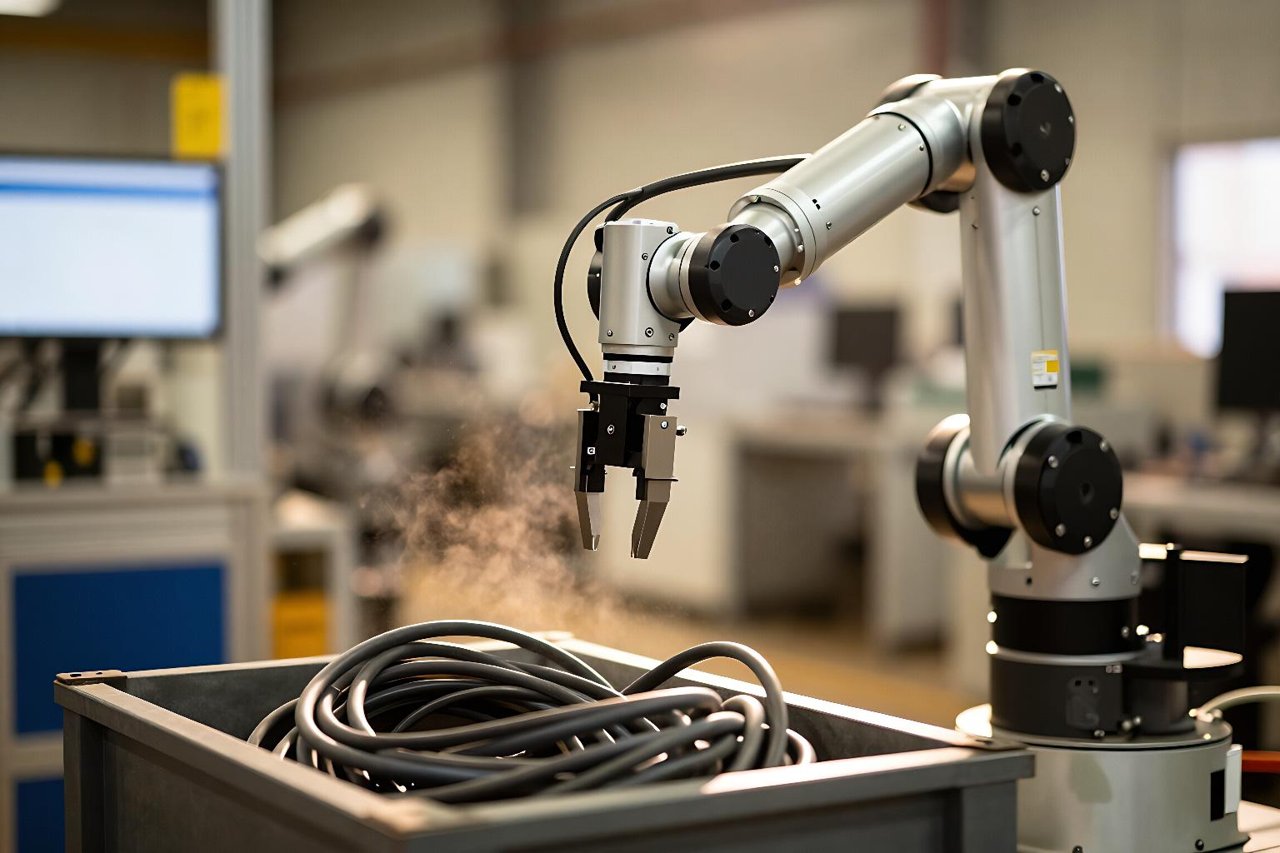
The human hand has roughly two dozen degrees of freedom and thousands of tactile receptors packed into each fingertip. No gripper on the market comes close at a price a factory will pay. Most deployed robots still use two-finger parallel jaw grippers, because they are cheap, rigid, and predictable. They also cannot rotate a part inside the grip, feel a slip starting, or pick up a ripe peach without bruising it.
Touch sensing is the bottleneck inside the bottleneck. Cameras got cheap because they scaled with the smartphone industry. Tactile sensors did not. A research-grade multi-axis force-torque sensor can cost more than the robot’s entire wrist and dies quietly if someone bumps it too hard. OpenAI’s Dactyl experiment remains the clearest proof of concept: a Shadow hand learned to solve a Rubik’s cube one-handed, but the rig cost tens of thousands of dollars and the training run was measured in months of simulated experience.

Perception Falls Apart Outside the Lab
Depth cameras are astonishingly good now, until the scene fights back. Clear plastic bottles scatter or absorb infrared light. Polished aluminum gives stereo vision nothing to match. Black rubber matting on a black conveyor belt produces a hole in the point cloud where the object should be. Any engineer who has deployed a bin-picking cell has a story about the one SKU that broke the whole pipeline.
The mathematics of reliability makes this brutal. A system that succeeds 99 times out of 100 sounds excellent until you run the numbers at production rates. At 1,500 picks per hour, a 1% failure rate means 15 interventions every hour, and each one needs a human to walk over. Getting from 99% to 99.9% is often a bigger engineering project than building the first version.
The Sim-to-Real Gap Refuses to Close
Training robot policies in simulation is fast, cheap, and safe. A modern physics engine can run thousands of parallel environments on a single GPU, compressing years of experience into a few hours. The trouble is that simulated contact is a lie. Real surfaces have micro-slip, stick-slip friction, flex, dust, and temperature-dependent behavior that no engine models perfectly.
Engineers paper over the difference with domain randomization, jiggling friction coefficients and masses until the policy stops relying on any single simulated detail. That works remarkably well for locomotion and grasping of rigid objects. It works poorly for cloth, cables, food, and anything where the physics of deformation dominates. Collecting the real-world data to fine-tune those policies is slow, because every demonstration needs a human, a rig, and a reset.
Safety Around People Is a Design Constraint, Not a Feature
Collaborative robots get marketed as friendly coworkers, and the standards behind that claim are serious. ISO 10218 and ISO/TS 15066 lay out requirements that shape everything from motor sizing to sensor redundancy. Typical measures include:
- Power and force limiting, so a collision delivers no more pressure than a defined threshold on each body region
- Speed and separation monitoring, with safety-rated scanners slowing the arm as a person approaches
- Redundant emergency stops and monitored standstill, verified rather than assumed
- Formal risk assessment for every task, fixture, and workflow change
The awkward part is that safety systems and productivity pull in opposite directions. A robot that slows to a crawl whenever someone walks within two meters is safe and also useless in a busy aisle. Getting useful speed with certified safety takes careful cell design, and most integrators will tell you the guarding and validation cost more than the arm.
Power, Heat, and the Limits of Actuators
Lithium-ion cells sit around 250 to 300 watt-hours per kilogram. Gasoline is roughly 12,000. That ratio shapes every mobile robot design decision. Boston Dynamics’ Spot runs for about 90 minutes of hard work. Humanoid platforms from Agility and Figure measure runtime in hours, not shifts, and battery swaps become a logistics problem of their own.
Heat is the quieter constraint. Joints are sealed, small, and asked to deliver high torque continuously. Motors derate as they warm, gearboxes lose efficiency, and suddenly the payload figure on the spec sheet does not hold after the fourth hour of a shift. Backdrivable actuators that are safe around people tend to be less stiff, which makes precise positioning harder. Every actuator choice is a trade, not a win.
Cost, Integration, and the Payback Problem
An industrial arm might list at $30,000 to $100,000. The installed system usually costs two to four times that once you add grippers, fixtures, safety scanners, conveyors, vision, PLC programming, and the integrator’s time. Deployments stretching past a year are common, and the factory loses production during the install.
Then the ROI math starts. A robot doing one repetitive task is easy to justify when volumes are high and stable. Small and mid-sized manufacturers run high-mix, low-volume production, where retooling a cell for a new part can eat the savings from the last one. This is why the long tail of manufacturing remains stubbornly manual, and why flexible robots that can be redeployed in an afternoon command such a premium.
Standards, Liability, and the Question Nobody Wants to Answer
When a robot with a learned policy drops a part on someone’s foot, who is responsible? The manufacturer, the integrator, the site safety officer, or the model’s training data? Traditional automation has an answer, because behavior is deterministic and traceable. A neural network that outputs a joint trajectory is neither. Insurers and legal teams are still building the frameworks, and the EU AI Act adds another layer of documentation for systems classified as high-risk.
There is also a talent squeeze underneath all of this. Building a working robot needs mechanical design, embedded firmware, control theory, perception, machine learning, safety engineering, and someone who can write a decent test plan. Those skills rarely live in one person, and the field-testing hours needed to prove reliability, often tens of thousands, cannot be bought or shortcut.
Where Progress Is Actually Happening
The most encouraging work right now is not a better demo. It is the unglamorous infrastructure around the hard problems. Low-cost tactile skins built on printed electronics are starting to ship at prices that make sense on a production gripper. Learned policies wrapped in classical safety layers, where a model proposes a motion and a certified controller vetoes anything outside a validated envelope, let teams get the flexibility of AI without throwing away their safety case.
Digital twins are cutting commissioning time by letting integrators validate a cell before the hardware arrives. Shared benchmark suites for manipulation tasks are making it possible to compare approaches honestly instead of trading videos. None of these will produce a headline. Together they steadily shrink the gap between the lab demo and the machine that quietly works the third shift, which is the only milestone that has ever mattered.


