
Table of Contents
Some instruments forgive. Press a piano key and the pitch is right, no matter how nervous your finger is. Strum four chords on a guitar and you can carry a campfire singalong inside a month. Then there are the instruments that seem to be grading you in real time, where a millimetre of lip pressure or the angle of a wrist decides whether the note sings or squawks.
Ask ten musicians which instruments are the hardest and you’ll get ten arguments. A brass player will tell you nothing is crueller than a French horn. A woodwind doubler will nominate the oboe and then go lie down. What follows is a look at the instruments that show up on almost every list, why they’re so punishing, and what that difficulty actually consists of.
What makes an instrument difficult, anyway?
Difficulty isn’t a single dial. It’s a stack of separate problems that rarely arrive in the same order for two players.
- Pitch is entirely your responsibility. Frets, keys and piano hammers hand you the note. On a violin or a trombone, you build it from scratch, thousands of times per hour.
- Your body becomes part of the instrument. Embouchure muscles, breath support and stamina are as trainable, and as fragile, as any finger technique.
- The limbs have to work independently. An organist runs two hands and two feet across three staves at once.
- Feedback is delayed or missing. Some instruments give you almost nothing to feel, see or hear in the moment you need it.
- The ceiling is absurdly high. It’s possible to be competent on the flute in five years. Players spend thirty on the violin and still find new problems.
The violin family: intonation without a safety net
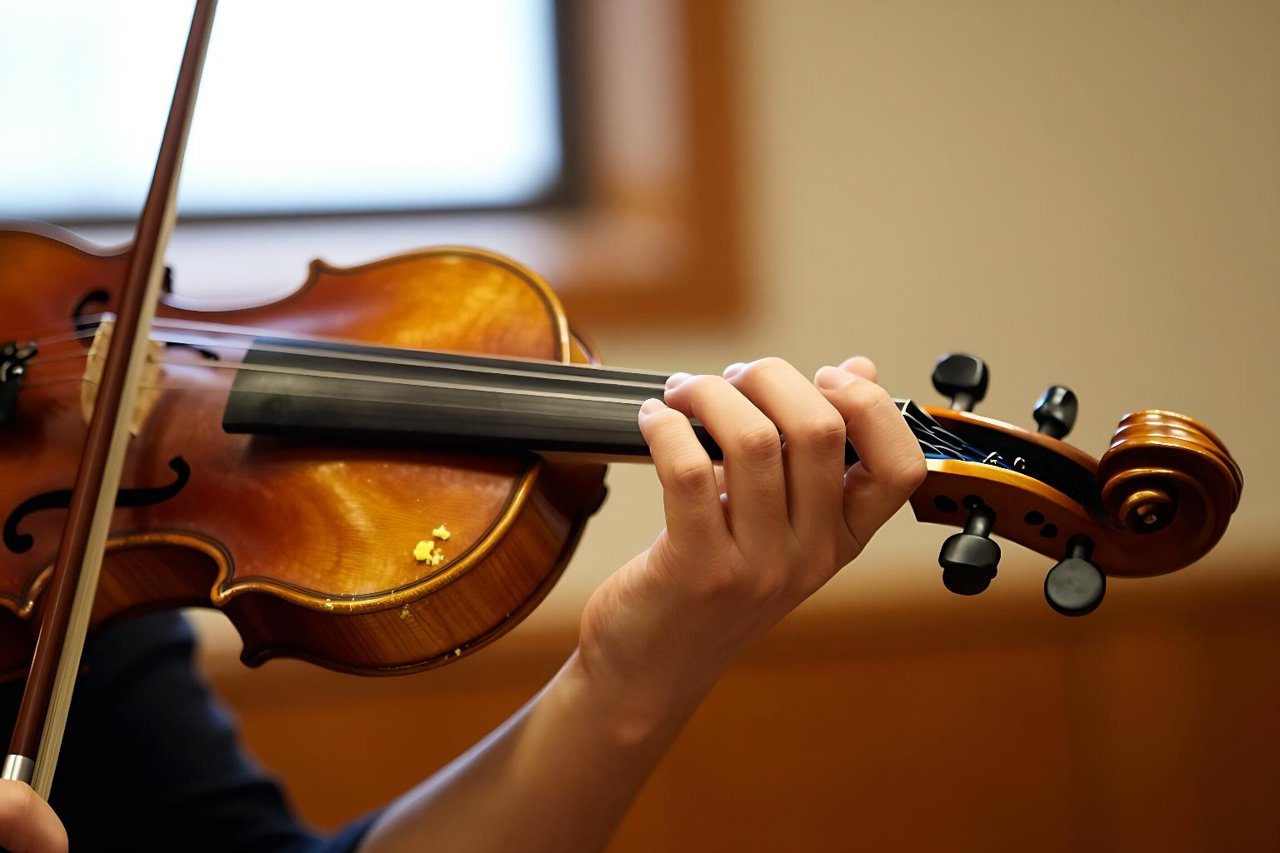
A violin has no frets. Every note is placed by ear and by muscle memory, and a fraction of a millimetre off is audible to anyone in the room. That’s before you add vibrato, which turns a fixed pitch into a living, wobbling target, or double stops, where two fingers must land perfectly at once.

The real complication is that the left hand and the right arm are two separate disciplines. A player can have flawless fingers and a bow arm that scrapes. Learning to draw a clean, unbroken tone at a steady speed, changing bow direction without an accent, controlling contact point between bridge and fingerboard, takes years of daily work. Conservatoire students routinely log three to four hours a day, and most will tell you the bow is the harder half.
French horn: twelve feet of tubing and nowhere to hide
The horn’s reputation is deserved. Its fundamental tube is roughly 12 feet long, and players spend most of their time in the upper partials, where the harmonics sit so close together that a small slip in lip tension lands you on the wrong note entirely. There are no keys to press in the right place; there is a valve system and your face.
Then there’s the hand. Players keep their right hand inside the bell, using it to tune notes, colour tone and, in stopped horn passages, produce a brassy, nasal snarl. Getting that hand position consistent while also balancing on a mouthpiece the size of a small coin is why horn sections are so exposed. One cracked note in a quiet orchestral passage is heard by everyone.
Oboe and bassoon: the double-reed tax
Single reeds are fussy enough. Double reeds are a different order of difficulty. An oboe player shapes two thin blades of cane so they vibrate against each other with a gap measured in hundredths of a millimetre, and the whole instrument’s response changes with temperature, humidity and how long the reed has been played.
Many oboists learn to make their own reeds, a craft that takes years on its own and sits entirely outside the practice room. Add severe back pressure, since the oboe resists breath far more than a flute, and the fact that the instrument is famously loud and piercing in the wrong hands, and you have something close to a hazing ritual. Oboe sections are small for a reason.
Pipe organ: four limbs, one brain
Organists read three staves at once and play a pedalboard with their feet, often while changing registration mid-phrase to bring different ranks of pipes in and out. The instrument is also wildly non-standard. Every organ in every church has a different layout, different stops and different action, so a player who has mastered one instrument can arrive at a recital and find a stranger.
Coordination is only half of it. Registration, the art of choosing which pipe ranks sound together, is a compositional skill in its own right. A pianist can sit down at any piano and be at home. An organist has to re-learn the room.
Theremin: playing an instrument you cannot touch
The theremin is controlled entirely by the distance between the player’s hands and two antennas. One hand governs pitch, the other volume. Nothing touches anything. There are no frets, no keys, not even a string to feel, and the instrument’s heterodyne circuitry responds to movements of a few millimetres.
Players talk about having to build an internal map of empty space, then hold their body still enough to stay on pitch while their other hand swells the note. It’s the closest thing in music to teleoperation, where the operator works through a remote interface rather than direct contact. Anyone curious about how that feels from the other side of a console might enjoy this explainer on how robotic surgery systems handle precision without touch, since surgeons face a similar problem of calibrating fine movement through an interface.
The voice: the instrument you cannot put down
Singers get left off lists like this, which is odd, because the voice is the only instrument where the player and the mechanism are the same object. You can’t inspect it, can’t replace a part, and can’t practise for eight hours without damaging it. Pitch, breath, resonance and diction all have to be coordinated in the same instant, and the feedback you get from inside your own head is famously misleading.
The best singers make it look like instinct rather than engineering, which flatters the illusion. It isn’t instinct. The singers generally considered the greatest of all time all spent decades on breath control, placement and repertoire before it sounded effortless.
Dark horses worth mentioning
A few instruments rarely make the top five but deserve an honourable mention.
- Tabla: a vast oral repertoire of bols, spoken rhythm syllables, played across two drums with distinct hand techniques and decades of apprenticeship.
- Concert harp: seven pedals with three positions each, placed by feet while both hands play, plus the widest reach of any string instrument.
- Great Highland bagpipe: constant pressure, three drones that must stay in tune with the chanter, and no way to play quietly or vary volume.
- Double bass: physically exhausting, with half-position shifts and string stops spread across a metre of scale length.
- Accordion: two keyboards, a bellows that acts as the breath, and completely different note layouts between the two hands.
Picking a fight worth having
The instruments on this list share one useful property: they make progress visible. A horn player who can finally nail a high, quiet entrance knows exactly what changed. An oboist who builds a reed that behaves for a whole rehearsal has solved a real, physical problem rather than a decorative one.
That’s worth thinking about before choosing what to learn. The hardest instruments demand a teacher, a daily routine and patience with long plateaus where nothing seems to improve for months. In exchange, they hand you a skill that can’t be faked and never runs out of depth. If you want a mountain, pick one of these. If you want a hobby you can enjoy at a party by next summer, pick something with frets and be honest with yourself about it.


