
Table of Contents
Ask ten archaeologists to name the oldest human settlement ever found and you’ll get ten slightly different answers, each one defended with a radiocarbon date and a raised eyebrow. The problem isn’t a shortage of candidates. It’s that “settlement” is a slippery word. A winter camp with three brush huts, a village of mudbrick houses, and a walled town of 8,000 people are all settlements, and they don’t appear on the same timeline.
What we can say is this: people were building permanent places to live far earlier than anyone expected a century ago, and the sites keep getting older. Here are the ones that matter most, plus the honest caveats that come with them.
First, What Counts as a Settlement?
Archaeologists generally look for three things: structures that took real effort to build, evidence of repeated occupation over years or generations, and signs that people invested in the place rather than just passing through. Storage pits, hearths, floors, plastered walls, and cemeteries all count in favour.
By that standard, the Natufian people of the Levant were settling down around 12,500 BCE, centuries before farming. They lived in semi-subterranean stone houses, harvested wild cereals, and buried their dead beneath the floors. For a long stretch of our species’ long and messy prehistory, that was the pattern: settle, harvest, move on when the wild food ran out.

Jericho: The Tower That Shouldn’t Exist
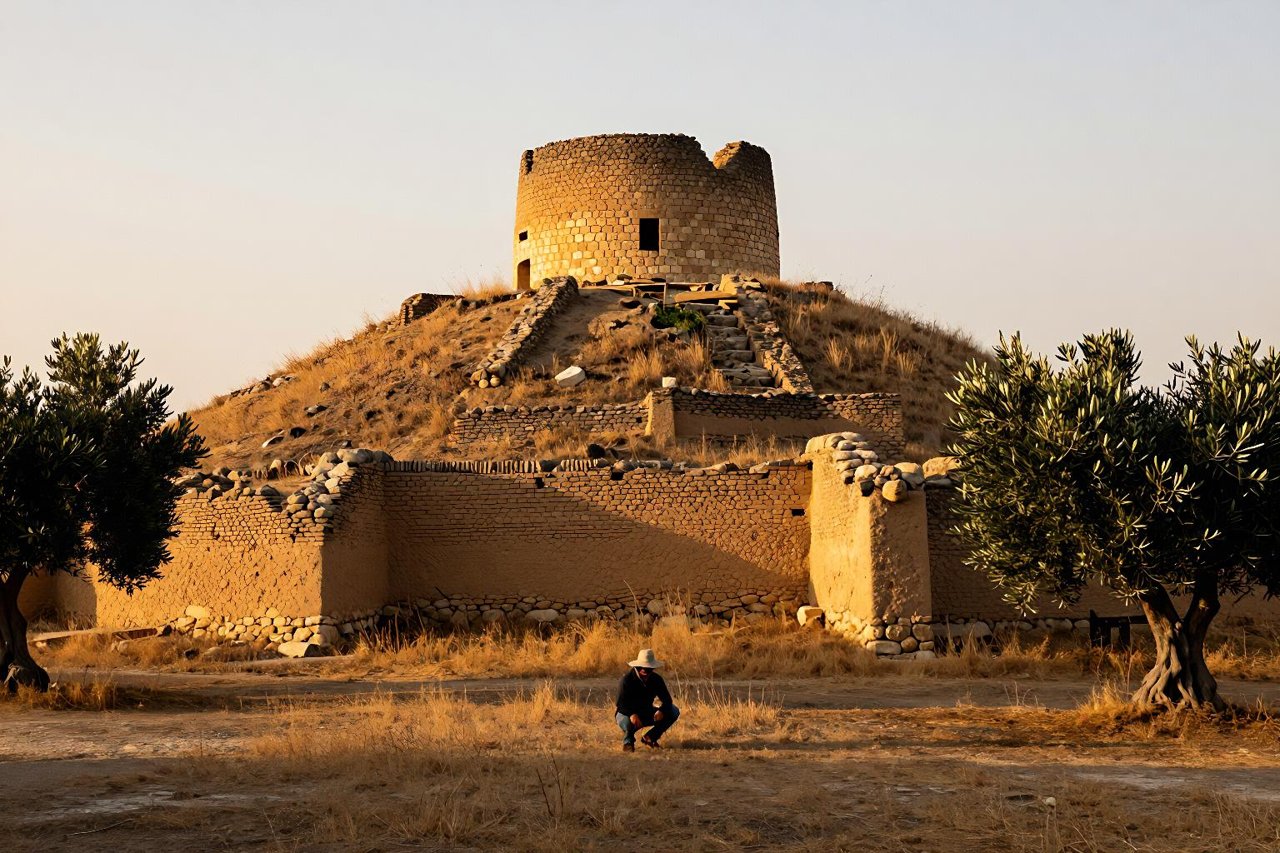
Tell es-Sultan, a mound just north of the Dead Sea near a spring called Ein es-Sultan, holds one of the best-documented early towns on Earth. Occupation there reaches back to roughly 9,000 BCE, and some estimates push it a thousand years earlier. That makes Jericho a strong contender for the oldest continuously occupied settlement known.
The eye-opener is the tower. Around 8,000 BCE, people who had no pottery, no metal tools, and no wheel hauled more than 1,000 tonnes of stone into a circular structure nearly 8 metres tall, with an internal staircase of 22 steps. Nobody is certain what it was for. Defence seems unlikely given its position. Storage, ritual, or a flood marker are all on the table.
Jericho also gave us some of the earliest plastered human skulls, faces reconstructed with lime plaster and shell eyes. Whatever those people believed, they were thinking hard about their dead.
Göbekli Tepe: Monuments Before Farming
On a limestone ridge in southeastern Turkey, hunter-gatherers carved and erected T-shaped pillars weighing up to 16 tonnes, arranged in circles, from about 9,500 BCE. Some of the stones carry animal reliefs: foxes, snakes, scorpions, cranes.
This is what makes Göbekli Tepe so disruptive. The classic story said farming came first, then surplus, then religion and monumental architecture. Göbekli Tepe seems to invert it, or at least complicate it. People who were still hunting and gathering spent enormous effort on ceremonial construction.
Only a fraction of the site has been excavated. Radar surveys suggest many more enclosures are still in the ground, which means the timeline we have now is provisional.
Çatalhöyük: A Town With No Streets
Between roughly 7,100 and 5,700 BCE, several thousand people lived packed into a mound on the Konya Plain in central Turkey. Çatalhöyük had no streets. Houses shared walls, and people entered through holes in the roofs, climbing down ladders into rooms that were part kitchen, part workshop, part shrine.
They buried their dead under the floors, painted bulls and hunting scenes on plaster walls, and traded obsidian across hundreds of kilometres. Fire destroyed buildings regularly, and the residents simply built the next house on top of the rubble, generation after generation, creating a mound nearly 20 metres deep.
Older Still: Ice Age Camps and Workshops
If you loosen the definition to “places where people lived year-round,” the dates jump dramatically.
- Ohalo II, Israel: brush huts on the shore of the Sea of Galilee from about 23,000 years ago, preserved in waterlogged mud along with the charred seeds of more than 100 plant species.
- Dolní Věstonice, Czech Republic: mammoth-bone huts from around 26,000 BCE, plus the world’s oldest known kiln, fired to temperatures near 800°C to make ceramic figurines.
- Kostenki, Russia: a cluster of settlements on the Don River with houses built from stacked mammoth bones, occupied repeatedly over thousands of years.
- Monte Verde, Chile: around 14,500 BCE, with wooden foundations and preserved seaweed, evidence of a coastal way of life in the Americas far earlier than once believed.
Not all of these were villages in the conventional sense. But they show people making serious, long-term investments in particular places tens of thousands of years before Jericho.
When the Sea Swallowed the Evidence
Sea levels rose roughly 120 metres at the end of the last ice age, drowning coastlines where many early communities would have lived. We know this because a few of those sites survive underwater.
Atlit-Yam, off the Israeli coast, is a Neolithic village from about 9,000 years ago sitting 8 to 12 metres below the surface, complete with wells, houses, and human burials. It’s one of several examples of remarkable archaeology preserved beneath the sea, and it raises an uncomfortable thought: the oldest settlement might be under water, not under soil.
The Oldest Cities Still Standing
Continuous habitation is a different record from first occupation, and a few places have been lived in for an extraordinarily long time:
- Damascus, Syria: settled by around 9,000 BCE at Tell Ramad, with later layers running right up to the present.
- Aleppo, Syria: occupation from roughly 6,000 BCE, its citadel mound built up over millennia.
- Byblos, Lebanon: inhabited from about 5,000 BCE, later a major port for the cedar trade with Egypt.
- Jericho: still a town today, which is why it appears on both lists.
Compare that with the earliest true cities of Mesopotamia: Eridu and Uruk appear around 5,400 BCE and later, with Uruk reaching perhaps 40,000 residents by 3,200 BCE. Impressive, but relative newcomers.
Why the Dates Keep Shifting
Every few years, someone publishes a paper that pushes an occupation layer back by centuries. Three forces drive that.
Radiocarbon dating has become far more precise thanks to Bayesian modelling, which layers calibrated dates against stratigraphy. Remote sensing has reopened landscapes nobody could survey on foot; the techniques behind recently rediscovered civilizations now routinely find whole settlements hidden under jungle, sand, and farmland. And drought occasionally does the work for us, parching rivers and reservoirs to reveal structures that were never meant to be seen again.
Then there’s the simple matter of excavation. Tel sites are excavated layer by layer, and a major mound can take decades. Most of what exists has never been touched.
What the Evidence Actually Tells Us
The old picture of a single moment when humans suddenly became settled is gone. What the record shows is a long, uneven process: seasonal camps that became permanent, permanent villages that grew into towns, and towns that sometimes collapsed and were abandoned for centuries before being reoccupied.
The people at Göbekli Tepe were carving animals onto limestone pillars before they had pottery. The residents of Çatalhöyük were burying their grandparents under the kitchen floor. The builders of Jericho’s tower were organising labour on a scale that implies leadership, shared belief, and probably some argument about who had to do the heavy lifting.
Each site chips away a bit more at the assumption that early humans were simple. And since only a small percentage of the world’s early settlements have been dug at all, the next headline about the oldest one yet found is almost certainly already sitting in the ground somewhere, waiting.


