
Table of Contents
In March 2022, a search team found the wreck of Ernest Shackleton’s Endurance at 3,008 metres in the Weddell Sea. The timber was intact. The ship’s name was still visible on the stern. That single image captured why underwater archaeology has become one of the most exciting branches of historical research: the sea can preserve what land destroys. Cold water, low oxygen and drifting sediment protect wood, rope, leather and even DNA for centuries. Every serious survey now has the potential to turn a vague legend into a measured, mapped site.
The field is often called marine archaeology or maritime archaeology. It covers shipwrecks, submerged settlements, harbours, ritual deposits and aircraft. The range is huge. In the past 30 years, sonar, robotic submersibles and DNA analysis have pushed the search from shallow coastal waters into the deep ocean. Some of the results have changed accepted trade maps, rewritten city histories and recovered objects that look almost too sophisticated for their age. The most remarkable archaeological discoveries beneath the ocean are rarely simple treasure stories. They are evidence of how people traded, built and migrated.
Why the Ocean Preserves What Land Destroys
A waterlogged shipwreck is a sealed context. On land, ploughs, construction and scavengers scatter objects. On the seabed, a hull can collapse in on itself and create a protected pocket. Fine sediment settles over cargo. Oxygen levels fall. Bacteria that normally rot wood struggle. In the Black Sea below about 150 metres, the water is anoxic, and researchers have found ships with rigging still attached after a thousand years.
This is not luck. It is chemistry. Waterlogged wood survives because it stays wet; if it dries too quickly after recovery, it crumbles. Conservators replace the water in the cells with polyethylene glycol over months or years, then freeze-dry the object. A single cannon can take years to stabilise. The same instinct that sent archaeologists into Pompeii and Tutankhamun’s tomb now sends them to the seabed, and some of these finds rank alongside the greatest archaeological discoveries ever made.

Shipwrecks That Rewrote Trade Maps
The Antikythera Mechanism
In 1900, Greek sponge divers sheltering from a storm off Antikythera found a wreck loaded with bronze and marble statues. Among the haul was a corroded lump of bronze that sat in a museum for decades. X-rays eventually revealed at least 30 interlocking gears. The device, dated to around the 2nd century BCE, modelled the movement of the sun and moon and predicted eclipses. No other object of comparable mechanical complexity survives from the ancient world. The wreck is still being excavated, and a 2021 survey found more fragments.
The Uluburun Shipwreck
Off the Turkish coast near Kaş, a Bronze Age ship sank around 1300 BCE. Local sponge divers found it in 1982. Excavation recovered more than 17 tonnes of cargo: 10 tonnes of copper ingots, a tonne of tin, glass ingots, ivory, ebony, ostrich eggs and gold. The ship carried goods from at least seven cultures. Its cargo shows that Late Bronze Age trade was not a series of local exchanges. It was an integrated network stretching from the Levant to the Aegean.
Vasa and the Mary Rose
Not every important wreck is ancient. Vasa sank in Stockholm harbour on its maiden voyage in 1628. Salvaged in 1961, it is around 98 per cent original and remains one of the best-preserved warships in the world. Mary Rose, Henry VIII’s flagship, sank in 1545 and was raised in 1982. Together they preserve clothing, food, tools, medical instruments and human remains that rarely survive on land. They are time capsules of ordinary life, not just royal power.
Sunken Cities and Submerged Landscapes
Sea levels have risen about 120 metres since the last ice age. That means thousands of prehistoric settlements are now underwater. Some were drowned slowly; others were hit by earthquakes, subsidence or liquefaction. Archaeologists now survey them with the same tools used on shipwrecks.
Thonis-Heracleion, Egypt
For centuries, the city was known only from Greek texts. In 2000, French archaeologist Franck Goddio located it in Abu Qir Bay, about 7 metres below the surface. Divers found a temple to Amun, colossal statues, gold coins, ritual barges and more than 60 shipwrecks. The city had controlled the entrance to the Nile before Alexandria rose. Its discovery turned a literary footnote into a major port.
Pavlopetri, Greece
Off the coast of Laconia, Pavlopetri has streets, courtyards and buildings laid out over about 500 metres. Pottery dates the site to around 5,000 years ago, making it one of the oldest known submerged towns. Unlike a shipwreck, it preserves urban planning. You can swim over walls that were built when the sea was lower and the coastline lay further out.
Atlit-Yam, Israel
In 1984, a marine survey off the Carmel coast found a Neolithic village under 8 to 12 metres of water. Atlit-Yam dates to roughly 7,500 to 8,000 years ago. Excavators recorded rectangular houses, hearths, storage pits, a stone well and around 65 human burials. Wheat seeds and animal bones showed a mixed farming and fishing economy. The site is a rare window into life before cities.
How Underwater Archaeologists Work
Marine archaeology is slow, expensive and heavily dependent on remote sensing. A typical survey starts with a wide sweep, then narrows to a target, then sends a diver or robot for close inspection. The sequence matters because diving time is limited and every object needs a recorded position.
- Multibeam sonar maps the seabed in high resolution and can reveal hulls, walls and channels under sediment.
- Side-scan sonar produces a black-and-white image of hard objects on the seabed, ideal for finding wreck debris fields.
- Magnetometers detect iron, including cannons, anchors and aircraft engines, even when buried.
- ROVs and AUVs reach depths beyond safe diving limits. AUVs can follow pre-set routes and collect photographic data for months.
- Photogrammetry turns thousands of overlapping images into a 3D model. A single wreck can be recorded in a day without touching it.
- Sediment coring and ancient DNA reveal what people ate, what crops they grew and which animals lived alongside them.
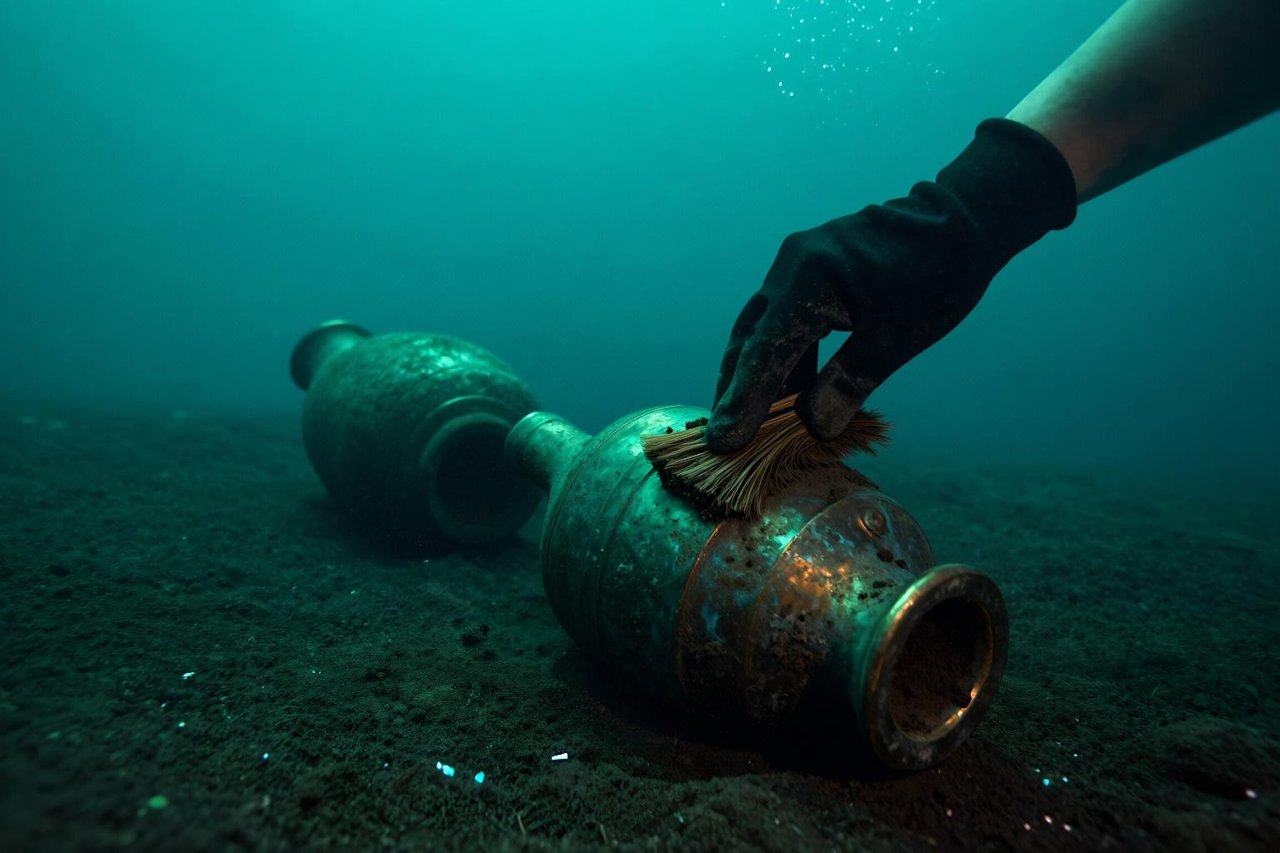
The best projects leave objects in place. Excavation destroys context, and underwater sites are difficult to guard. Recording, sampling and 3D modelling often yield more information than hauling a cannon to a museum store.
The Threats Beneath the Surface
Underwater sites face pressure from trawling, dredging, coastal construction, pollution and illegal salvage. Climate change adds erosion and shifting sediment. Deep-sea mining could disturb abyssal plains before they are surveyed. The 2001 UNESCO Convention on the Protection of the Underwater Cultural Heritage sets out principles for preservation, but enforcement varies widely. Commercial treasure hunting remains legal in some waters, and the results are often destructive.
There is also a practical problem: many wrecks are war graves. A ship sunk with its crew is treated differently from a cargo vessel. Archaeologists work with navies, descendant communities and heritage agencies to decide what should be recorded, what should be left alone and what should be recovered for conservation.
What Comes Next
Technology is changing the scale of the search. Satellite-derived bathymetry can map shallow reefs from orbit. Machine learning sorts sonar contacts faster than any team. DNA from waterlogged wood can identify timber sources and trade routes. Recent robotic surveys have mapped Roman harbour systems buried under metres of mud, revealing quays and channels that no diver could follow.
The most important shift is ethical. The question is no longer whether we can find a site. It is whether we should excavate it, who owns the finds and how we preserve them for the next century. The next headline may come from a fishing port, a melting glacier or a deep-sea ridge. It will still depend on the same patient work: survey, record, conserve, explain.


