
Table of Contents
In 539 BCE, a king named Cyrus walked into Babylon and took the largest city on earth with barely a battle. He had started two decades earlier as ruler of Anshan, a modest kingdom in the hills of southern Iran. By the time he died in 530 BCE, his armies had swallowed Media, Lydia, Bactria and Babylon. The Persian Empire was suddenly the biggest political entity the world had seen, stretching from the Aegean coast to the Hindu Kush.
What made it remarkable wasn’t just the size. It was the fact that the Persians managed to hold it together for two centuries, and then, after a gap, built a second empire that lasted another four hundred years. That’s a longer run than Rome managed in the east. The region they ruled had already seen a thousand years of states rise and fall along the Tigris and Euphrates, from Sumer to Assyria, and the Persians learned from all of them. If you want the deep background, the story of ancient Mesopotamia sets the stage that Cyrus inherited.
How Cyrus Held It All Together
Most conquerors of the ancient world ruled by terror and deportation. Cyrus did the opposite, mostly. Conquered peoples kept their local rulers, their gods and their customs, and in exchange they paid tribute and supplied soldiers. The Cyrus Cylinder, a baked clay barrel now in the British Museum, records him restoring sanctuaries and sending displaced communities home. Whether that was sincere tolerance or brilliant public relations is still debated by historians. Either way, it worked, and it was cheap.
The Judean exiles in Babylon were allowed to return to Jerusalem and rebuild their temple. That single decision earned Cyrus a favourable mention in the Hebrew Bible, several centuries before the Roman Empire existed. Few imperial gestures have travelled further through history.

The satrapy system
Darius I, who took the throne in 522 BCE after some messy dynastic violence, turned Cyrus’s loose arrangement into a machine. He divided the empire into roughly twenty provinces, called satrapies, each governed by a satrap. To stop any one governor becoming too powerful, he added separate military commanders and royal inspectors who reported directly to him. The Greek word for those inspectors was “the king’s eyes and ears.”
The Royal Road
The Royal Road ran almost 2,700 kilometres from Sardis in western Anatolia to Susa. Relay stations stood at intervals of a day’s ride, and mounted couriers could cover the whole distance in about nine days. Herodotus was so impressed he wrote that neither snow, rain, heat nor darkness stopped them. The United States Postal Service later borrowed the line for its motto, which is a strange afterlife for a Persian logistics achievement.
Add to that a single gold coin, the daric, accepted from Egypt to Central Asia, and Aramaic as a shared administrative language, and you can see why the empire functioned. These are the practical details that separate a durable empire from a temporary conquest. It’s the same pattern that shows up again and again in the forces that made the world’s greatest empires endure.
- A gold and silver coinage standardised across three continents
- Royal inspectors with the power to audit provincial governors
- Garrison towns and road stations placed at regular intervals
- Aramaic as a lingua franca for tax records and decrees
- Local elites kept in place rather than replaced
Darius I and the Machinery of Empire
Darius also built Persepolis, starting around 518 BCE. The site was never the empire’s administrative capital in the way Susa or Babylon were. It was a ceremonial centre, a place for the king to receive tribute and remind everyone who was in charge. His other great monument, the Behistun inscription, was carved high on a cliff face along a royal road, in three languages: Old Persian, Elamite and Babylonian. Nineteenth-century scholars used that trilingual text to crack cuneiform, roughly the way the Rosetta Stone unlocked Egyptian hieroglyphs.
Persepolis: Propaganda in Stone
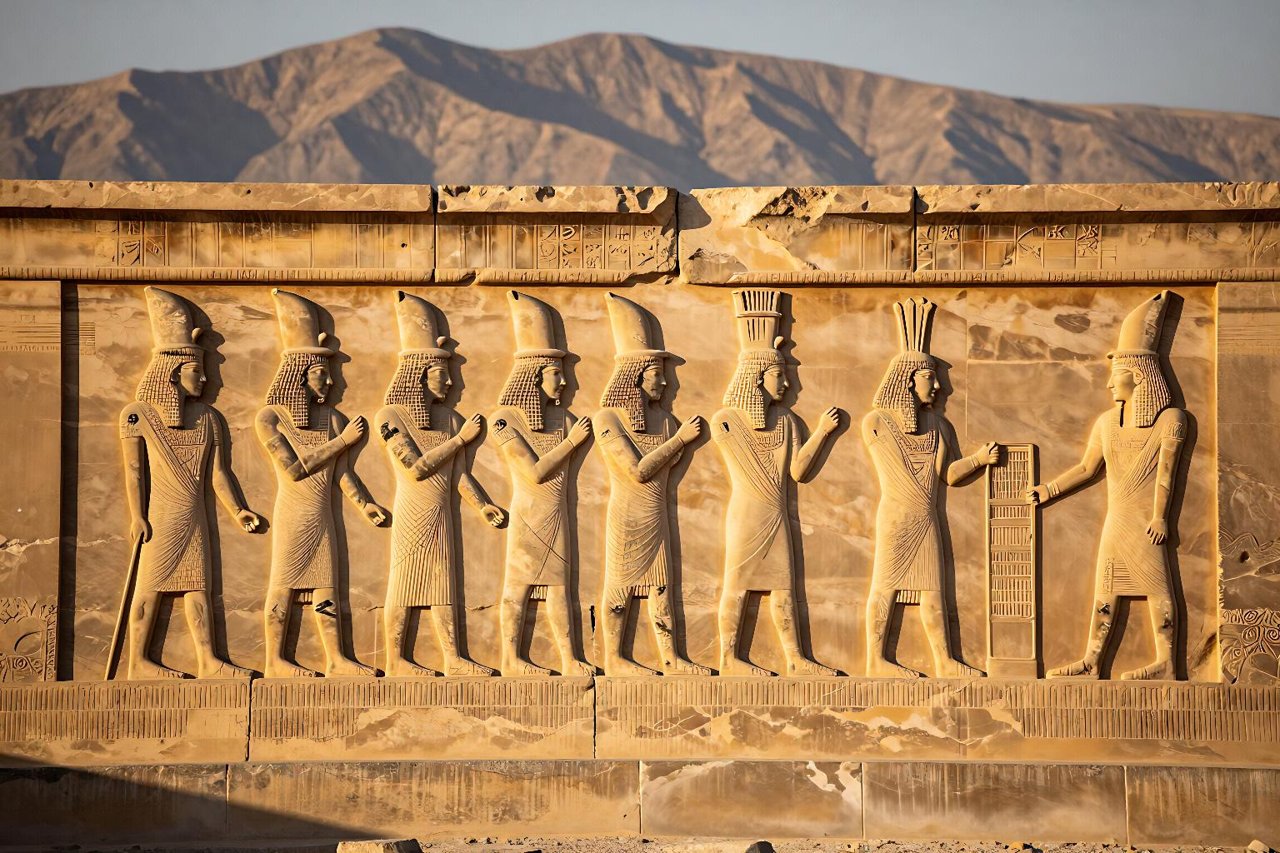
Walk the Apadana staircase today and you meet the empire’s own version of a corporate brochure. Delegates from twenty-three subject peoples file up the reliefs, each group carrying a distinctive gift: Bactrian camels, Nubian giraffes, Libyan chariots, Indian gold. There are no scenes of conquest or defeated enemies grovelling. The message is harmony under a king who sits above it all, supported by the whole world in orderly procession.
Greeks from Athens and Sparta never appear among those delegates, which tells you something about what had happened by then.
Zoroastrianism and the Imperial Religion
The Achaemenid kings were almost certainly worshippers of Ahura Mazda, the supreme god of what became Zoroastrianism. Inscriptions invoke him repeatedly, and Darius presents himself as ruling by his favour. The religion’s emphasis on truth against falsehood, light against darkness, and a final judgement struck a chord well beyond Iran. It’s arguable how much it influenced Judaism, Christianity and Islam directly, but the overlap in ideas about cosmic dualism and resurrection is hard to ignore.
Later, under the Sasanians, Zoroastrianism became a formal state religion with fire temples, a priesthood and a legal system attached. That’s a much more institutional version than anything Cyrus would have recognised.
The Wars with Greece
Almost everything most people think they know about the Persian Empire comes from its enemies. The Ionian Revolt in 499 BCE drew Athens into Persian affairs, and Darius sent an expedition that was beaten at Marathon in 490 BCE. Ten years later, Xerxes invaded in force. Thermopylae, Salamis and Plataea are famous today because Greek writers made sure they would be. Less often mentioned is that the empire kept its western provinces for another 150 years, and that Persian coin, Persian administration and Persian ritual flowed steadily through Greek cities in Anatolia.
The conflicts cut both ways. Athens borrowed Persian art styles, Persian loanwords crept into Greek, and the Greek cities of Asia Minor had been part of the empire for generations. For a fuller picture of the other side of the story, it’s worth reading about how those small Greek city-states changed the world in turn.
Collapse and the Second Persian Empire
Alexander of Macedon crossed into Asia in 334 BCE. He won at the Granicus, at Issus in 333, and finally at Gaugamela in 331. Darius III fled east and was murdered by one of his own satraps before Alexander could catch him. Persepolis went up in flames. Alexander reportedly regretted it later, but the damage was done.
The Persian story, however, didn’t end there. The Parthians took control of Iran around 247 BCE and fought Rome to a standstill for centuries. Then in 224 CE, a prince called Ardashir overthrew them and founded the Sasanian dynasty, deliberately styling himself as heir to the Achaemenids. The Sasanians rebuilt the empire around a centralised bureaucracy, a state church, and a fortified frontier. They held off Rome and Byzantium for four centuries. Their final king, Yazdegerd III, lost to Arab armies at Nahavand in 642, and the empire collapsed by 651.
Where the Persian Empire Still Shows Up
Look at a map of the Middle East and you are still looking at Persian decisions. The Silk Road corridors they secured, the administrative habits, the cities they founded and the irrigation networks they maintained all shaped what came after. So did the religious landscape: the Sasanian capital at Ctesiphon was still a living metropolis when the Abbasid caliphs a century later borrowed Persian bureaucratic methods, Persian poetic forms and the Persian idea of a court.
Nowruz, the New Year festival celebrated at the spring equinox, has survived every empire and every regime since. Modern Persian, the language of Iran, Afghanistan and Tajikistan, is a direct descendant of the Middle Persian spoken by the Sasanian court. The Sassanian blending of religion, law and kingship fed directly into the way Islamic empires imagined power.
Stand at Naqsh-e Rostam, where four Achaemenid kings are carved into the cliff face above their tombs, and you can read the same formula again and again: “Persian, son of a Persian, Aryan of Aryan descent.” The empire is long gone. The inscription still has a visitor’s attention span, twenty-five centuries later. Understanding it also demands knowing the wider region that carried it, since the Persians sat at the centre of what historians still call the cradle of civilizations and crossroads of empires.


