
Table of Contents
On 28 June 1914, a 19-year-old student fired two shots in Sarajevo that pierced the Archduke of Austria-Hungary and his wife. Within weeks, Europe’s great powers had declared war on one another. The conflict we now call World War I, or the Great War, ultimately dragged in more than thirty countries and mobilised over sixty-five million soldiers. By the time the guns fell silent in November 1918, roughly 8.5 million soldiers and an estimated 13 million civilians were dead.
The war did not come out of nowhere. It was the product of decades of imperial ambition, ferocious nationalism, and a scaffolding of secret alliances built to keep the peace but instead primed to detonate. To understand how a local murder became a planetary catastrophe, it helps to look at the broad patterns of history. Civilisations that overreach, that arm themselves to the teeth and divide the world into rival blocs, tend to stumble into slaughter. That dark rhythm runs through world history, and 1914 marks one of its most tragic chapters.
The Spark and the Smoke: Why the World Caught Fire
A fragile web of alliances
Europe in 1914 was a powder keg with a dozen fuses. The Triple Entente bound Britain, France, and Russia into a defensive agreement. On the other side sat the Triple Alliance of Germany, Austria-Hungary, and Italy, though Italy would later switch sides. These treaties were designed to deter aggression, but they turned a tinderbox into a chain reaction. When Austria-Hungary delivered an ultimatum to Serbia, Russia called on its allies. Germany then declared war on Russia and France, and swept into neutral Belgium to outflank Paris. That move dragged Britain into the fight. By the end of the first week of August, virtually the whole of Europe was marching.
The blank cheque and the guns of August
Germany’s role in the escalation was decisive. Kaiser Wilhelm II offered Austria-Hungary his full backing, the so-called blank cheque, and urged the leadership in Vienna to strike hard against Serbia. This was not an accident; it was a calculated gamble. German generals believed a major war was inevitable and best fought sooner than later. The Schlieffen Plan aimed to defeat France in forty days, then turn on the slower-mobilising Russian army. The plan failed, but its failure created trenches that stretched from the North Sea to Switzerland.

The War Nobody Expected: Trench Warfare and Stalemate
Soldiers in August 1914 marched off expecting a short, heroic war. They expected to be home by Christmas. Instead, they found a landscape scarred by artillery, and an enemy that refused to be broken. The Western Front settled into a brutal stalemate where progress was measured in yards.
Life in the mud
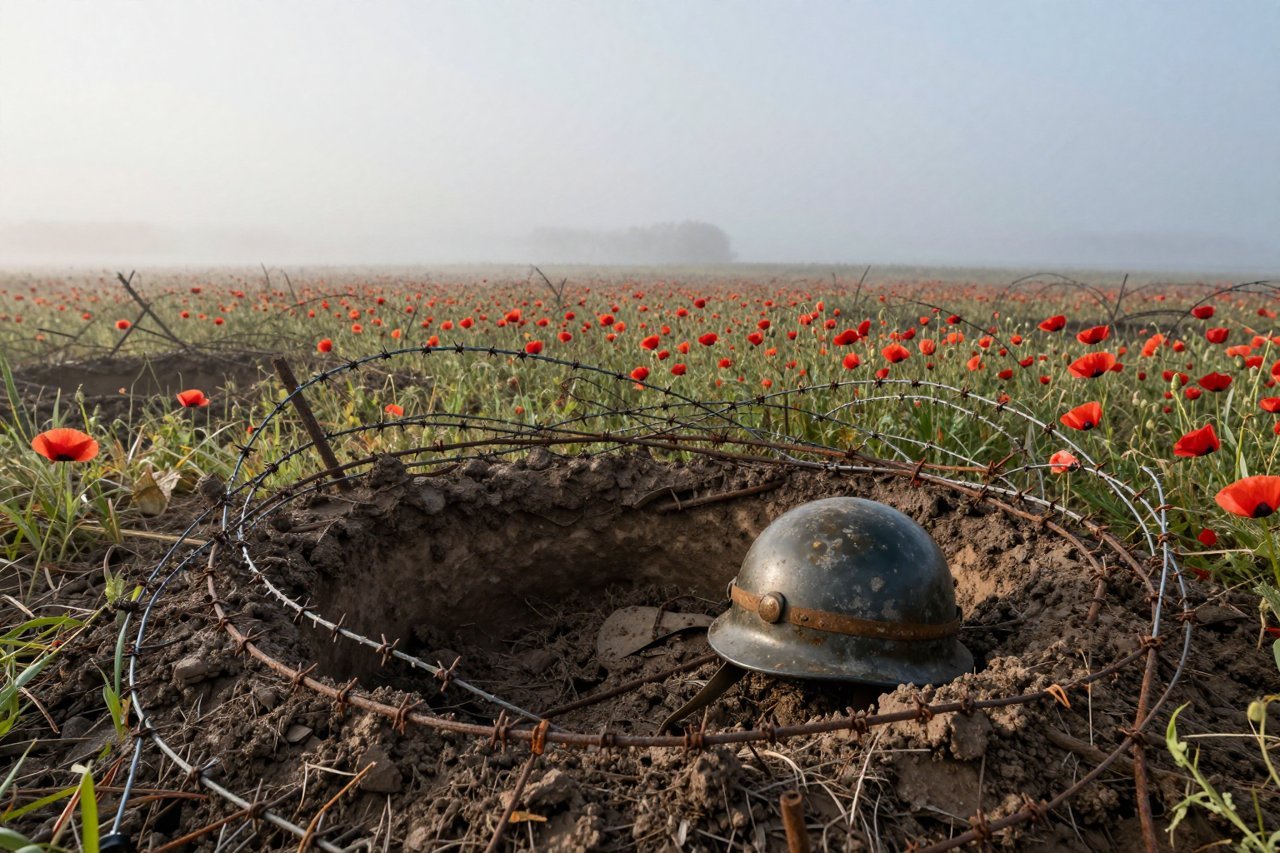
The trenches were a world of their own. Water pooled in the bottom, rats grew fat on corpses, and soldiers slept upright in their dugouts. Trench foot, a painful infection caused by prolonged immersion, crippled thousands. Men lived with the constant threat of sniper fire, artillery shells, and poison gas. For the average infantryman, the war was not a story of glory but of misery, boredom, and terror.
Verdun and the Somme
Some battles became bywords for futility. Verdun, which ran for ten months in 1916, swallowed around 700,000 casualties. The Somme, launched in July of the same year, was worse: over a million men were wounded or killed. On the first day alone, the British army lost almost 57,000 men, most of them in the first hour. In terms of industrialised slaughter, nothing like it had been seen before. It is a grim echo of earlier conflicts where siege warfare could drag on for years. Just as the brutal Peloponnesian War left a shattered civilisation in its wake, Ancient Greece showed how prolonged conflict can drain a culture’s soul, and the Western Front replicated that lesson with modern weapons.
Technology and Total War
World War I is often called the first industrialised war, and for good reason. Factories churned out weapons around the clock, and engineers raced to build ever more effective ways to kill. The technology of warfare changed more in those four years than in the previous four centuries, and its impact lingered long after the ceasefire. Many of the tools we now take for granted, in both civilian and military life, got their start on the battlefields of 1914-18. From the wheel to the web, human history is a story of relentless innovation, and the Great War slammed the pedal down on many of those inventions that changed the world forever.
- Tank: first used in 1916; it ultimately broke the deadlock of trench warfare.
- Poison gas: used by all major powers; forced entire armies to develop protective gear.
- Aerial warfare: reconnaissance planes soon became fighters and strategic bombers.
- Submarines: unrestricted U-boat campaigns nearly severed Britain’s supply lines.
- Flamethrowers: devastating at close range in the confined space of a trench.
The Home Front: A Whole Continent Mobilises
Total war meant that entire nations became factories and rationing boards. Women took over manufacturing and transport jobs, proving their indispensability and helping to unlock voting rights after the war. Governments ran massive propaganda campaigns to keep public morale high, and censorship quashed dissent. In Britain alone, the Defence of the Realm Act gave the state sweeping powers. The line between soldier and civilian dissolved. A bombing raid or a submarine attack could kill thousands of people far from the front.
The United States Enters: The Tide Turns
Unrestricted U-boats and the Zimmermann Telegram
For the first three years, the United States remained neutral. But patience snapped when Germany resumed unrestricted submarine warfare, sinking merchant ships, including the Lusitania with 128 Americans aboard. Then came the Zimmermann Telegram, in which Berlin offered Mexico a chunk of the American southwest if it joined the war. British intelligence intercepted and decrypted the message. On 6 April 1917, the United States declared war on Germany. The addition of fresh manpower and industrial output would prove decisive.
The doughboys and the Hundred Days Offensive
In the spring of 1918, Germany gambled on a massive new offensive to win before American divisions could arrive in strength. They advanced to within striking distance of Paris, but the exhausted infantry could not hold the ground. Over a million American soldiers, known as doughboys, reached France. In August, the Allied Hundred Days Offensive began, a continuous assault that shattered German lines. By November, mutiny and hunger gripped Germany, and on 11 November 1918 the armistice was signed in a railway carriage at Compiègne.
The Aftermath: A Broken World
A brittle peace at Versailles
The war’s official end came with the Treaty of Versailles in 1919. It was not a lasting reconciliation but a punitive document that assigned Germany sole responsibility and forced it to pay reparations of 132 billion gold marks. The treaty stripped land, limited the army to 100,000 men, and seeded a national humiliation that would fester. Most historians see this as a turning point not just for Europe but for the entire 20th century. The map was redrawn: the Austro-Hungarian, German, Ottoman, and Russian empires all collapsed. New states appeared in Eastern Europe and the Middle East, but the borders often ignored ethnic and religious realities. Those arbitrary lines continue to shape regional violence and diplomacy.
A century shaped by one war
World War I did not simply end; it leaked into every decade that followed. The Russian Revolution grew directly out of the war and installed a communist regime that would split the world for seventy years. The global power balance shifted from Europe to the United States, which emerged as an economic giant. Diplomats tried to build a new order through the League of Nations, but its failure foreshadowed the Second World War. The soldiers who came home were forever changed; many joined veteran movements that demanded better treatment. The cultural shock of the trenches can be felt in everything from T.S. Eliot’s poem The Waste Land to the peace movements of the 1960s. A century on, the war remains a warning about what happens when diplomacy fails and industrial power is turned on human beings.


