
Table of Contents
Some historical puzzles close neatly: a document turns up, a grave is identified, a shipwreck is found. Others refuse. The seven cases below are among the top 7 historical mysteries that remain unsolved, not because people have stopped looking, but because every answer creates a new problem. Empty ships, vanished colonies, unreadable manuscripts, and missing royals all appear here, along with the evidence that keeps each case alive.
1. The Mary Celeste: An Empty Ship and a Missing Crew
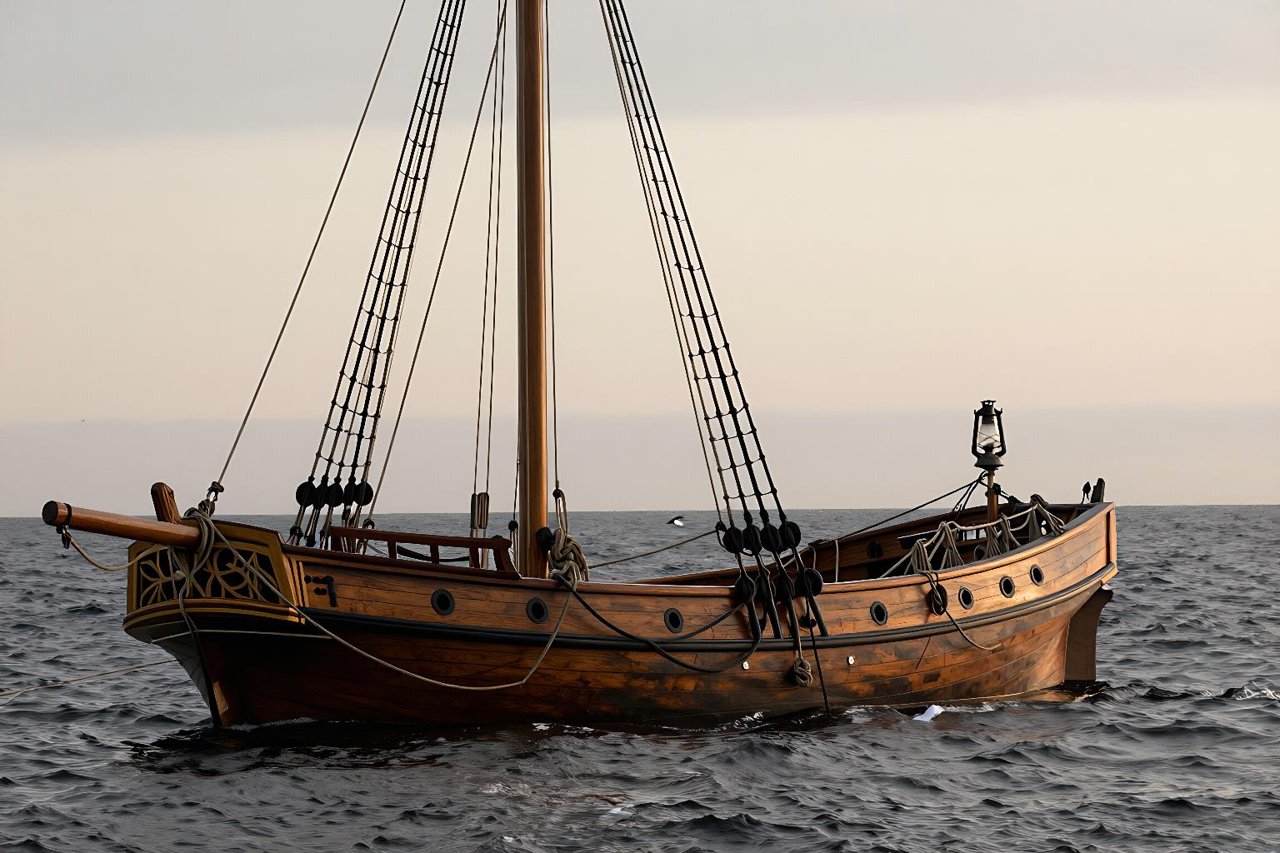
On 5 December 1872, the Canadian brigantine Dei Gratia spotted the Mary Celeste about 400 miles east of the Azores. The 282-ton ship was bound for Genoa with 1,701 barrels of industrial alcohol. She was sailing erratically but was not sinking. When the Dei Gratia’s crew boarded, they found no one.
Captain Benjamin Briggs, his wife Sarah, their two-year-old daughter, and seven crew members were gone. The last log entry was dated 25 November. The lifeboat was missing. There was no blood, no sign of a struggle, and the cargo was largely intact. The ship was seaworthy enough to be sailed to Gibraltar. The ten people aboard were never found.
Popular retellings add still-warm tea and a meal on the table, details that come from Arthur Conan Doyle’s 1884 short story rather than the record. The real evidence is odd enough. A missing lifeboat suggests a deliberate evacuation. The absence of bodies suggests the crew did not simply drown nearby. Common explanations include:

- Alcohol vapour: Industrial alcohol could have leaked and heated, prompting the captain to order a temporary evacuation before an explosion.
- Waterspout or rogue wave: A sudden sea could have swept the deck, though the ship survived in good condition.
- Mutiny or piracy: No valuables were taken, and there were no signs of violence.
- Insurance fraud: An elaborate plot would require the crew to vanish permanently, which seems unlikely.
None of these accounts for every detail. That is why the Mary Celeste remains one of the most famous unsolved historical mysteries.
2. The Roanoke Colony: 115 People and One Carved Word
In 1587, 115 English colonists settled on Roanoke Island, off present-day North Carolina. Governor John White sailed to England for supplies. War with Spain delayed his return until 1590. By then, the settlement was dismantled. White found the word CROATOAN carved into a post and the letters CRO on a nearby tree. The agreed distress signal, a cross, was absent.
The leading theory is that the colonists assimilated with the Croatoan people, ancestors of the Lumbee. That would explain the carved word and the lack of bodies. Drought, disease, and attacks from rival groups are also possible. Archaeological work on Hatteras Island has found European artefacts in Native American contexts, but nothing that proves the colonists’ fate beyond doubt.
3. The Voynich Manuscript: A Book No One Can Read
The Voynich Manuscript is a 240-page illustrated codex named after Wilfrid Voynich, the book dealer who bought it in 1912. Carbon dating places the vellum between 1404 and 1438. Its script has never been convincingly deciphered. The illustrations show plants that do not match known species, astronomical diagrams, and figures in pools.
Cryptographers and linguists have attacked it for more than a century. Some think it is a cipher, others a constructed language, and some argue it is an elaborate hoax. The text has statistical properties similar to natural language, which makes a simple hoax less likely. No bilingual key has surfaced. Without a known parallel text, even a correct decryption would be hard to prove. The manuscript sits in Yale’s Beinecke Library, still unread.
4. The Princes in the Tower: A Royal Disappearance
When Edward IV died in 1483, his sons Edward V, aged 12, and Richard, Duke of York, aged 9, were lodged in the Tower of London. Their uncle, Richard III, declared them illegitimate and took the throne. The boys disappeared from the record. Their fate has been argued over for more than five centuries.
Suspicion has always fallen on Richard III, but Henry VII had motive too. So did Henry Stafford, Duke of Buckingham. In 1674, workmen found a wooden chest beneath a staircase at the Tower containing two small skeletons. The bones were later moved to Westminster Abbey. They have never been conclusively identified. Requests for DNA testing have been refused or blocked, partly because the remains are royal and the legal issues are delicate.
5. Amelia Earhart’s Last Flight
On 2 July 1937, Amelia Earhart and navigator Fred Noonan took off from Lae, Papua New Guinea, in a Lockheed Electra 10E. Their destination was Howland Island, a tiny speck in the Pacific. They never arrived. The US Navy mounted a massive search, but no trace of the aircraft or crew was found.
The simplest explanation is that the plane ran out of fuel and sank. A competing theory places Earhart on Nikumaroro, then called Gardner Island, where she may have survived as a castaway. The evidence is suggestive but incomplete: a partial skeleton found in 1940, a piece of aircraft metal, and a woman’s shoe. Forensics have been disputed. Another theory claims the pair were captured by the Japanese, which has never been substantiated.
6. The Dyatlov Pass Incident: Nine Hikers, One Cut Tent
In February 1959, nine experienced Soviet hikers were found dead in the northern Ural Mountains. Their tent was cut open from the inside. Some had fled into the snow without proper clothing. Injuries included skull fractures and severe chest trauma. One hiker was missing her tongue. A small amount of radiation was detected on some clothing.
The official investigation blamed a compelling natural force and closed the case. Explanations have ranged from an avalanche to a secret military test to strange atmospheric phenomena. A 2021 study in Communications Earth & Environment used computer simulations to argue that a slab avalanche could explain the deaths, including the fractures. That is currently the strongest scientific explanation, but it has not ended the debate. Questions remain about timing, clothing, and why the group split up.
7. The Lost Ninth Legion
The Legio IX Hispana was a Roman legion with a long record in Britain. Then it vanished from the historical record. The last firm references place it in the early second century. After that, nothing. The Ninth Legion simply drops out of the lists.
Popular history often says the legion was destroyed in Scotland, marching north and never returning. That story inspired Rosemary Sutcliff’s novel The Eagle of the Ninth and later films. Historians are less certain. The legion may have been transferred to the Rhineland, disbanded, or absorbed into another unit. There is no mass grave, no battlefield, and no inscription that settles the question. The mystery survives because the Roman army kept detailed records, and the absence of those records is itself the puzzle.
What Would Actually Solve These Historical Mysteries
Unsolved historical mysteries are often not short of theories. They are short of decisive evidence. A ship’s log, a grave, a maker’s mark, or a single line in an archive can undo decades of speculation. For the Mary Celeste, a surviving crew statement would help. For Roanoke, a European artefact found in a securely dated Croatoan context would be powerful. For the Princes in the Tower, DNA from the Westminster Abbey bones could settle a royal cold case if permission were granted. Earhart’s case needs wreckage with a serial number, not another blurry photograph.
That is the less romantic truth about the top 7 historical mysteries that remain unsolved. They endure because the evidence is missing, contaminated, or ambiguous, not because no one has looked. Every few years, a new search, scan, or translation attempt makes headlines. Sometimes the answer arrives and the story shrinks. Until then, these cases keep their hold because they sit at the edge of what the record can prove.


