
Table of Contents
Skin cancer rarely announces itself. It turns up as a spot that looks almost like a freckle, a dry patch on the ear that never quite settles, a small bump on the nose you keep meaning to mention to somebody. Most of these changes are painless, which is exactly why they get filed away as nothing.
That delay matters. Basal cell and squamous cell carcinomas, the two most common types, are usually cured with a simple office procedure when caught early. Melanoma caught before it spreads carries a five-year survival rate above 99%. Once it reaches distant organs, that figure falls to roughly 35%. The gap between those numbers is almost entirely about timing.
Dermatologists tend to describe the same handful of red flags over and over. Below are the seven signs worth memorising, what each one actually looks like, and what to do if something on your skin matches.
The seven warning signs dermatologists look for
1. A mole that is changing
Change is the single most important clue. A melanoma can be perfectly round and evenly coloured; what makes it suspicious is that it wasn’t there five years ago, or that it has grown, darkened, or started to feel different. This is where the ABCDE checklist helps: Asymmetry, irregular Border, uneven Colour, Diameter over about 6mm (a pencil eraser), and Evolution. Of the five, evolution is the one that gets melanomas caught. Photograph your moles with a phone and compare every few months; a slow change is far easier to see side by side than from memory.

2. A sore or patch that won’t heal
A spot that scabs, bleeds a little, then seems to heal, then breaks down again is a classic presentation of squamous cell carcinoma. These often sit on the lip, the rim of the ear, the bald scalp, or the back of the hand, and they can look like a stubborn wart or a patch of eczema that ignores every cream. Anything that hasn’t settled within about eight weeks deserves a look. A quick rule of thumb: if you’ve treated a spot as a wound or a rash for a month and it hasn’t behaved, it isn’t behaving like a wound or a rash.
3. A brand-new spot in adulthood
Adults don’t really grow new moles. The average person’s mole count peaks somewhere around their thirties and then slowly declines. So a new pigmented spot appearing at 42 or 55 is not just another freckle from a summer holiday, and it’s worth having a professional glance at it.
4. The mole that doesn’t match its neighbours
Also known as the ugly duckling sign. Look at your back or forearm: most moles on one person share a family resemblance in colour, size, and shape. One that breaks the pattern, darker, larger, or oddly shaped compared with the rest, stands out for a reason. Dermatologists use this pattern recognition constantly, and it’s often more reliable than measuring lesions against a ruler.
5. Rough, sandpaper-like patches
Actinic keratoses are sun damage made visible: small, dry, scaly patches, usually under 1cm, that feel like fine grit when you run a finger across them. They favour the nose, temples, ears, forearms, and the backs of the hands, mostly in people over 50 or anyone with a lot of cumulative sun exposure. Not every one becomes cancer, and a minority do progress to squamous cell carcinoma. Freezing or cream treatment is quick and takes minutes, so there’s little reason to leave them alone.
6. A pearly bump or a pink scaly patch
Basal cell carcinoma is the most common cancer in the world, and it’s a master of disguise. It can look like a small translucent or waxy bump with a rolled edge and a few tiny blood vessels running through it. On the trunk it might appear as a flat, pink, slightly scaly patch that resembles a patch of dry skin or a healing insect bite. It can also look like a pimple that never comes to a head, sitting on the nose or eyelid for six months. Basal cell cancers rarely spread to organs, but they grow locally and can do real damage to an eyelid, ear, or the side of the nose if ignored for years.
7. Bleeding, itching, or a dark streak under a nail
Any mole that bleeds without being knocked, itches persistently, or feels tender is worth checking. So is a dark vertical band in a fingernail or toenail, particularly on the thumb or big toe, especially if the pigment smudges into the cuticle skin. That pattern can signal subungual melanoma, a form of the disease that’s easy to mistake for a bruise from a dropped object. Spontaneous bleeding from a skin lesion is different from easy bruising or nosebleeds, which usually point to a clotting or platelet issue rather than a skin one; if bruising is your main concern, this overview of what a low platelet count can mean explains how doctors tease those causes apart.
What skin cancer looks like on darker skin
The classic photographs in textbooks skew heavily towards fair skin, which leaves a lot of people unprepared. In darker skin tones, melanoma most often appears on the palms, soles, under the nails, and inside the mouth, not on the back or calves. That is the acral lentiginous type, and it’s the melanoma Bob Marley developed under a toenail in his thirties; it’s also the reason a dark streak or a non-healing sore on the foot deserves attention rather than a shrug.
Basal cell carcinomas in darker skin are frequently pigmented, so they get mistaken for ordinary moles and appear most often on the head and neck. Squamous cell carcinoma can arise in old scars, chronic ulcers, and areas of long-standing inflammation. Skin cancer in Black patients is often diagnosed at a later stage, which makes self-checks on the less-inspected parts of the body genuinely useful rather than merely advisable.
How to check yourself without overthinking it
Ten minutes once a month is plenty. You’re not looking for a diagnosis, just for anything new, changing, or out of character.
- Use bright overhead light and two mirrors, or rope in a partner for your back, scalp, and the backs of your ears.
- Work in order: face and neck, scalp part lines, ears, hands including between the fingers, forearms, arms, chest and belly, then legs and feet.
- Check the spots people forget: soles, between the toes, nail beds, behind the ears, genitals, and inside the mouth.
- Take dated photos on your phone of any mole that’s larger than a pencil eraser, oddly shaped, or in a spot you can’t easily see.
- Write down what you find and when. “It’s been there a while” is hard to act on; “it doubled in size since March” is not.
Who should be checked by a professional more often
Self-checks are useful, but some people should be on a formal surveillance schedule. That includes anyone with a history of blistering sunburns, more than 50 moles, a family history of melanoma, or previous use of sunbeds (starting before 35 raises melanoma risk substantially). People who’ve already had one skin cancer are at higher risk of a second, so annual checks become part of the routine.
Long-term immunosuppression is another significant factor. Organ transplant recipients and people on certain medications for autoimmune conditions or blood cancers run a much higher skin cancer risk, which is why many transplant programmes build dermatology reviews into follow-up care. If you’re unsure whether your own health history puts you in that group, this breakdown of the main risk factors for immune deficiency is a useful starting point, and so is understanding how conditions affecting the blood and immune system, including several common blood disorders and their warning signs, can influence skin surveillance.
What actually happens at a skin check
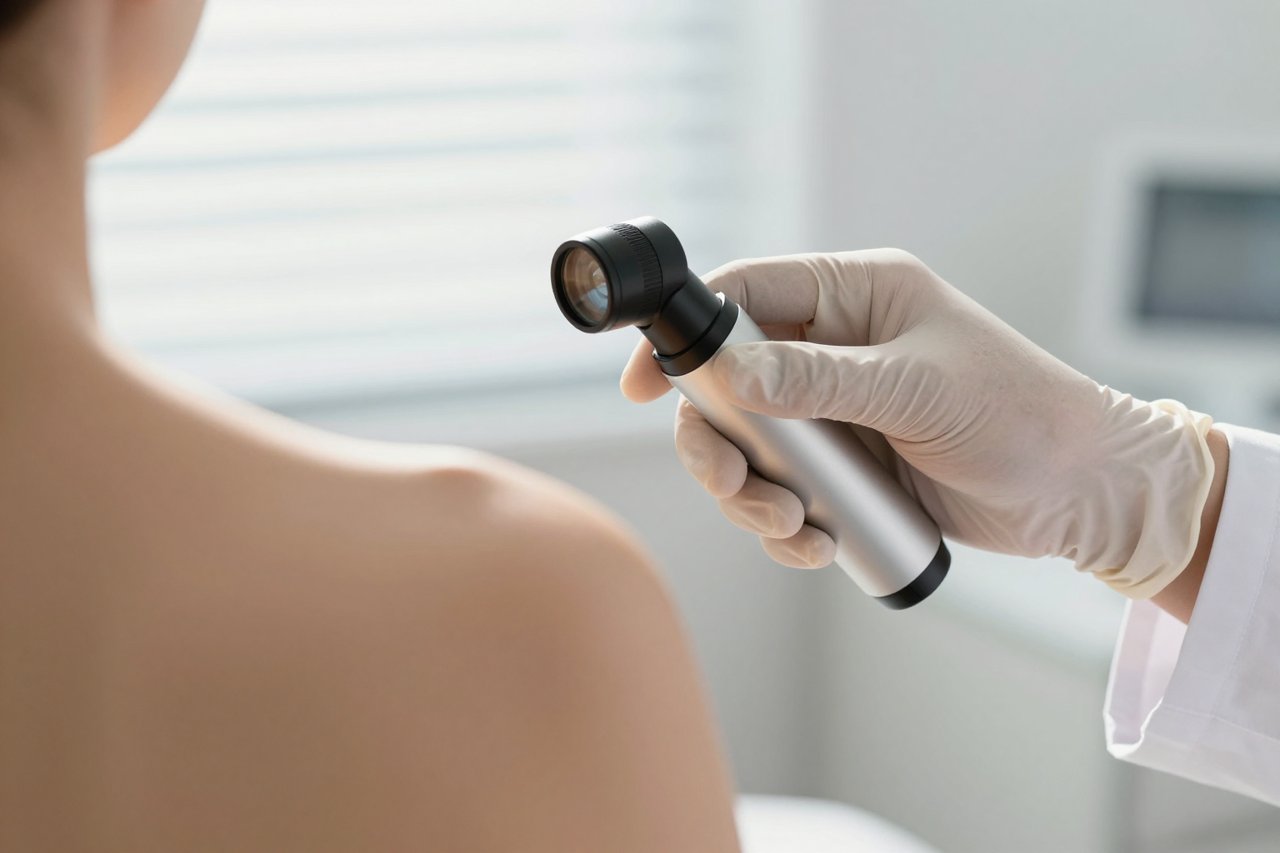
A full-body skin examination takes 10 to 15 minutes. You’ll be given a gown, and the dermatologist works from the scalp down, using a handheld dermatoscope, a magnifier with a built-in light, to look at suspicious lesions in detail. It’s painless. If something needs testing, a punch or shave biopsy is done under local anaesthetic the same day, and the specimen goes to pathology. Results typically come back in five to ten days.
Two practical tips before you go: skip nail polish on your hands and feet, because pigment under the nail needs to be visible, and bring a list of the spots that worry you, even the ones on your back that you can only see with a mirror. Half the value of the appointment is the conversation about what’s new. If a biopsy does come back positive, most early skin cancers are removed in a follow-up visit with a small scar and no further treatment, and melanoma caught at that stage usually needs nothing beyond wide local excision and regular checks.


