
Table of Contents
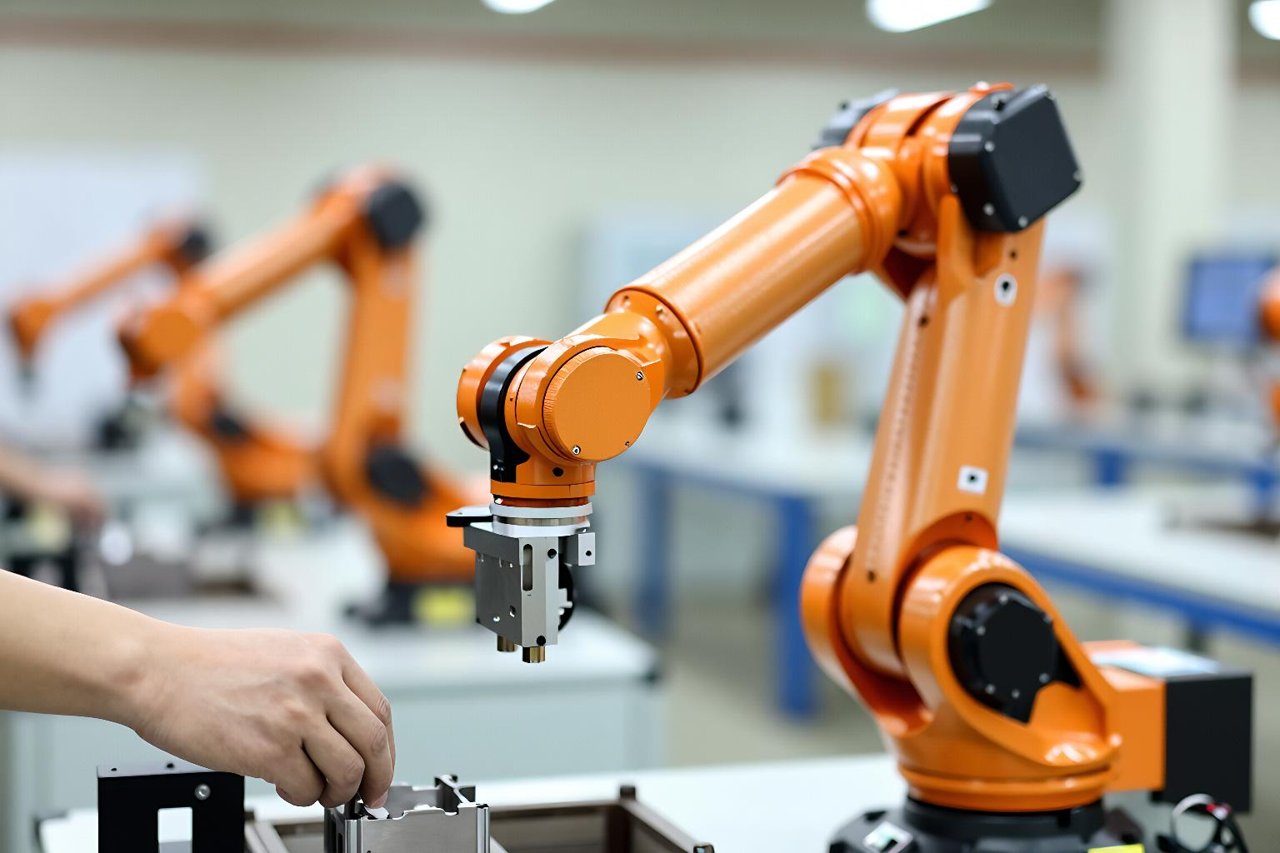
A collaborative robot is a robot built to share a workspace with people. The pitch sounds like marketing until you watch one work: a slim arm bolted to a bench, lifting hot parts from a press while a technician stands an arm’s length away, loading the next batch by hand. No safety cage. No light curtain. The robot slows when the person steps closer and stops if they get too close.
That is the practical definition of a cobot. It is not a weaker industrial robot with a different paint job. The whole design, from rounded joints to force sensors in each axis, assumes a human will be within reach.
What Makes a Robot Collaborative?
Under ISO 10218, the safety standard for industrial robots, there are four recognised ways a robot can operate collaboratively: safety-rated monitored stop, hand guiding, speed and separation monitoring, and power and force limiting. Most cobots on the market rely on the last one. Their arms are designed to limit impact force if they hit a person, and their control software monitors torque at each joint.
ISO/TS 15066 adds force and pressure limits for specific body regions, from hands and fingers to chest and skull. A cobot that claims to be collaborative should come with a risk assessment showing it stays under those limits in your actual application, with your actual tooling. The robot alone is not certified safe. The setup is.

How Cobots Differ From Industrial Robots
The differences go beyond safety fencing.
- Payload. Most cobots handle 3 kg to 16 kg; a few reach 30 kg. Traditional industrial robots routinely lift 100 kg or more.
- Speed. Cobots are deliberately slower. A UR10e, for example, has a 12.5 kg payload and 1,300 mm reach, but it will not match a high-speed SCARA or delta robot on a packaging line.
- Weight. A UR5e arm weighs about 18 kg, so it can be moved on a cart and bolted to a bench with four bolts. A comparable industrial robot often needs a forklift and a concrete foundation.
- Cost. A cobot arm typically runs $25,000 to $50,000. A complete industrial robot cell with fencing, safety scanners, and integration can pass $150,000.
- Programming. Many cobots are taught by hand: you grab the arm, guide it through the motion, and save the waypoints. Industrial robots usually need offline programming or a specialist.
Where Cobots Earn Their Keep
The best cobot applications share three traits: repetitive work, small batches, and a human nearby who can load or inspect parts. Machine tending is the classic. A cobot can open a CNC door, swap a blank, close the door, and press cycle start while the operator deburrs the previous part. One arm tending two lathes can keep a second shift running without hiring a second operator.
Common Applications
- Machine tending for CNC mills, lathes, and injection moulding machines.
- Palletising boxes and bags at the end of a line, often at 6 to 12 cycles per minute.
- Screwdriving, gluing, and dispensing in assembly cells.
- Quality inspection with a camera mounted on the wrist.
- Welding and grinding, where the cobot holds the torch and the operator fixtures the part.
Payback periods of 12 to 24 months are common when a cobot replaces a repetitive task on a second shift. The maths gets worse if the task is already automated, runs at high speed, or needs a custom gripper that costs as much as the arm.
The Catches Nobody Puts in the Brochure
Payload is the first trap. A 5 kg cobot with a 1.5 kg gripper and a 0.5 kg camera leaves 3 kg for the part. Acceleration and centre-of-gravity offsets can reduce that further, so most integrators recommend staying below 70% of rated payload. If your part weighs 4 kg, a 5 kg cobot is the wrong choice.
Cycle time is the second. Cobots trade speed for safety. A task that takes eight seconds by hand might take twelve seconds with a cobot, and that difference matters on a line making 1,000 units an hour. Cobots fit low-to-medium volume production, not high-speed packaging.
Safety is the third. A cobot without a cage is not automatically safe. Sharp tools, hot parts, and heavy workpieces still need guarding or a risk assessment that proves the application is safe. The robot may stop when it touches a person; the knife it is holding will not.
Programming Without a Robotics Degree
Hand guiding gets most of the attention, and it is genuinely useful for simple pick-and-place paths. Teach pendants have improved too. Universal Robots’ PolyScope software, for instance, uses a graphical flow chart of waypoints and actions. An experienced maintenance technician can learn the basics in two or three days.
Complex tasks are different. Vision-guided bin picking, force-controlled assembly, and welding with variable gaps still need an integrator. Budget for that. A cobot that looks simple in a demo can take weeks to tune in a real cell with real part variation.
The Cluster Effect
Cobots improved fast because the supply chain around them matured. Odense, Denmark, is the clearest example. Universal Robots spun out of a university lab there in 2005, and the city now hosts dozens of gripper makers, safety sensor suppliers, and integrators. That density matters: a startup can source a custom end effector and a safety assessment within a few kilometres. The wider Danish ecosystem, from Denmark’s robot city to national test facilities, has become a template for other robotics clusters.
How to Tell If a Cobot Fits Your Process
Run these checks before you request a quote.
- Payload with tooling. Add the gripper, camera, and cables, then divide by 0.7. That is your realistic part weight.
- Reach in the real cell. A 1,300 mm reach sounds generous until you account for the fixture, the machine door, and the operator’s access.
- Cycle time target. Ask for a video of the exact task at production speed, not a demo of a clean part.
- Risk assessment. Confirm who writes it and whether the cobot’s force limits cover your tooling and workpiece.
- Total installed cost. Arm, gripper, fixture, safety sensors, integration, training, and downtime during commissioning.
- Who programs it. If no one on your team can adjust a waypoint, you are renting expertise every time a part changes.
If the numbers work on a single shift and the task is dull, dirty, or repetitive, a cobot is often the cheapest pair of hands you can add without rebuilding the line. If the task runs at high speed or needs a custom machine, a traditional robot or a fixed automation cell will usually win.


