
Table of Contents
Ask five safari guides where to go and you’ll get five confident, completely different answers. That isn’t evasion. Wildlife moves, rainfall shifts, and a camp that delivered four leopard sightings last April may offer nothing but tracks the following year. What separates a good safari from a great one has less to do with which country stamps your passport and far more to do with season, ecosystem, and how many days you give yourself.
Still, some places stack the odds in your favour so reliably that they earn a permanent place on any shortlist. Here’s where to point the binoculars.
East Africa: The Classic Safari Heartland
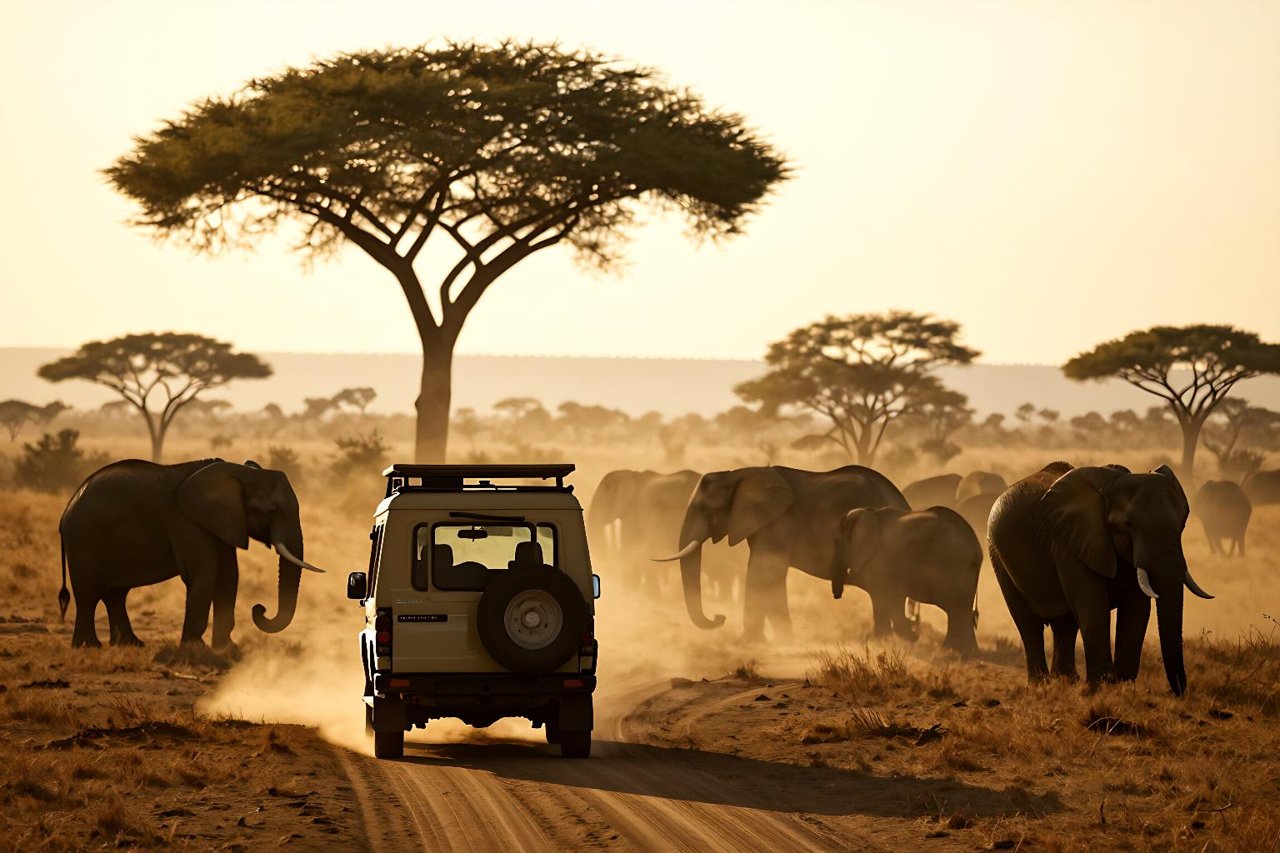
Nowhere else comes close for sheer volume of animals. The Serengeti-Mara ecosystem carries roughly 1.5 million wildebeest and a quarter of a million zebras, all shuffling clockwise across 25,000 square kilometres in search of grass.
Serengeti and the Masai Mara
Timing is everything. From July to October the herds mass on the Kenyan side of the Mara River, where crossings draw crowds of vehicles as well as crocodiles. Head south to the Ndutu plains in February and you’ll catch the calving season instead — a short, brutal, extraordinary window when thousands of calves hit the ground within a few weeks and the cats follow.

Why Kenya keeps pulling people back
Kenya’s advantage is variety packed into a small map. Amboseli gives you big elephant bulls framed against Kilimanjaro. Samburu, north of the equator, holds species you won’t see elsewhere on a standard itinerary: reticulated giraffe, Grevy’s zebra, gerenuk. The Laikipia conservancies combine serious rhino conservation with walking and night drives that national parks don’t permit. Guiding standards are high and internal flights are short, which matters when you’re moving between three camps in eight days.
If you want to compare routes and price points, this roundup of Kenyan safaris worth trying covers the classics and a few lesser-known options. Plenty of travellers tack on a week at the coast afterwards, and if you can work remotely there’s a growing case for staying longer — these coastal towns in Kenya suited to remote work make the transition from bush to beach fairly painless.
Botswana and Southern Africa: Water in the Desert
Botswana takes a different approach: low visitor numbers, high prices, and wilderness that feels genuinely untouched.
Okavango Delta
The delta is a 16,000-square-kilometre fan of channels and islands that never reaches the sea. Its party trick is hydrological — the flood arrives in the dry season, peaking around June to August, so you’re gliding through reeds in a mokoro canoe when everything around you is parched. Add wild dog in the Linyanti, lion and leopard in Moremi, and Chobe’s elephant population (well over 100,000 in northern Botswana) and you have one of the finest wildlife destinations on earth.
Kruger and the Sabi Sands
South Africa suits self-drive and tighter budgets. Kruger spans nearly 20,000 square kilometres with decent roads and affordable rest camps. For sightings, though, the private concessions bordering it — Sabi Sands above all — allow off-road driving and night drives, which is how you end up twenty metres from a leopard with a kill. The dry winter months from May to September deliver thin vegetation and concentrated game at waterholes.
Worth a detour
Namibia’s Etosha rewards patience at its floodlit waterholes. Zambia’s South Luangwa pioneered the walking safari, and the Lower Zambezi lets you watch elephants from a canoe. Both are quieter alternatives to the marquee parks.
Asia’s Big Cats: India and Sri Lanka
If your goal is a tiger on footpaths rather than a tiger brochure, India is the answer. Ranthambore in Rajasthan has the highest density of tigers on the subcontinent and photogenic ruins to frame them. Kanha and Bandhavgarh in Madhya Pradesh offer sal forests and meadows, while Tadoba in Maharashtra has become a favourite for photographers. Permits are sold online in fixed morning and afternoon slots, six passengers per jeep, and the hot pre-monsoon months of April to June push animals to water.
Sri Lanka trades tigers for leopards. Yala’s Block 1 holds one of the densest leopard populations anywhere, though the crowds can rival the cats. Wilpattu is quieter, and Udawalawe is close to a sure thing for elephants.
The Americas: Jaguars, Sloths and Sea Lions
Brazil’s Pantanal is the least-known heavyweight on this list — a wetland roughly the size of England that floods seasonally and concentrates wildlife along the Cuiabá River. Between July and October you can watch jaguars hunting caiman from a boat, which almost nowhere else allows.
Costa Rica plays a different game: quetzals in the Savegre cloud forest, scarlet macaws on the Osa Peninsula, sloths in pretty much any roadside tree. The Galápagos is the outlier of all wildlife destinations, because the animals have never learned to fear people. A sea lion will swim into your snorkel mask and stay there.
For a broader sweep of options across continents, this collection of top wildlife destinations is a good starting point before you start comparing flight routes.
Frontiers: Polar Ice and Borneo’s Rivers
Svalbard, reached via Longyearbyen, supports around 3,000 polar bears and offers midnight-sun expeditions from June to August. Antarctica delivers penguin colonies in the hundreds of thousands, best from December through February. Closer to the equator, Borneo’s Kinabatangan River packs orangutans, proboscis monkeys and pygmy elephants into a narrow riparian corridor you can cover by boat in three days.
Timing, Cost and Choosing an Operator
Two variables shape almost everything: when you travel and how you travel. Kenya’s two rainy seasons reshape the entire calendar, and the best times of year to go on safari in Kenya breaks down what each month actually delivers. Get that wrong and you’ll spend good money looking at long grass.
Costs vary wildly, so know what you’re paying for:
- Season — peak-season rates in Botswana can double low-season ones for identical camps.
- Camp tier — a mid-range tented camp in Kenya runs roughly $350–600 per person per night; high-end Botswana can exceed $1,500.
- Private versus shared vehicle — a private guide costs more but lets you stay with a cheetah for two hours instead of leaving for breakfast.
- Park fees and permits — often invisible in the quoted price, and they add up fast in India and Tanzania.
- Internal flights — bush planes save days of driving and cost accordingly.
Read reviews for the guide, not the décor. A great guide will find you a porcupine on a slow afternoon and explain why the grass looks the way it does. Ask how many years the company has operated in that specific park, and check whether they cap vehicle numbers at sightings.
Matching the Destination to the Traveller
First-timers usually do best in Kenya or Tanzania, where logistics are streamlined and wildlife is abundant enough to forgive a few missed sightings. Photographers should look hard at Botswana for off-road access and low vehicle density. Budget-conscious travellers can self-drive Namibia or Kruger and still come home with remarkable photographs. Families with young children are better served by South Africa’s malaria-free Madikwe or Costa Rica’s shorter drives and beach time.
Anyone chasing a specific species should work backwards from the animal rather than picking a country first: mountain gorillas mean Uganda or Rwanda, wild dogs mean Botswana or Zimbabwe, tigers mean central India. If you’re still weighing a wider range of trip styles, these vacation spots matched to different types of traveller help narrow the field. Pick the animal, pick the season, then pick the camp — in that order, and you’ll rarely be disappointed.


