
[ad_1]

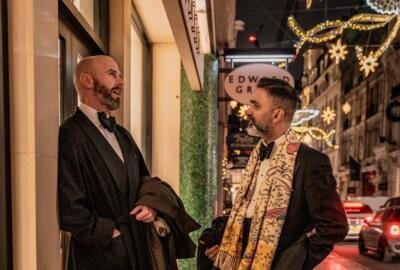
Here’s a slightly controversial idea. I think there’s an argument that all black-tie events should be ‘creative’ or ‘alternative’ black tie – ones that actively encourage variations on the classic dress code, rather than sticking with the traditional dinner jacket.
Why? I’m glad you asked.
There are precious few opportunities for men to wear really elegant tailoring today. It’s no longer the standard in the workplace, and often too dressed-up for the evening.
One of the few opportunities is black-tie events, such as dinners, award ceremonies and so on. In my old job running legal magazines, we used to have a half dozen of these a year. A friend in private equity told me recently that it’s one of the few times he wears a tie today – and it’s a bow tie. So black tie presents an opportunity to get people interested in tailoring.
At those professional events, there is a huge variation in quality. On the one hand, quite a few people wear rented tuxes, or if they’ve bought one it’s the cheapest thing they could get away with. On the other, those that have decided to spend good money are wearing really nice pieces, often bespoke. As a result, the overall impression is neither cohesive nor elegant – surely two of the core appeals of black tie.
If it were more acceptable to wear ‘creative’ versions of black tie, perhaps more people would get into it. They could wear that black velvet jacket to the awards dinner, but also to an office party, even sometimes at home. More important than this versatility is they might enjoy it, feel different and even sexy in it.
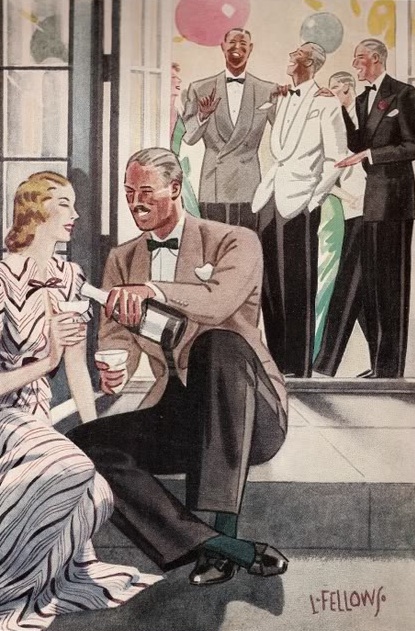

Here’s another argument. Historically, black tie was a dress code for men and women, and men looked very elegant as the dapper, subtle shadow to their partners. It was the women that got all the colour, the jewellery, and the creativity.
But it’s rather different when you’re at an event where the audience is nearly all male. Suddenly all the sparkle has gone. This might be an event for professionals, but it also certainly happens at menswear events (my weird little Venn diagram). In that situation, it’s great to have some colour, some drama. Maybe not that much jewellery, but certainly some jewel tones.
Creative or alternative black tie can be wonderfully expressive. Are you the kind of person that goes for black velvet, to be just a little different? Or you go a step further and wear a latte-coloured silk, whose colour really shows against the black and white of your dress shirt and bow?
Are you bolder than that, and favour a bottle-green smoking jacket, revelling in all the frogging? Or is your personality stronger still, and feels at home in bright-pink watered silk? Is even animal print within your range?
Suddenly it feels like there’s licence to bring in formal traditions from around the world. Embrace your Indian heritage with a Jodhpuri suit; wear the Prince Charlie coatee, kilt and sporran; co-opt things from other traditions, like a bolo tie. All this should feel authentic of course, not cos-play, but they’re all easier to wear when you stand out less – when everyone is being creative.
This is also all more inclusive – in terms of cultures but also in terms of letting people express their personalities and style.


Of course the problem is, a lot of people will fuck it up. Give them freedom, and many will go far, or just demonstrate very visibly and publicly their lack of taste and style.
But perhaps this is a price worth paying; it probably depends on the people. It will help if it’s a regular event, so people might start to get a sense of the boundaries and not go too far. I’m hoping our recent Christmas drinks, for example, might become an annual thing, and if they do then people will come knowing what everyone wore last time.
Perhaps it’s a little like office suits – everyone doesn’t wear the same thing, as they do with black tie, but they know not to wear much beyond single and double-breasted, black or brown shoes, coloured but not garish shirts and more coloured but still not garish ties. Creative black tie can be more free than that, but the point is people and occasions establish their own limits.


Now the opposing view. Black tie is a beautiful, traditional form of dress that has somehow managed to survive (perhaps due to American weddings). It’s also something where a man can look good without having to have a deep understanding of style. Why kill this?
Maybe being more creative won’t kill black tie. Maybe it will make people more aware of the traditions, as they become aware of what they’re working against. Maybe strict black tie can still be maintained, but for things like weddings which are (a) more serious and (b) have more women, and creative black tie can be used for everything else.
Traditional black tie does make it easy for men to look good, but it also excludes quite a few people. Most friends I know have some great suits, but no black tie. They would buy even more suits – and support all those lovely tailors – if they could wear them in interesting ways like this. If they could wear a black corduroy suit, or a cream linen, rather than just a dinner jacket.
There is of course a whole separate article about what we consider creative black tie, and what is not black tie at all. It’s got something to do with maintaining the core – the shirt, the bow, perhaps the trousers – and then playing with things around it. But that’s a subject for another day.
For now, I hope this has raised some interesting points, and it will stimulate discussion. As ever with these articles, half the fun is hearing how and why everyone disagrees.
Images: Mostly from our Christmas Drinks in the Piccadilly Arcade, to which I was wearing a Bryceland’s Tuxedo Lounge Jacket. Others PS Archive or La Bowtique.

[ad_2]
Source link


