
[ad_1]


Nearly 4,400 miles separate Washington, D.C., from South America. Yet a regulatory decision made in the U.S. capital could have unexpected consequences for distant ecosystems across the neighboring continent.
The GENIUS Act, signed by Donald Trump in July 2025, requires stablecoins — a type of cryptocurrency — to be backed by U.S. dollars or Treasury securities, giving formal structure to a market that has grown with little oversight.
As cryptocurrency becomes more integrated into the global financial system, its environmental footprint may increasingly be felt far from Wall Street — in this case, in the rivers, forests, and wetlands of South America. The problem, experts say, is that the measure strengthens demand for cryptocurrencies and data centers, which require enormous amounts of electricity and indirectly increases the search for cheap energy in countries like Brazil and Paraguay.
In these places digital mining operations to produce cryptocurrencies are already beginning to put pressure on electricity systems and intensify debates about expanding energy infrastructure in environmentally sensitive regions such as the Pantanal and the Gran Chaco.
These two biomes are among the most important reservoirs of biodiversity on the planet. The Pantanal, the world’s largest tropical wetland, spans parts of Brazil, Bolivia, and Paraguay and depends on the hydrological balance of the Paraguay River basin, which regulates seasonal floods essential for wildlife. The Gran Chaco, South America’s largest dry forest, stretches across Paraguay, Bolivia, and Argentina and hosts emblematic species such as jaguars, giant armadillos, and hundreds of bird species, as well as the traditional territories of Indigenous peoples.
What is the GENIUS Act?
The GENIUS Act creates a regulatory framework for so-called stablecoins, cryptocurrencies whose value is typically pegged to the U.S. dollar. The law requires companies issuing these coins to maintain reserves equivalent to the value in circulation, composed mainly of dollars or U.S. Treasury securities, in a market that had previously operated with little oversight.
Francis Wagner, head of cryptocurrencies at Hurst Capital, says the GENIUS Act “has more potential to expand global demand for cryptocurrencies than to slow the sector.”
For the International Energy Agency, electricity consumption associated with cryptocurrencies could grow by more than 40% by 2026.
According to the agency, cryptocurrencies consumed about 110 terawatt-hours of electricity in 2022, equivalent to roughly five times the electricity used in Paraguay in a single year, although it still represents only a fraction of Brazil’s electricity consumption.
This high energy consumption is tied to the very functioning of the network. The validation system known as proof of work requires thousands of computers to compete to solve cryptographic problems to confirm transactions, a process that runs 24 hours a day, seven days a week. Because financial rewards grow along with cryptocurrency prices, price surges — or regulatory incentives like the GENIUS Act — tend to attract more miners, increasing the use of hardware and electricity.
According to Cleber Leite, director of sustainable energy and bioeconomy at the Brazilian think tank Instituto E+ Transição Energética, cryptocurrency miners look for cheap electricity, proximity to substations, and permissive regulatory environments, which can create local pressures.
“Mining is an intensive and continuous load,” he says. “Even when it operates using surplus electricity at certain times, it can still pressure local infrastructure, require grid upgrades, raise system costs, and influence planning decisions. Energy is a strategic asset. Even in countries with relatively clean energy matrices, like Brazil and Paraguay, there are limits in transmission networks, firm capacity, and coordinated expansion.”
Brazil and Paraguay in the Crypto Spotlight
That search for abundant and cheap electricity has turned countries like Brazil and Paraguay into attractive destinations for crypto miners.
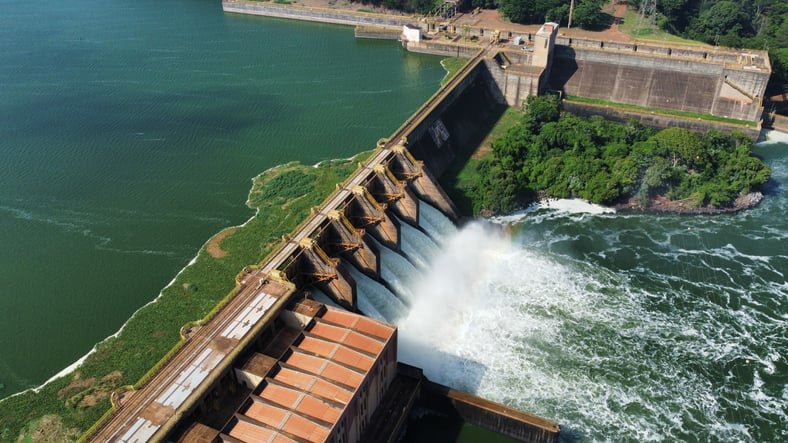
The Itaipu Dam, located on the Paraná River along the border between the two countries, is one of the largest hydroelectric plants in the world. Inaugurated in 1984 and jointly operated by the two governments, the plant generates most of the electricity consumed in Paraguay and a significant portion of Brazil’s electricity supply.
Creating the dam’s reservoir required the flooding of approximately 520 square miles (1,350 square kilometers), covering extensive areas of forest and agricultural land along the border region. The new lake displaced local communities and led to the loss of natural habitats, as well as submerging the Sete Quedas de Guaíra, once considered the world’s largest waterfalls by water volume.
With 20 generating units and an installed capacity of about 14 gigawatts, Itaipu produces between 90 and 100 terawatt-hours of electricity per year, depending on hydrological conditions. This output makes it one of the largest generators of clean electricity in the world.
This is precisely what has placed the two countries on the radar of the crypto mining industry. In recent years Paraguay has emerged as one of the world’s key hubs for Bitcoin mining. The activity already consumes more than 700 megawatts of electricity in the country and could reach 1 gigawatt in the next couple of years, according to the state-owned utility ANDE.
Although the sector in Brazil is still smaller, energy companies and investors are already negotiating mining projects linked to surplus renewable electricity.
For Guillermo Achucarro, an environmental engineer from the National University of Asunción and a master’s graduate in hydrology from the University of Montpellier, an important factor behind this increase in consumption is the migration of companies from the Global North to the Global South in search of lower production costs.
“In this context Paraguay becomes a new element in this migration from North to South for crypto mining,” he says. “The country becomes key because it has very cheap electricity for multinational companies and for political allies.”
According to Achucarro, the electricity surplus produced by Itaipu may be exhausted within the next five years due to the growing demand from the crypto industry.
Expansion and Environmental Impact
Lourenço Henrique Moretto, coordinator of the Energy and Sustainability Program at the Brazilian consumer advocacy organization Idec, says the rapid expansion of crypto mining could require new investments in energy generation and transmission.
“When a very large demand for energy appears in a short period of time, there is a need for investment to meet that demand, especially if it was not previously planned in the energy system,” he says.
This digital race for cheap electricity is already beginning to reshape landscapes, pressure rivers, and place some of South America’s richest ecosystems under new strain. Brazil and Paraguay share interconnected ecosystems within the Paraguay River basin, such as the Pantanal, and the Gran Chaco.
According to José Luis Cartes Yegros, a Paraguayan biologist and conservation specialist, discussions are already underway in Paraguay about expanding the energy matrix using natural gas, which would increase greenhouse-gas emissions, and building new solar farms.
“There is a tendency to develop solar farms that could occupy large areas or sensitive zones in the Chaco, which is a preferred location due to its high solar radiation throughout the year,” he says.
Cartes Yegros warns that this infrastructure expansion poses a threat to the country’s biodiversity.
As power lines and roads expand to support the new demands, natural areas can become more isolated, making it harder for wildlife to move between them, he explains. “They also increase wildlife mortality, either from collisions with cables and structures or from road traffic.”
For Ângela Lúcia Bagnatori Sartori, a professor at the Federal University of Mato Grosso do Sul, the reduction of natural areas could profoundly affect the ecological balance of both the Pantanal and the Chaco. When vegetation is cleared, she says, plant populations can lose genetic diversity due to an inability to exchange pollen and spread seeds.
Recent research, she adds, suggests two major risks for vegetation in the Chaco: limited investment in biodiversity studies and rapid deforestation.
“Large areas of the Chaco still have very few scientific records, and ongoing deforestation may lead to the loss of areas before we even have the opportunity to understand their flora,” she says.
For Bagnatori Sartori, decisions about energy expansion must consider scientific evidence and the impacts on ecosystems. “Future scenarios must be less arid, less hot and less dry, and food security must be guaranteed across the entire ecosystem,” she concludes.
From Washington’s financial regulations to the wetlands of the Pantanal and the dry forests of the Chaco, the growing digital economy is leaving a footprint that is anything but virtual.
—
This story was originally published by The Revelator. Reprinted under a Creative Commons license.
***




If you believe in the work we are doing here at The Good Men Project, please join us as a Premium Member today.
All Premium Members get to view The Good Men Project with NO ADS.
Need more info? A complete list of benefits is here.
Photo credit: iStock
[ad_2]



