
Table of Contents
The ocean covers more than 70 percent of Earth’s surface, yet we have mapped less than a quarter of its floor. Every year, expeditions return with ocean discoveries that challenge what we thought we knew about life, geology, and even the history of our planet. Some of these findings are subtle shifts in our understanding; others are outright paradigm-busters. Here is a look at some of the most remarkable recent revelations from the deep.
The Deepest-Dwelling Fish Ever Found
In 2023, a team of scientists filmed a snailfish at a depth of 8,336 meters in the Izu-Ogasawara Trench off Japan. That is deeper than the height of Mount Everest. The fish, belonging to the genus Pseudoliparis, set a new record for the deepest vertebrate ever documented. Snailfish are gelatinous, translucent creatures that look almost alien, but they thrive under pressures that would crush a steel submarine. The discovery wasn’t just about setting a record—it reshaped our understanding of where vertebrates can survive. If life can exist under those crushing conditions, what else might be lurking in the hadal zone?
Underwater Volcanoes and the Birth of New Ecosystems
Volcanic activity on the seafloor has long been known, but recent surveys off the coast of Hawaii and in the Pacific have revealed entire communities of organisms living near hydrothermal vents that were only discovered a few years ago. These vents spew superheated water rich in minerals, and around them thrive tubeworms, crabs, and microbes that rely on chemosynthesis instead of sunlight. In 2024, researchers exploring the Pescadero Basin in the Gulf of California found a new field of hydrothermal vents with chimneys over 30 meters tall. The creatures there, including a yet-unnamed species of giant tubeworm, are completely dependent on the vent’s chemistry. Each new vent field is a microcosm of evolution in action.
To understand how such extreme environments compare to other transformative scientific breakthroughs, check out The Most Mind-Blowing Scientific Discoveries That Reshaped Our World.

New Species Discovered at an Astonishing Rate
It is estimated that 91 percent of marine species have yet to be described. Expeditions in 2024 and 2025 have been particularly fruitful. A team from the Schmidt Ocean Institute returned from the waters around Chile with over 100 potential new species, including deep-sea corals, glass sponges, and bizarre crustaceans. Among them was a bioluminescent sea cucumber that glows blue when disturbed and a carnivorous sponge that traps tiny prey with hook-like structures. These are not just curiosities—they are key players in deep-sea ecosystems, many of which are threatened by deep-sea mining.
The Role of Citizen Science
Remarkably, some of these new species were first spotted by citizen scientists analyzing footage from remotely operated vehicles (ROVs). Platforms like Ocean Census allow volunteers to tag interesting organisms in videos, helping researchers prioritise which samples to collect. This crowdsourced approach has accelerated the pace of discovery dramatically.
For a closer look at the strangest deep-sea creatures ever filmed, read Into the Abyss: Discovering the Strangest Deep Sea Creatures on Earth.
Lost Ecosystems Beneath the Antarctic Ice
Antarctica is not just a frozen continent—it hides a secret world beneath its ice shelves. In 2024, a team drilling through the Filchner-Ronne Ice Shelf, more than 900 meters thick, discovered a community of sponges and other filter-feeders living on the seafloor. This was the first evidence of a stationary ecosystem under an ice shelf, far from any obvious source of food. How do these creatures survive? Researchers believe currents carry nutrients from distant open water, but the discovery raises profound questions about life in extreme isolation. It also hints that similar ecosystems could exist under ice on other worlds, like Jupiter’s moon Europa.
Ancient Ocean Discoveries Hidden in the Deep
The seafloor is also a vast archive of Earth’s history. In 2025, a team using subsea robots recovered sediment cores from the Pacific that contain evidence of a massive algal bloom that occurred 2.5 million years ago. The bloom was so large that it may have triggered a global cooling event. Such discoveries help scientists predict how the ocean will respond to modern climate change. Other finds include submerged forests off the coast of England and Australia, preserved by rising sea levels after the last Ice Age. These ancient woodlands are time capsules of a world before humans dominated the landscape.
Some of the most unexpected clues about our own species’ history come from the ocean floor. To explore how marine archaeology and genetics are rewriting human origins, see Human Evolution: The Epic Story of Our Origins.
Technological Breakthroughs Driving Ocean Discoveries
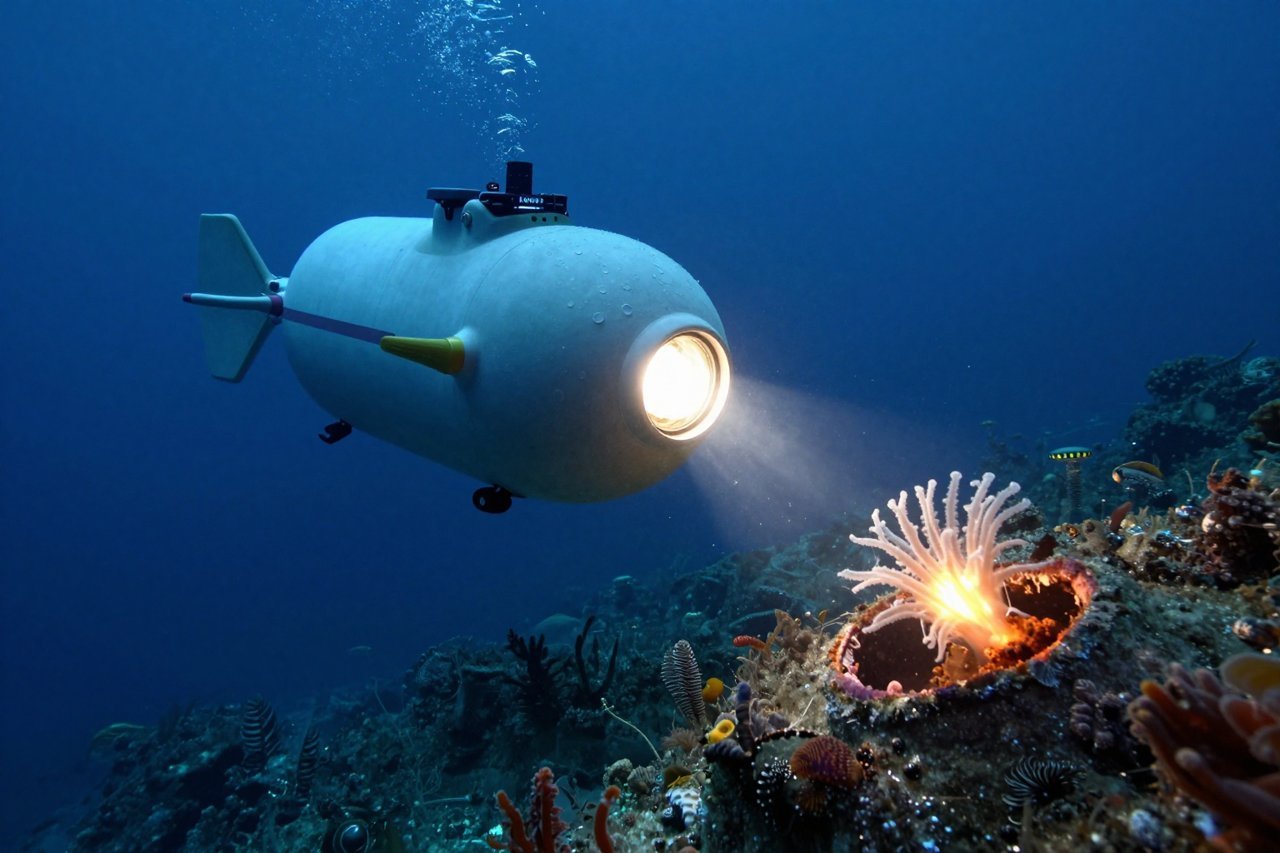
None of these findings would be possible without leaps in technology. Autonomous underwater vehicles (AUVs) like the Bathysaurus can now map the seafloor at resolutions of a few centimeters. Environmental DNA (eDNA) sampling lets scientists detect species from a single water sample without ever seeing them. In 2024, a single eDNA survey in the Gulf of Mexico identified 22 species of sharks and rays, several of which had not been recorded in the area for decades. Meanwhile, satellite altimetry has allowed researchers to discover thousands of previously unknown seamounts—underwater mountains that serve as biodiversity hotspots.
What the Future Holds
The next decade promises even more. The Ocean discoveries of the 2020s have already pushed the boundaries of biology, geology, and climatology. As we continue to explore, we will almost certainly find new forms of life, new resources, and new understanding of our planet’s past. The ocean is not just a last frontier—it is a living laboratory that keeps surprising us.
If you are fascinated by how exploration changes what we know, you might also enjoy NASA Discoveries That Changed Our Understanding of the Universe. And for a glimpse of the newest species being described right now, read Meet the New Species Discovered in 2025: From Deep-Sea Oddities to Mini Frogs.


